Robinsonades in Voyant, Works of One Syllable in HTRC

Voyant

Dataset

I chose a set of Robinsonades (aka “desert island stories”) from Robinson Crusoe itself (1719) to The Blue Lagoon (1908). I confined my selection to novels and semi-historical book-length narratives set on actual islands which were written, translated, or adapted into more or less modern English and are available on Project Gutenberg. In addition, I found copies of Hatchet (1987) and The Further Adventures of Robinson Crusoe (1719) but chose to exclude them from this initial exercise because neither concerns stranded protagonists on an island. My full list of texts is as follows.

Robinson Crusoe (1719) by Daniel Defoe
The Swiss Family Robinson (1812) by Johann David Wyss
The Coral Island (1858) by R. M. Ballantyne
Godfrey Morgan aka School for Crusoes (1882) by Jules Verne
The Blue Lagoon (1908) by Henry De Vere Stacpoole

Research Question

My research question, which I hope to hone over time, is how the language of Robinsonades changed over the nearly 200 years represented by my dataset, and to what extent later Robinsonades relate on a textual level to Robinson Crusoe.

Results

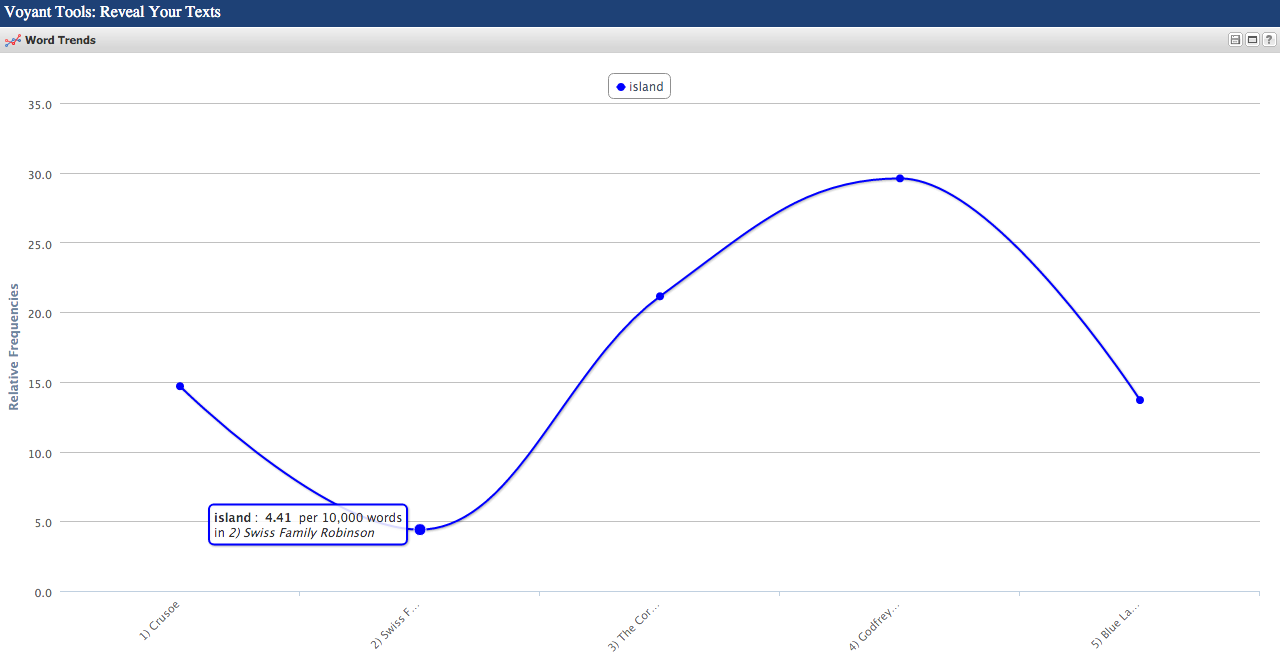
“Island” frequency across corpus (Word Trends tool)

Screenshot 2016-03-03 10.12.53

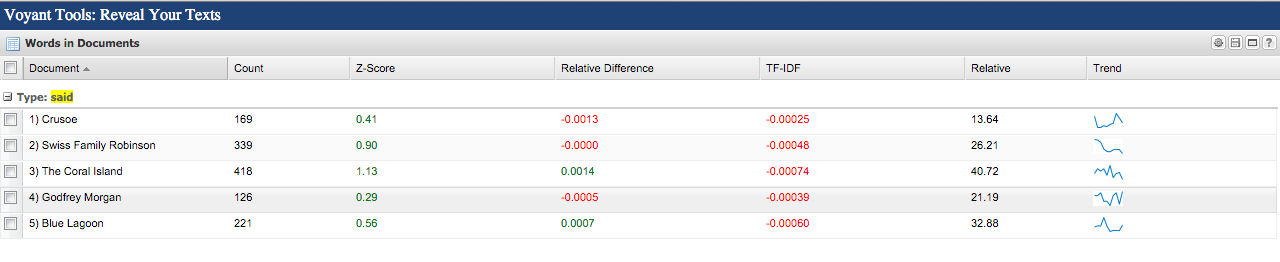
“Said” in corpus (Words in Documents tool)

Screenshot 2016-03-03 10.14.28

Hathitrust

Dataset

I chose 88 works with the string “in words of one syllable” in the title. These were largely late 19th century British and American history books and “great works” of fiction for children.

Results

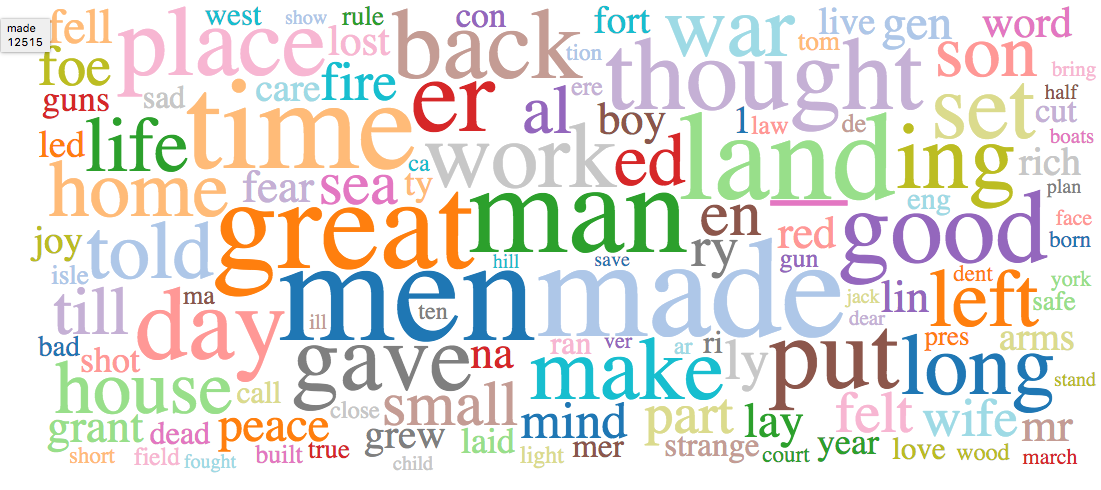
Tagcloud

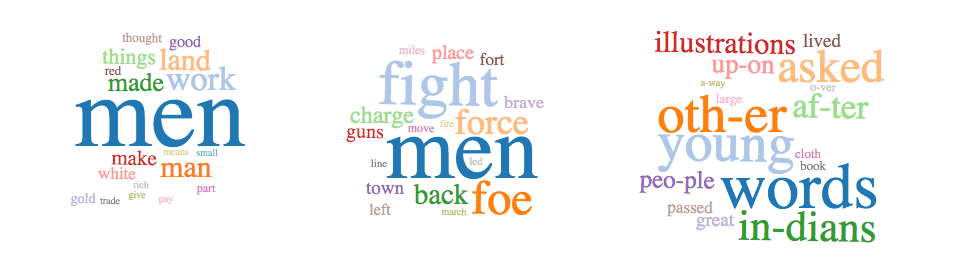
Screenshot 2016-03-03 10.15.24

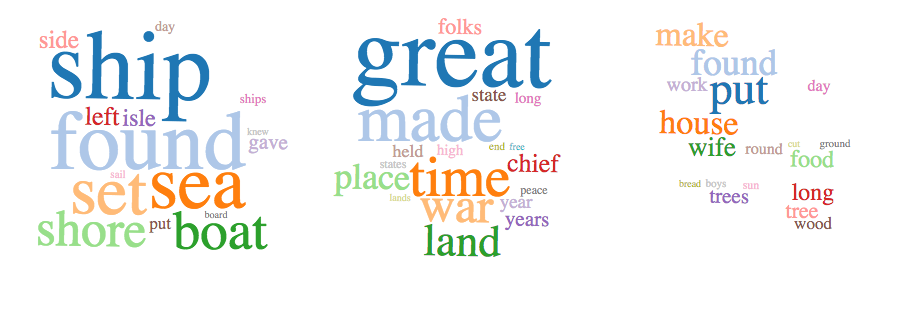
Topic modeling

Screenshot 2016-03-03 10.16.34 Screenshot 2016-03-03 10.16.28 Screenshot 2016-03-03 10.16.20

Screenshot 2016-03-03 10.16.38

Overview

New Research Questions

One question that I hope to pursue is how subsequent editions of Robinson Crusoe, legitimate or otherwise, differ from the original over its very long publication history. For instance, I was able to find about a dozen versions of Crusoe on Hathitrust that had been abridged and censored for “little folks.” Crusoe, of course, has a long legacy of retellings, responses, and other derivative or related works far beyond the 5 Robinsonades I looked at in Voyant. I wonder what text mining could tells us about that legacy.

Reflection

I was surprised by how labor-intensive this processed ended up being. I had to change my corpus several times in Voyant before I found five texts that fit my criteria and worked well. I had hoped to use postwar texts but found every source that wasn’t from Project Gutenberg did not work very well in Voyant. As a student of contemporary literature, I find this troubling. I’m excited by the possibilities of text mining but would rather not wait 100 years to begin studying works in my field.

That said, I found these tools very useful. They allowed me to pose questions that I would have difficulty answering without them, such as “how important does this word seem to be in this particular book as opposed to the rest of a related corpus?” I was especially surprised and interested by what I didn’t find. Certain words that I imagined were prevalent and distinctive in various texts or across the corpus, such as “cannibal,” “Providence,” and even “castaway,” were in fact very rare, especially compared to words like “great,” “little,” and “time.” I think any critical tool that is capable of really surprising a researcher is useful—it gives us something to spark new questions, challenge our intuition, and allow new ways to look at texts, especially those, like Crusoe, that have been studied seemingly to death.

6 novels, 6 “insane” female characters

For the Voyant portion text mining exercise, I wanted to look at a sample of texts that range across a long time span. This was initially an idea prompted by grasping at straws (where does one begin, am I right?), but turned into a pretty exciting research endeavor, I think. For my corpus I collected 6 novels, fairly evenly distributed across the past 3 centuries, which directly address “insane” women. (Jane Eyre, 1847; The Yellow Wallpaper, 1892; Rebecca, 1938; The Bell Jar, 1963; Misery, 1987; and Girl, Interrupted, 1993). I thought this topic befitting to the exercise of text mining because female insanity – and the vocabulary surrounding it – inhabits such a burdened historical narrative. Moreover, this narrative is directly related to words. The concept of female insanity is embedded in a vocabulary (namely, the concepts of “wandering womb” and female hysteria as a medical diagnosis ) that has doggedly effected the way we understand female protagonists. So my experimentation with text mining was driven by the vocabulary of “hysteria”: how has it changed over time? Has it? How do these texts variously locate the source for insanity? In the mind or body? Have any trends emerged or receded since the mid 19th century?

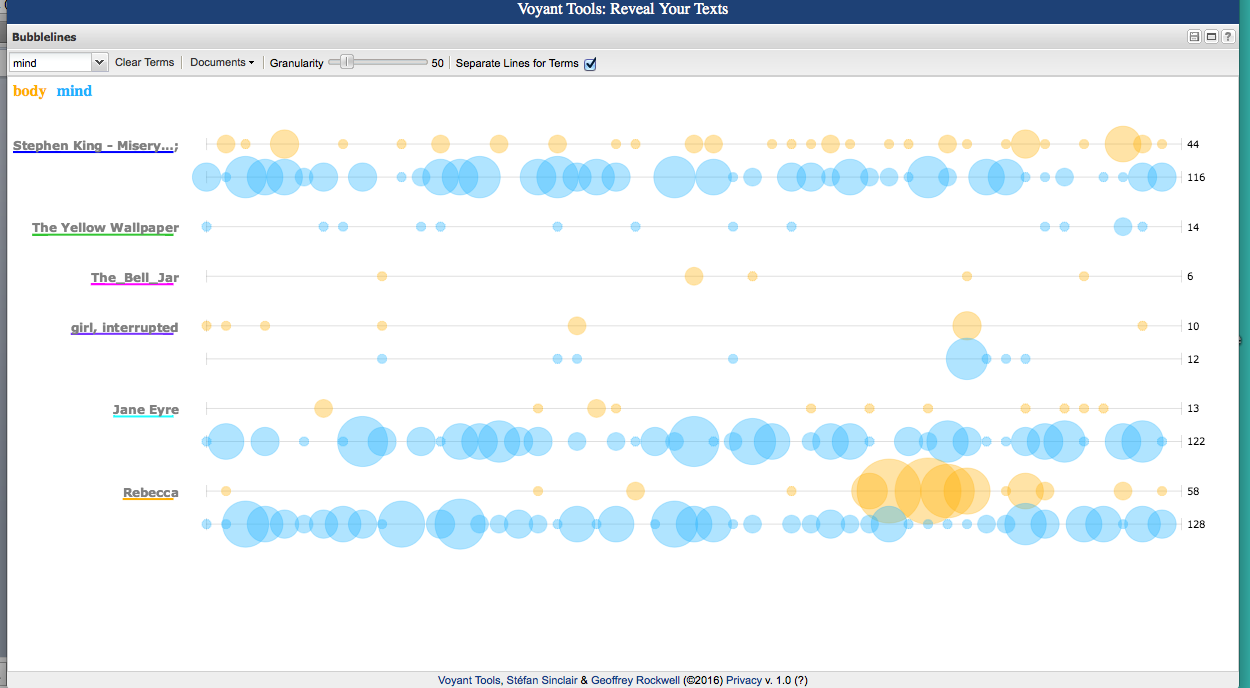
With those research questions in mind, I found some pretty interesting trends, especially regarding the usage of the words “mind” and “body”. My objective with this concentration was to distinguish whether/how the ideology of female madness in fiction shifts from the 19th-20th century from the notion of a corporally-based madness to one located in the psyche. Here’s what I found:

Screen Shot 2016-03-03 at 6.36.13 AM


This chart is striking to me because it displays a significant absence of the word “mind” in the two works that deal most directly with the concept of a sick mind (The Bell Jar and Girl, Interrupted). I would have assumed the opposite to be true because these two are both first-person narrations of madness, but this data suggests that the idea of mental illness as located in the mind is incompatible with these types of narratives.

Another interesting trend I noted was the prevalence of proper nouns in the works published after In the latter half of the 20th c. By viewing the Cirrus word cloud for each document individually, there is a clear uptick over publication dates in the quantity of people’s names in Misery, TBJ, and Girl, Interrupted. If I were a gambler, I would be inclined to bet that this has to do with the increased association with social factors’ impact on mental illness.

But I’m not really a gambler….. honestly, at times, my experimenting with these tools felt like I was fishing (no pun intended) for proof of a hypothesis that I’d framed and then tailored my findings to prove. I think this is because of the labor (am I the only one?) of the process behind tools like Voyant. I think that there is something to be said (theoretically) for using tools that, do the work for you, like SEASR or Paper Machines, so we can see the results without having to curtail the text load as much. I’ll explain some of these tools in class during my presentation.

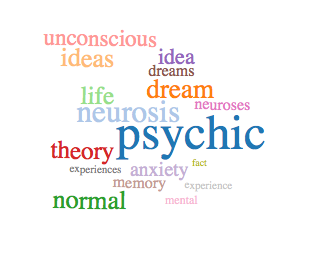
When I took this topic to HathiTrust, I wanted to use the workset to compile vocabulary used about hysteria in the early 20th century.  This exercise eased my qualms about hypothesizing arbitrarily because there was a much larger corpus available for algorithmic investigation.  I think the vocabulary displayed in the topic model top tags cloud  is really telling if we think about the above frequencies of the word “mind” in the texts published in the early 1900s:

Screen Shot 2016-03-03 at 9.32.12 AM

Obviously, this cloud is influenced by my workset’s inclusion of Freud’s writings; but all the same, I think there is something valuable about the use of these two tools in conjunction to paint a broader picture of the cultural moments whence texts emerge.

Trends in 19th-Century Corporeality

Using Voyant, I selected Edgar Allen Poe’s five-volume collected works from Project Gutenberg and noted the word frequency throughout to think about temporality and corporeality in Poe’s writing, particularly through the new directions in queer studies of Poe’s work. I was curious beginning the text mining assignment how or if the frequency of words indicate his focus on these two concepts and if there is any way from a distant reading of Poe’s work to think about it queerly.

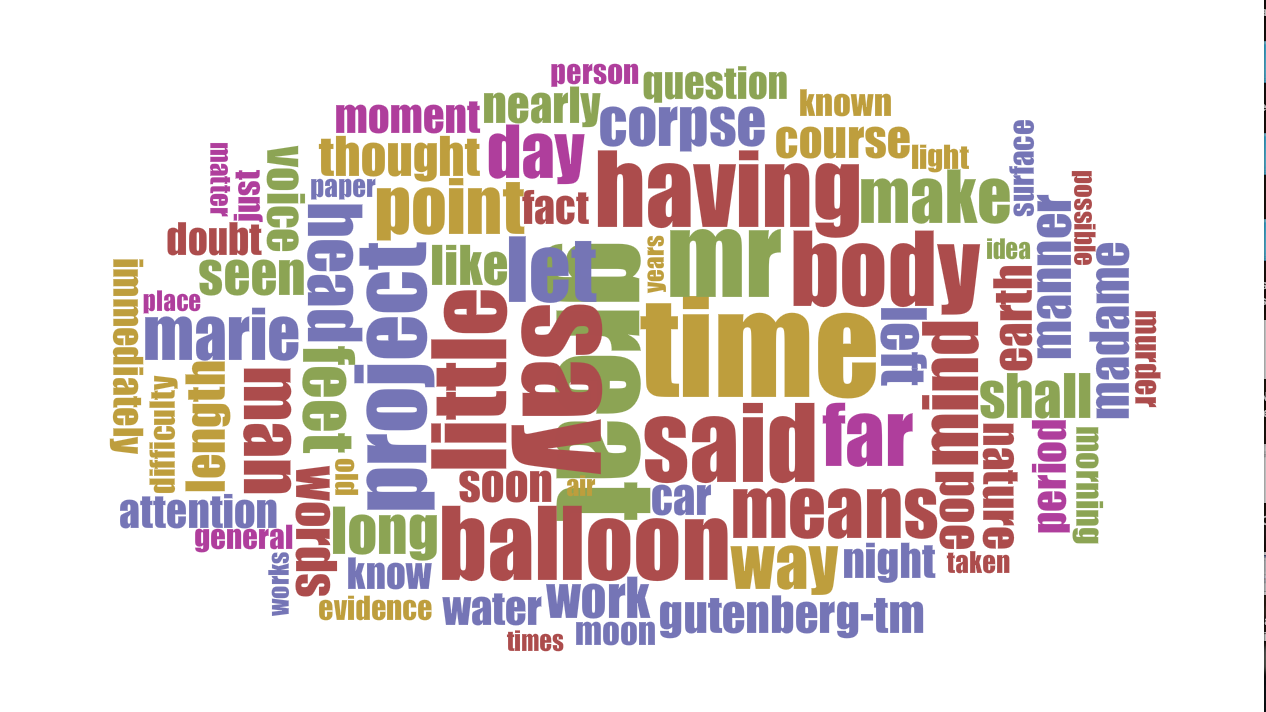
Under the “distinctive words” category in the “summary” section for Volume 1, I noticed that “body,” “mind,” and “corpse” are frequently “distinctive words” that appear throughout his work, which lends to thinking about his preoccupation with the the body and the mind, as well as death and decay. Initially, I was curious why “balloon” and “Marie,” but the first volume has “The Balloon-Hoax” and “The Mystery of Marie Roget” in them, which accounts for that.

Word cloud for volume 1:Screen Shot 2016-03-02 at 10.41.01 PM

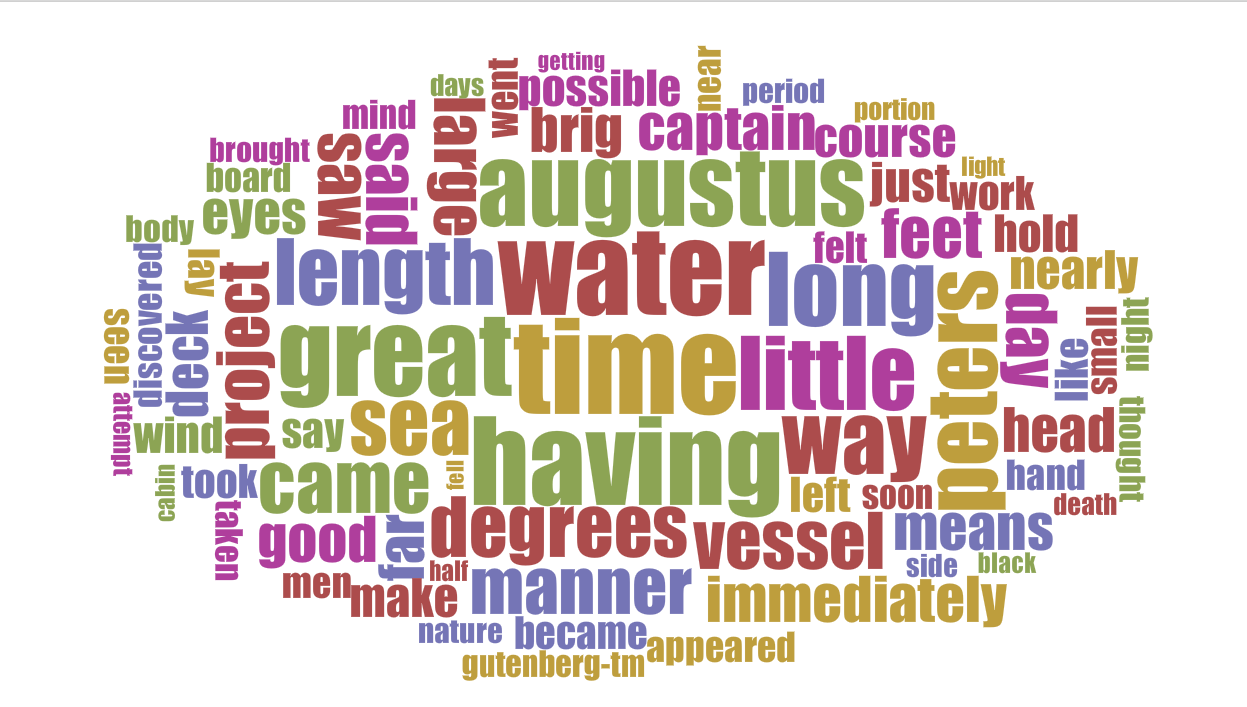
Word cloud for volume 3:

Screen Shot 2016-03-02 at 11.22.02 PM

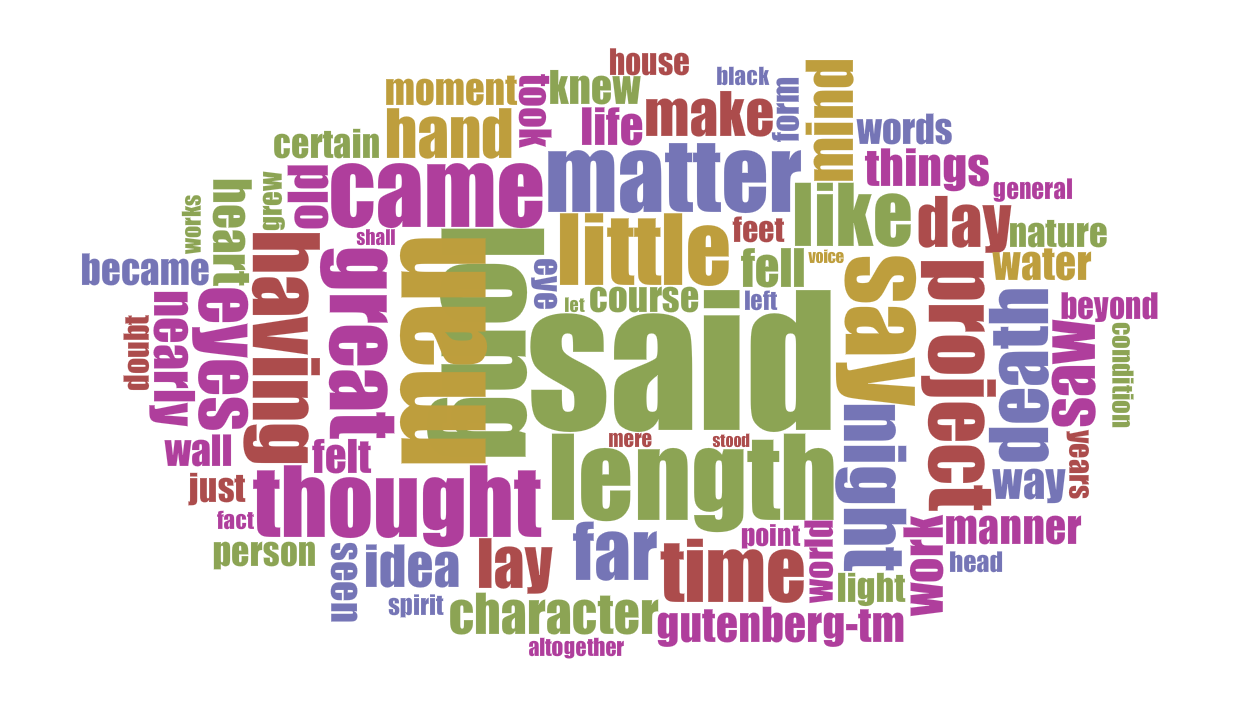
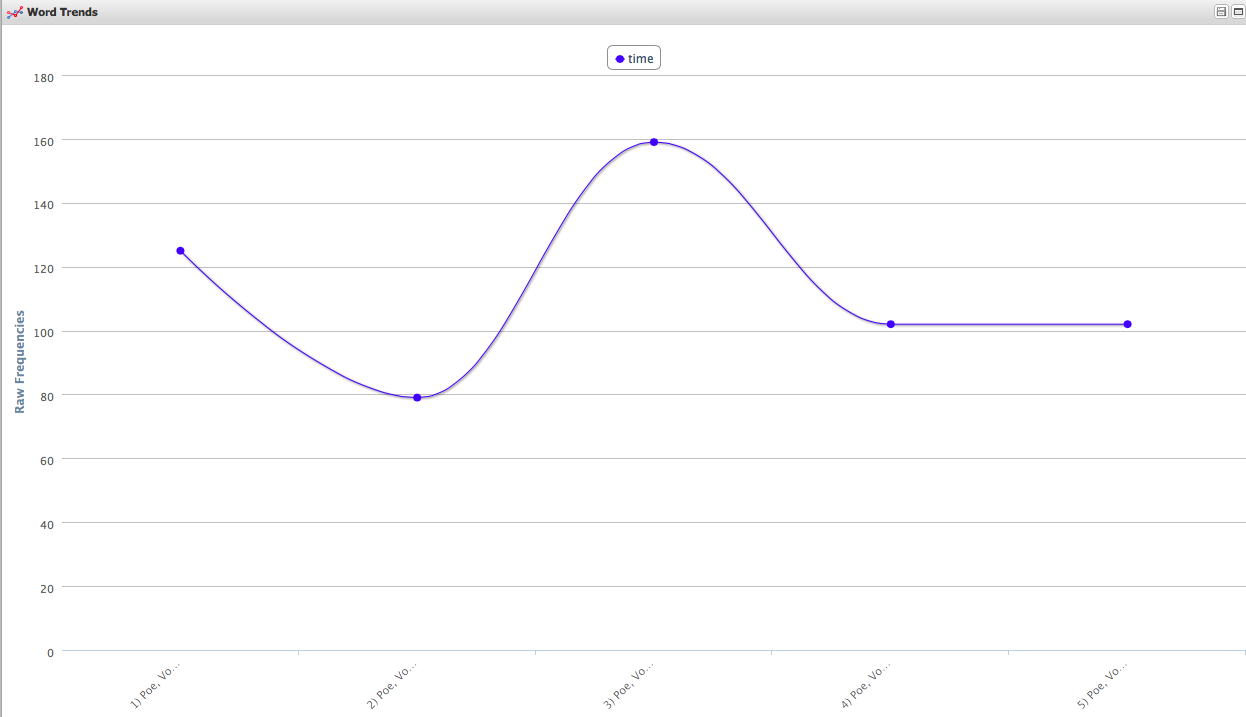
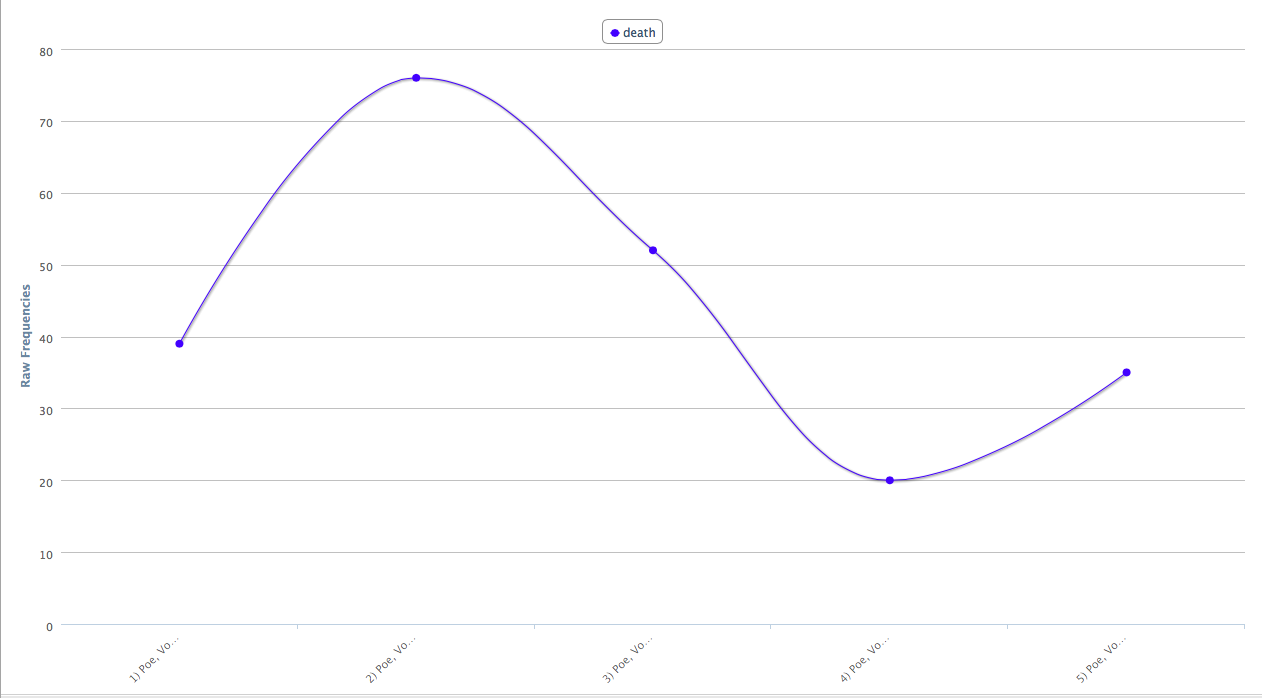
Moving to volume 2 and 3, “body” is still frequent, but lessens from 89 times in the first volume. The “word trends” graphs show the decline in the appearance of “body” throughout the volumes. Poe seemed to have a strong and consistent focus on the corporeal throughout his work. This appears in words other than just “body,” and I wonder if this could also be apart of his focus on the grotesque? For Volume 2, the word cloud still has “time” standing out, but then other words beyond just the word “body” also appear: “eyes,” “head,” “hand,” “heart,” and “man.” The distinguishing bodily parts come out in the second volume in particular. These appear in volumes 3 and 4, as well, but not as prominently as in volume 2.

Screen Shot 2016-03-02 at 11.26.01 PM

“Time” frequently appears through all volumes and shows up prominently in every word cloud for each separate volume. I wonder if this could also indicate a possible queer reading of Poe’s work. His work frequently plays with conceptions of temporality, which he appears to be highlighting by his frequent use of the word throughout all of his writing.

Screen Shot 2016-03-02 at 10.56.45 PM


Screen Shot 2016-03-02 at 11.03.39 PM

Though this is smaller sample of the charts of graphs for Poe’s 5 volume collection, I am interested how time and bodies relate to one another in Poe’s work. His writing plays with conceptions of temporality and corporeal reality, which appear as themes in the word frequency throughout his collected work. I was a bit surprised that the imagery of death didn’t appear more frequently in the text, but instead was mostly about the body and time.

For HTRC, I looked at 30 books of poetry by black poets in the 19th century south. I mostly used collections by Paul Laurence Dunbar and George Moses Horton along with James Wheldon Johnson, Frances Ellen Watkins Harper, and Georgia Douglas Johnson. I used the Topic Modeling Algorithm and came up with this:

Screen Shot 2016-03-02 at 11.51.09 PM Screen Shot 2016-03-02 at 11.51.20 PM

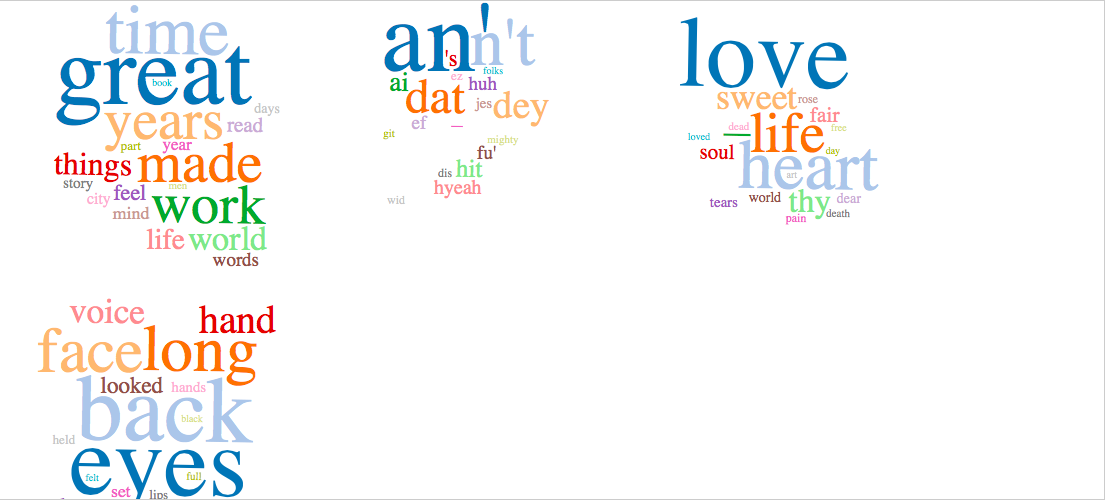
For the HTRC clouds, I was curious about what words were frequently used together by black southern poets of the 19th century and what these clusters could indicate about the trends throughout their work. I’m working on a project on Paul Laurence Dunbar, so I was curious about what some of the threads were throughout his contemporary poets, as well. There are a lot of apostrophes throughout, which in poetics can often signify absence and a complicated duality of presence, as well. I see this throughout a few of the clusters, which could signify black presence in the south, but a vocal absence, which these poets are working within.

Experimental Criticism

In using the platforms chosen for today’s activity (Hathtrust and Voyant), I ran into a few, albeit non-insurmountable, problems. The largest problem I have involves both Hathtrust and Voyant and that they provide too many options in terms of operations but too few in terms of application. Succinctly, there are numerous things you can do in both Hathturst and Voyant, but not much to say about the data unless you are well versed in the methodology of distant reading. For instance, there are numerous algorithmic operations in Hathtrust, but many of the texts that you can mine are public domain texts from the late 19th and early 20th century. This is perfectly fine if your studies take you in this direction, as mine do for me. However, if your forte is more contemporary, Hathtrust isn’t your friend. For instance, I tried searching for texts on Grass and there were many available, but not in English, making an algorithmic data pool related to it less useful in this context.

To this end, Voyant is a better tool inasmuch as it is afflicted with the opposite problem. It is possible to place nearly any text you need into it. Yet, it provides numerous options in terms of saving, viewing, and browsing that makes sharing somewhat difficult. In terms of the project I am pursuing in this course, Voyant is a far better tool, but I can imagine neophytes to the digital humanities such as myself struggling with it.

Thus, the tool is determined by the research question as good scholarship is wont to do. But, in a sense, if we are generating metadata by our questions and not the other way around, are we still engaged in a distant reading or is our distance an imagined one?

Word Trends, Popularity, and the Canon

Starting out, I did not have a clear idea of a set of texts I wanted to use text mining to explore. It was while investigating the Project Gutenberg website that I noticed the site allowed you to sort their items by popularity. The top five texts most downloaded are, in order: Pride and Prejudice, The Yellow Wallpaper, Alice’s Adventures in Wonderland, Frankenstein, and Adventures of Huckleberry Finn. Primary observations of this list: 3 of the 5 texts were written by women, all 5 authors were white, all 5 were originally composed in English (number 6 on the list is Kafka’s Metamorphosis. I find this especially amusing considering the nationality of the project’s namesake), 3 of our authors are British, and 2 of our authors are American. I point out these observations because a list based on popularity undoubtedly brings up questions of the canon. I don’t know the demographics of the typical Project Gutenberg user. Can we assume these downloaders are students who have been assigned these books? Or might they be pleasure readers, who us finally got around to their reading bucket list? In either case, the question remains: why are these books the most downloaded? Can we find any similarities in word content in these works?

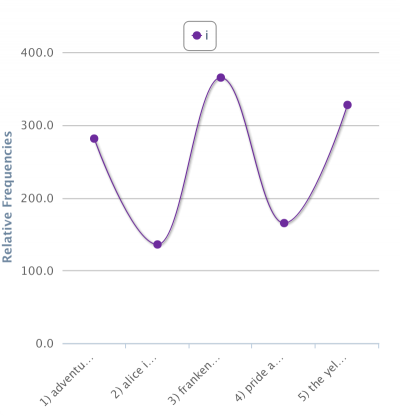
The most commonly used word was said, a trend I’m sure many of you have also observed. (People say things in works! Cool!) Says was also high on the list of words. Both Frankenstein and Huck Finn used says around the same amount that they used said. Another highlight of word usage: the varying use of “I”. I would like to do further research on the popularity of first-person texts: are they growing in popularity, and if so, is their popularity related to our growing solipsism?

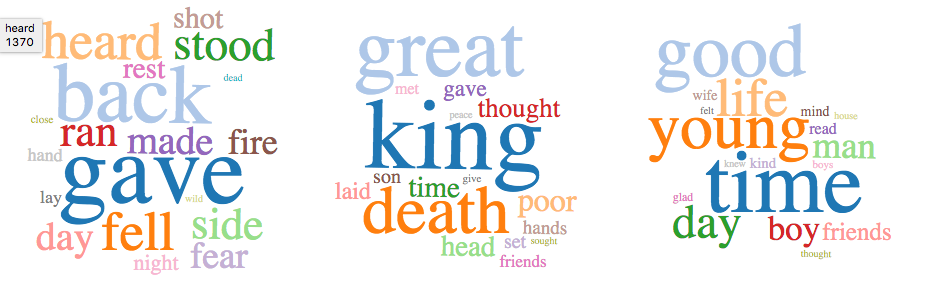
topic model 1

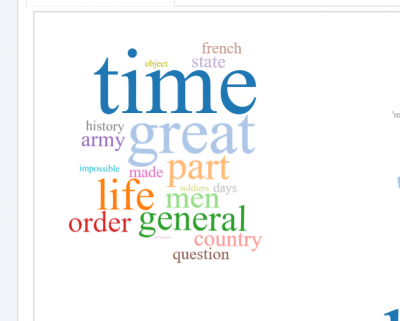
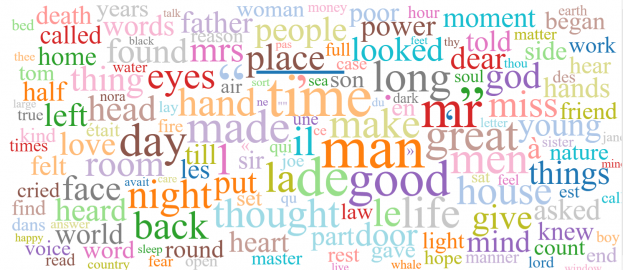
For my HathiTrust experiment, I entered as many of the books on the Project Gutenberg list that I could find, starting with the most popular and working my way down until I had 30 books collected. From the topic modeling algorithm, I see that time is a frequently discussed topic. Could the discussion of great works be related to their frequent discussions of time, considering the popularity of historicizing these works in order for undergraduates to understand them, find value in them, find significance in them?

topic model 2 time

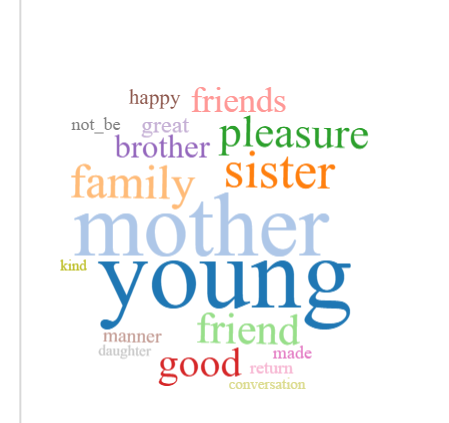
Another topic cluster which struck me, for similar reasons, is what I’ll call the youth and family relations cluster. If our goal in the humanities is to investigate human behavior, doesn’t it make sense to include those works which explore topics relatable to students? Regardless of your relationship with your family or your youth, each of us have or have had these things… I don’t want to delve into the territory of justifying the canon, and these are questions that have been considered before. But I do think text mining can help us to better explore some of these questions, as it allows us to step back from the text proper (in a way, to step back from our pre-formed assumptions of textual popularity and value) to see patterns of the whole.

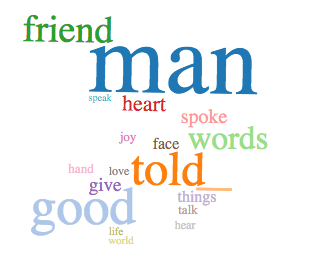
word cloud

Canary in a Text Mine

Voyant: My Digital BF

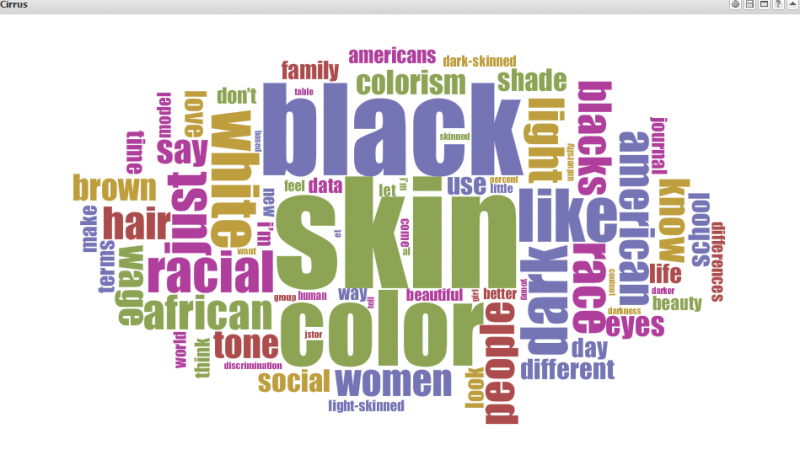
I used Voyant before and found it super helpful, but I really came to love it after the DSL text mining workshop last week. My corpus for this experiment included 5 academic research articles on colorism and a couple hundred poems about colorism. An initial question is simply, How do the two corpuses or genres of texts compare and contrast?

peak in word frequency 02 peak in word frequency girl-boy peak in word frequency 01

In general, the poems had a much lower word Density than the academic articles. The older age group of the poetry divisions only had a minimal increase in word Density (161.7 vs. 162.4).

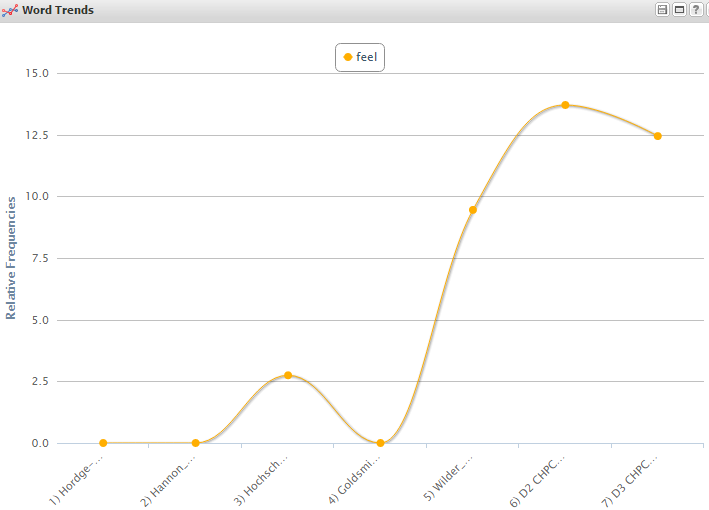
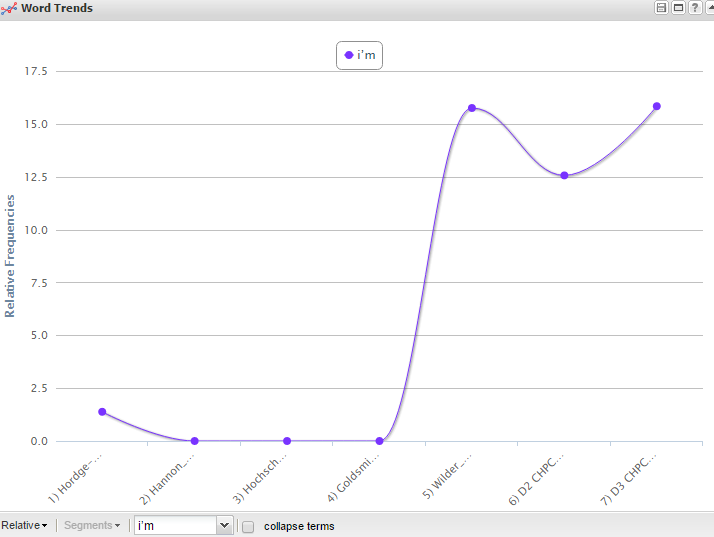
Notable peaks in word frequencies- “I’m” and “Feel” occur at significantly higher rates in poetry than academic prose (surprise!). Would this remain true in a larger sample of both academic and poetic works? Does it matter given the typical genre conventions of academic prose and poetry? I hypothesize that it might, especially if we don’t also see similar peaks in other similar words like “you” or “we” or other “feeling” words.

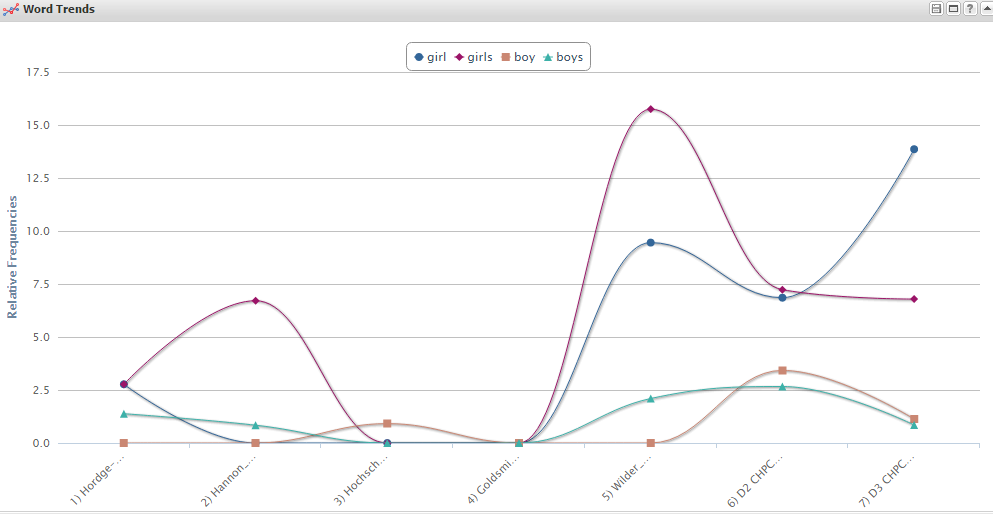
The terms “girl” and “girls” appear at much higher rates in the entire corpus than “boy” or “boys,” but particularly in the poetry. Why is that? Why a greater presence of Girls in general, but also, why in the poetry in particular? Would this finding remain unchanged if I tested the entirety of my collection of academic articles on colorism? Other data I’ve collected as well as plenty of data from other sources show that women and girls have a significantly higher presence in the colorism discourse, both as participants and subjects, than men and boys. Does the content of the poems illustrate why this might be the case? It might be interesting to focus on the instances of the words “boy” and “boys” since they are the anomaly in the pattern of female centric texts. Another interesting question to ask would be a comparison of the gender of the authors for academic vs. poetic texts. I could then also align that data with data about male or female subjects.

I often worry about confirmation bias when studying a subject I have such intimate familiarity with. Ted Underwood indirectly mentions confirmation bias, and I’m wondering to what extent does computer aided reading help to buffer against confirmation bias. As Fish notes, the element of surprise is very important in DH work. For me surprises in the data are sort of reassuring me that I am indeed mitigating confirmation bias. The level of familiarity I have with my topic almost necessitates an equally significant level of deformation made accessible by computer assisted reading in order to push myself to continue seeing and understanding new things.

HathiTrust: My Digital Frenemy

I have not yet completed my HathiTrust experiments due to technical difficulty. I spent hours to get the collection I wanted only to not be able to save it. (HathiTrust should allow you to store selected items without converting them into a workset. This would have allowed me to try and fix my technical glitch without having to go back and find all 37 of my texts all over again, which I had to do a few times.) I took some time finding an interesting topic with a rich enough data source to gather 30 interesting texts. I realized that part of the problem was that I simply did not know what sorts of texts HathiTrust makes available. After having no luck finding texts with the keywords most relevant to my research interests, I browsed preexisting worksets in order to see what kinds of data were possible, and I found one with a collection of 10 or so slave narratives, which is broadly related to my research. I was finally able to gather enough items using various searches in TITLE and SUBJECT with key terms +slave AND +narrative OR +memoir OR +autobiography. I found plenty of interesting texts and was quite eager to mine them, only to repeatedly get a message saying “system error” each time, even on multiple browsers on different computers. Now that I’m intrigued by this interesting collection of 3 dozen slave narratives, I still want to text mine the corpus. I have not given up on HathiTrust just yet. I emailed them about my problem and am awaiting their reply. I assume it’s something I’m doing wrong because I haven’t been able to find any discussion of problems like mine online.

Finally, I just want to note that I’m a huge fan of mixed methods.

Henry Wadsworth Longfellow’s Work with Words

For this week’s digital humanities project, since I created a database for illustrations of Henry Wadsworth Longfellow’s “Evangeline,” I chose to explore more of Henry Wadsworth Longfellow’s works in the word frequency tools.

For my work with Voyant, since Longfellow wrote many poems, I wanted to look at Longfellow’s style with his epic and narrative poems. “Evangeline” and the “Song of Hiawatha” are really considered two epic poems, but he also wrote other narrative or dramatic poems including “Hyperion,” “The Wreck of the Hesperus,” and “Tales of the Wayside Inn.” I got these texts from Project Guttenberg and converted them into PDFs.

From what Longfellow I have read, these poems seem to be romantic but also very religious; so I felt like these themes would be evident in a word frequency analysis tool. For my research question for Voyant, I wanted to explore: Are there any distinguishable themes in Henry Wadsworth Longfellow’s narrative poems that are evident in word frequency, and if so, could these themes hint at Longfellow’s style of narrative poems?

Heather's Voyant

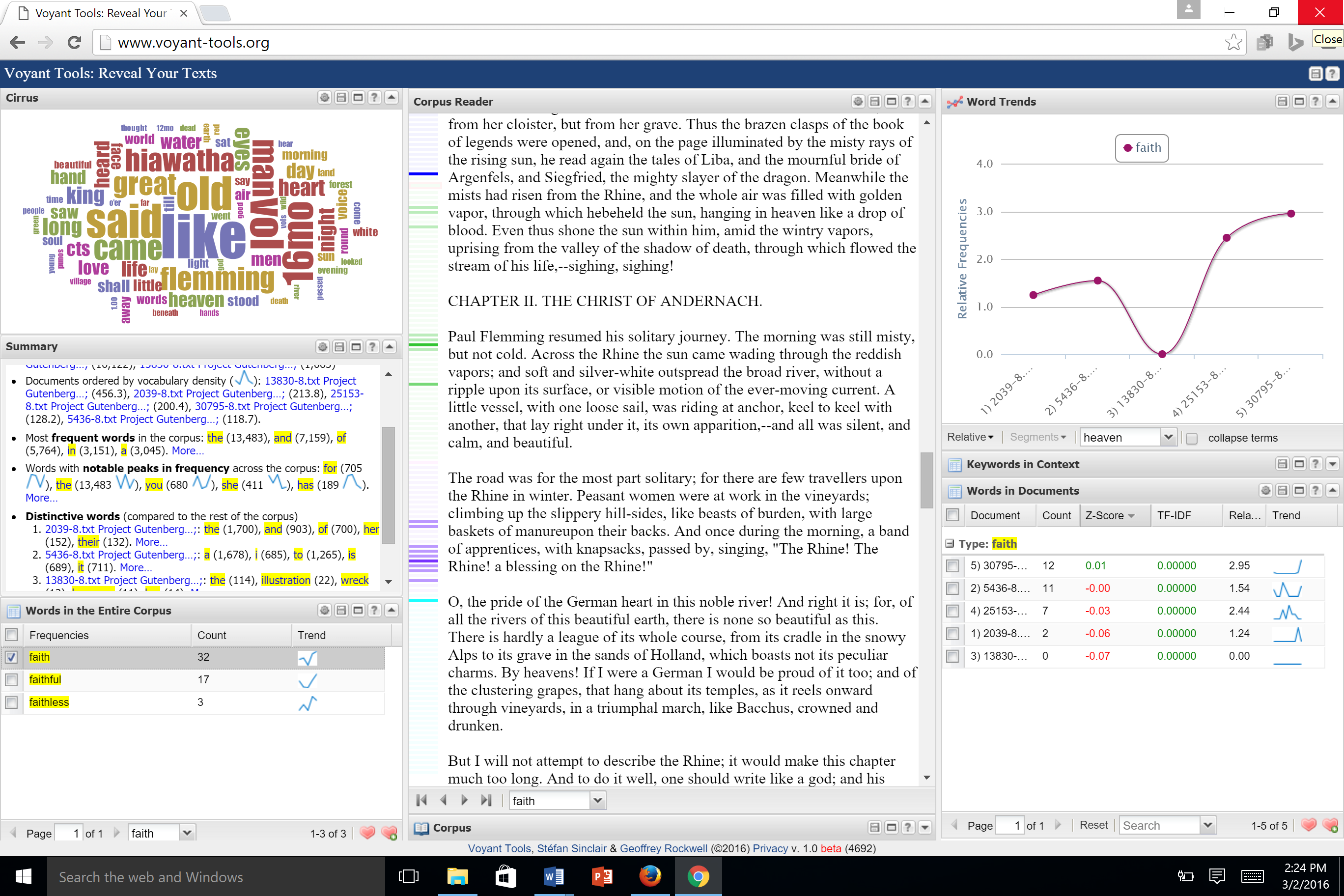
I knew there are strong religious themes throughout. So, my hypothesis was that there would be a lot of religious terminology, and I would be able to find some of the more religious aspects or themes in the poem through the use of words like “God,” “faith,” “heaven,” and “prayer.”

As far as my hypothesis, the word “God” was pretty consistent at 92 throughout, “prayer” at 32, “pray” at 20, “faith” at 32, and “heaven” wins at 166.
However, in my analysis of the corpus, I think some of my most interesting findings was the use of “eyes” and “love.” I found eyes and love in the section about “notable peaks in frequency” eyes being 191 and love being 165. It was extremely interesting to see this in a chart form too because his use of “eyes” definitely shifted throughout the works but his use of the word “love” stayed more or less the same: http://www.voyant-tools.org/tool/TypeFrequenciesChart/?corpus=1456946127804.185&type=eyes&type=love&mode=corpus
(For the chart 1) Evangeline, 2) Hyperion, 3) The Wreck of Hesperus, 4) Tales of the Wayward Inn, 5) Song of Hiawathia)

Call me a romantic but I liked how the word “love” was a pretty steady theme throughout the works based on the word trends graph. (Also I found out later that heart was even greater than eyes at 202). And, I think this is interesting in terms of Longfellow’s works because even though religious themes are present, this data calls for another reading of these texts to analyze the contexts for these words. Perhaps more close reading could show that these themes are perhaps more prominent than his underlying religious themes.

And, after doing this project, I don’t see how Fish is so upset about data analysis tools like these. True, I did not close read – as that is not what this tool is – but this only inspired me to want to go back and close read. But because of Ted Underwood’s section in his article about having a hypothesis and trying to prove it, I was hyper-aware of my hypothesis, and even though I did test my hypothesis, I tried not to let it color my analysis or do any “data dredging” that Ted Underwood talks about.

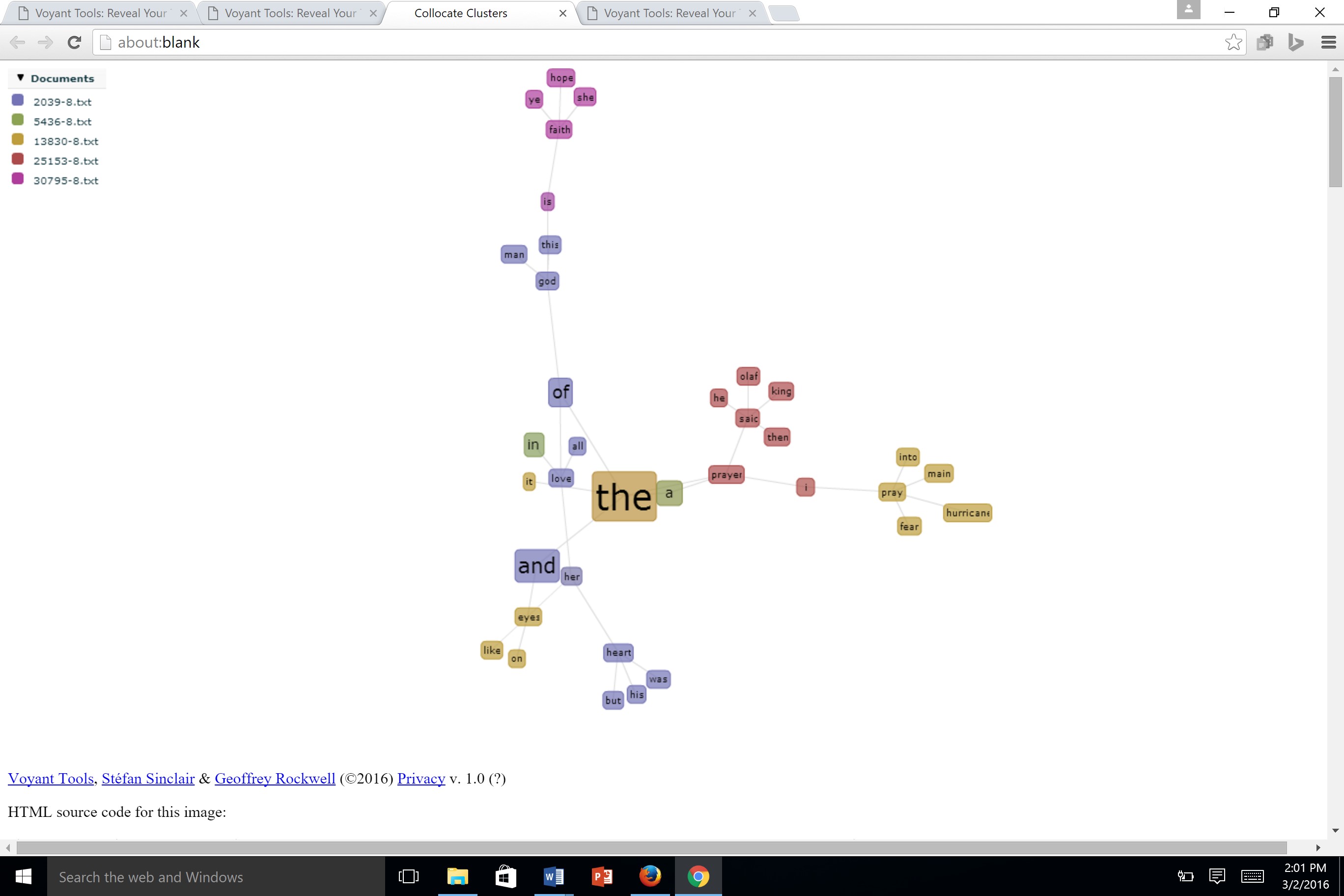
I played around with Voyant a bit more, mostly because I was dying to try out the other tools! I did play with the collocate clusters. It would not do all of the texts, but I did type in the keywords I found earlier to see how they would link up. Maybe these words and their connections could demonstrate how these themes of love and religion are interconnected or maybe how they are connected to something else entirely?

Voyant Cluster

I thought Voyant was interesting. I would love to close reading where Longfellow has these words and how the meanings of these words evolve from the beginning of the tales to the end. Next time I experiment with this, I would want to compare just his two epics and then his narrative or dramatic poems separately to analyze the differences as well as compare all of his different styles individually, i.e. epics, narrative or dramatic, poems of places, romance, and lyrics, versus all in a clump to see whether his writing is drastically different in each subgenre of his works or if there is a consistent pattern that marks Longfellow as an individual writer.

For my HathiTrust Research, I actually created two worksets to experiment with because I could not decide what I wanted to use as my dataset. For my first dataset, I pulled 30 different texts from various American authors, including Henry Wadsworth Longfellow, who wrote in the nineteenth century. I tried to make these writers mostly around the time of Longfellow, but some are a few years after him. For this dataset, I wanted to see if some of the themes I found in Voyant were evident in other writers of the time, and/or if these writers had similar themes or patterns or words in their writings.

For the second data set, I devoted the dataset only to Henry Wadsworth Longfellow. I gather 17 texts by Longfellow including the narratives I already did in Voyant as well as poetical works, other narrative poems, ballads, and lyrics. Like the first dataset, I wanted to see if I could distinguish any distinct patterns or themes overall in Longfellow’s writings. And, I wondered if any words would match the other dataset and what I found in Voyant.
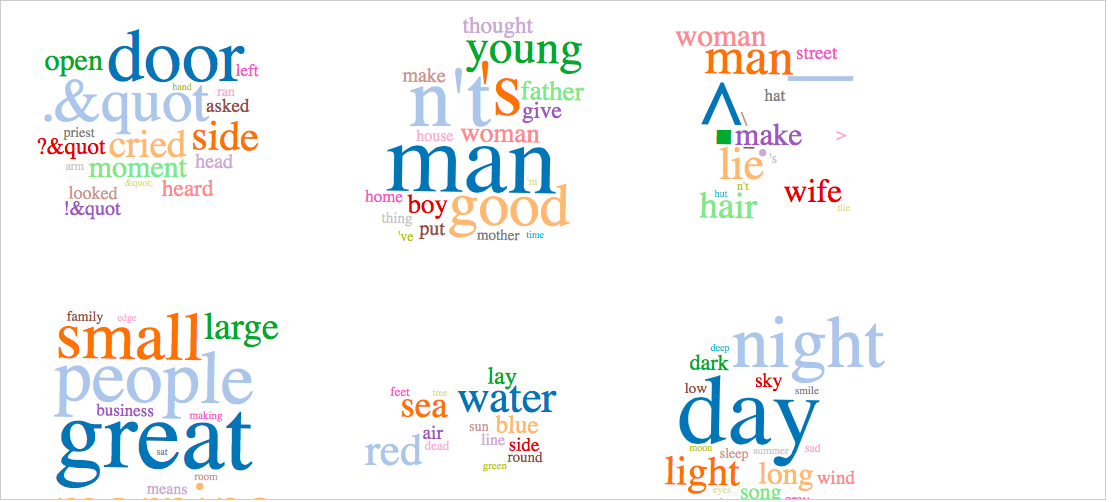
From the topic modeling I found that Longfellow’s pieces dealt with nature, night and day, light, as well as life and day and great. But, it seemed like from the data that he dealt with time a lot and the changes of the day. In the larger set with all the pieces from various authors, dealt with a lot of the same stuff, with perhaps a greater emphasis on time, men, and the world than Longfellow’s.

As far as drawing concrete conclusions, I felt like this was more of a keyword search, for me in the stage of my project. It was interesting but demands closer reading and re-evaluation of themes and context.

Distantly Reading Horror and Dewey

In Voyant, I looked at five horror novels/stories—Dracula, The Shunned House, volume I of Poe’s collected works, Kafka’s Metamorphosis, and The Damned (by someone named Blackwood). I got these out of the Gutenberg Project “horror fiction” wiki thing. I wanted to look for uses of words having to do with dark and light as they relate to…well, I’m not quite sure. I guess I’ve always assumed that a writer was sort of forced to use light and dark to indicate mood. That’s reductive, but it does seem like a writer is in a language bind when trying to describe the basic aspects of setting, because there are only so many ways to say “it was a bright day” or “the night was dark.” Anyway, I thought in horror novels there might be a high incidence of use of darkness, especially vs. light, and that you could tell something about the overall tone or “feel” of a work if you knew how often certain ones were referring to lightness or darkness. It turns out not to be true, at least in the case of these five works, that light+day or dark+night terms are used significantly more or less, and the more prevalent terms switch depending on which you’re looking at. As far as relative uses of words like dark/night/evil/black, Dracula was significantly darker/later/eviler/blacker than the other works, with volume I of Poe being a distant second. This is an interesting way to frame a work—I would now be extra sensitive to the light gradient in Dracula if I read it, which I haven’t, which points out probably what I see as most useful in these tools, at least at this cursory level: they are a good way to vet broad hypotheses or pet theories before diving in and possibly treading a few thousand pages before realizing you’ve wasted your time.

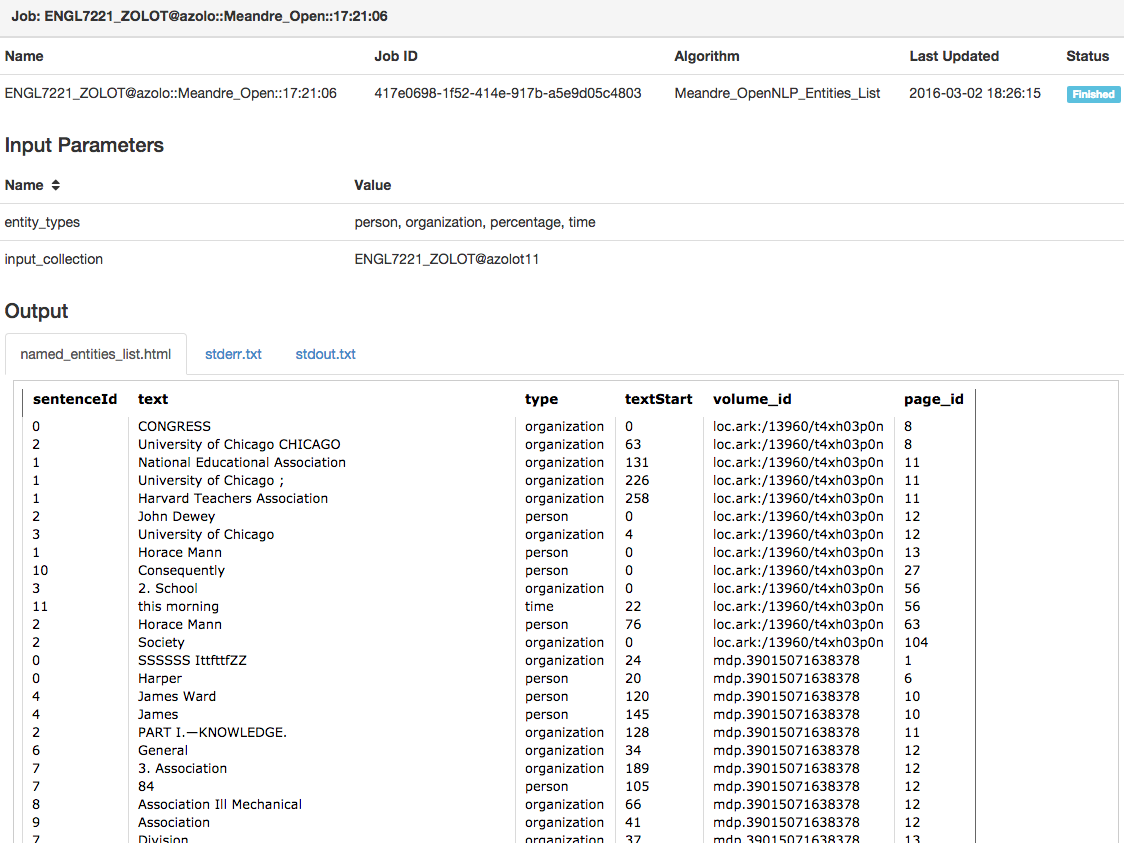
The same thing goes for the HTRC deal. I fed pretty much all of John Dewey’s works that they had in the database (w/o repeats) to extract a list of persons, organizations and (for kicks) time and percentages. It provides a pretty good road map, I think, for approaching Dewey’s work. This is coming from someone who’s read exactly 1.5 of Dewey’s books. The point is, he wrote a hell of a lot, and this would be a pretty solid way to focus reading around topics or people that I might want to see his reaction to. But it feels a little lacking…for one thing, it’s rife with errors. For another, this isn’t really anything I couldn’t do flipping through the book. Maybe I don’t have all the books on hand, but apparently I can get a lot (all?) of this freely since it’s public domain (not even to mention all the copyrighted stuff you can get online—and, perversely, with less hassle)—and what I’ve found is looking through one document with speedy deployment of CTRL+F is way better than trying to make heads/tails of this sort of list. So maybe I’m just not sold on list-based research. It seems like a lot of algorithm-application and intensive CPU time for little reward, especially as compared to: I did genuinely find the Voyant thing helpful, and am sure there would be even more benefit from diving into the various statistical measures, your Z-scores, your relative thises and logarithmic thats. Plus Voyant is 300 times faster.

And this all certainly opens up a whole vista of further research questions and possibilities. I’d be interested in a more complete/thorough analysis of light gradients in works of different types. But the technology involved would be more complex. I sure couldn’t create it, and I’ve yet to see something prepackaged that could handle questions like: How often are light gradients used to indicate mood vs. general setting? How is an author resisting using the same words to describe qualities of light (this is an extension of a general lexical richness thing)? Or is the author resisting at all? And couldn’t we measure all the synonyms/different expressions of light (or whatever) in a sort of ratio to see how much dictional acrobatics are going on? In other words, is the author even conscious of this kind of thing? Another question: how is the author using light/dark symbolically? In what way? Why? Where? In what situations? Etc.

Assuming you wanted to teach a computer to answer these kinds of non-quantifiable questions, the amount of effort and headache would seem greatly outweighed by the fact that a person can do this just fine—probably better, given the error rate on the list I pulled from Dewey’s work.

Maybe the issue I’m having is I’m more interested in individual aesthetic situations and choices and how the mesh of really great writing is woven, and this is particular, idiosyncratic, minute, resistant to macro analysis and aggregation. I maintain that counting words across books is to miss what literary criticism is about, at least for me. It might provide a top-down map for seeing areas I might want to go to, but there’s nothing a graph can tell me about why a sentence, paragraph, chapter, or book works well. Just can’t. And it seems there’s a sort of social/historical impulse in the mass distant reading that has to do with correcting past bias, which is good and fine and important. It’s important to know really how many books different demographics contributed, who bought them, how different markets grew and swelled and circulated and all that. But that doesn’t really touch the content of the books. And if you use that as a starting point for criticism, then what you’ll get is really good socially conscious criticism (or really crappy socially conscious criticism), but, essentially, social criticism shoved into a literary husk. The alternative would be to extract social (or whatever) meaning/redemption/instruction from the literary work itself, from the particulars of a given writer’s work, the way they use plot, language, convention, etc.—for which you often need only one book, one paragraph, one sentence. Not millions. The whole distant reading thing just seems all confused to me, somehow. I mean, it seems like a lot of people confusing what the point of literature is, the same way capitalism confuses what human relationships are for. I agree that there is great benefit to seeing big picture type stats and info on literature, movements, schools, demographics, so on and so on, but I guess I’m put off by people who suggest the old forms of humanist criticism could be replaced or superseded by some sort of techno-crit. It strikes me as being overly eager to embrace nifty new technologies, the kind of unearned faith in computers that drove a lot of that futurist writing from the 40s and 50s about how scholarship would be indistinguishable from panglobal mind melding once we could get these dang light projection index desks working right. What I mean is, I’m skeptical, and I find good criticism to be so powerful for so many reasons that are categorically other than macroanalytical, broad, etc. And I totally understand that the subjective approach to criticism is tied at the hip to all the anglocentric, colonial, empiric, hegemonic, misogynist, racist shenanigans of exclusionary literary canons from Aristotle to Updike, but I think we can perform strong subjective criticism in the light of this broad macro understanding without throwing out the method altogether, and we are also now better able to smell when the subjective is dangerously so (racist, sexist, classist, etc.), and if the contribution of these massive distant readings is to reveal just how wide and deep the contributions of different peoples have been, that’s a big win and I’m all for it. But contextualizing is not the same as scholarship—the first is part of the second, and can’t replace it. This is my opinion in more words than is necessary.

(And still) I just reject out of hand the idea that an impulse toward statistically significant trends—toward literary measurement that looks scientific—is a better—or even particularly good—spiritual seed for engaging literature.

(Not saying I couldn’t be convinced—but where’s the really sophisticated statistical/algorithmic literary analysis drenched in aesthetic principles and the humanist spirit to blow my hair back?)

UPDATE: So I took a nap and now I feel bad for being so grumpy about this. I amended part of this to try to make more sense about my resistance to corpus statistics as critical revolution.


Voyant stuff:

http://voyant-tools.org/tool/CorpusTypeFrequenciesGrid/?corpus=1456959104869.4453&stopList=1456959155370yr&query=night%2Cevil%2Cdark%2Cblack

http://voyant-tools.org/tool/TypeFrequenciesChart/?corpus=1456959104869.4453&stopList=1456959155370yr&type=night&type=dark&type=black&type=evil&mode=corpus

http://voyant-tools.org/tool/DocumentTypeFrequenciesGrid/?corpus=1456959104869.4453&stopList=1456959155370yr&type=dark&type=evil&type=night&type=black

http://voyant-tools.org/tool/TypeFrequenciesChart/?corpus=1456959104869.4453&stopList=1456959155370yr&type=night&type=day&type=light&type=dark&mode=corpus


Screenshot from HRTC (I couldn’t find another way to drop an example in here?):
Screen Shot 2016-03-02 at 6.07.41 PM

Bodies of Corresponden(ts)ce

I’ve recently been interested in the connection between letters and the bodies of the people who write and receive them. In what ways are letters extensions of peoples’ bodies? How does the materiality of letters sent across space affect the content of those letters? What is the function of letters in novels, epistolary and otherwise? More specifically, how might nineteenth century courtship letters have embodied the sexuality of correspondents?

With this last question in mind, I decided use Voyant to mine five early American sentimental novels. I haven’t read all of these novels, but most sentimental novels involve some sending of letters, so I figured something interesting might pop up.

When looking at word trends, I found that Foster’s The Coquette frequently used the term “letters,” which is unsurprising because it is an epistolary novel. Uncle Tom’s Cabin frequently uses the term “body,” but not “letters.” This is interesting, but not very surprising, since Uncle Tom’s Cabin is more explicitly about bodies. I also noticed that Caroline Hentz’s book Love After Marriage uses a high number of body-related words, such as heart, eyes, hand, face. The most frequently used word in the corpus is, by far, said, which draws attention to sentimental novels’ focus on dialogue.

I actually found the differences between the five novels more illuminating than the similarities. I had assumed the five word clouds would be close to identical, with words like love and heart looming over the rest. In fact, each novel has a somewhat distinct set of words connected to it. One is distinguished by dark, gothic words, for example, while another has a lot of romantic, abstract words.

I was happier with my results on HathiTrust. It was surprisingly difficult to curate a group of 30 texts I wanted to mine, but I finally settled on collections of letters, on which I used the topic modeling algorithm. This was satisfying, because my strongest topics were related to letter writing (letters, write, signed, sent, received) and bodies/nature (eyes, feet, face, beauty).

A couple of take-away thoughts: 1) a larger and/or more closely related corpus is likely to produced more readable results. 2) with smaller corpuses (like my 5 sentimental novels), a program like Voyant is more likely to reveal nuances in tone and rhetoric than highly specific connections. If I were to move forward with this project, I would be interested in exploring the context in which correspondents write about their bodies–is it literal, metaphorical, etc.? More specifically, do bodily descriptions depend on the motive of the letter? For example, one topic revealed by the topic modeling algorithm is related to the state/public/government. Bodies would probably function differently in this grouping than in the friend/heart/love topic.

Mining for Vikings and Outlaws

For this project, I chose to look at data mined from a small set of Old Norse sagas (both modern retellings and medieval text translations) and from a set of 30 texts related to Robin Hood, most of which were fictional retellings of the early Robin Hood ballads.

I used Project Gutenberg as the digital source for the Old Norse sagas and cleaned up the texts slightly by deleting some irrelevant introductory material before running them through Voyant. I had read Stanley Fish’s terse “Mind Your P’s and B’s” column before loading anything into Voyant, and, determined to hypothesize prior to experimentation, I wrote several test questions. Here they are, in no particular order:

  1. What can Voyant tell me about the role of music in Old Norse sagas?
  2. In stories of Norse heroism, are kings or gods considered more important to the plot, and is that import consistently portrayed in both medieval texts and modern versions of the sagas?
  3. Will Voyant’s data show evidence of the practice of boasting through an abnormally high number of personal pronouns associated with feasting?
  4. How often are boats and seafaring mentioned in these works, and what can travel-related words tell me about Norse ideas of honor and independence?

Unfortunately, the only question I could begin to answer with Voyant’s data is the last one. After analyzing all the sources, I realized that I had been asking the wrong type of questions, as my questions couldn’t be answered satisfactorily with relative frequency data. Or, at least, I needed to start with a more basic question and see if I could trace the thread of a syntactical pattern or unique contextual use first, and then follow that thread to a deeper conclusion. This type of dependency on data—a sort of guided treasure hunt instead of a quest to prove or disprove a hypothesis—is, I suspect, why Fish seems to have a problem with data-based literary studies. After completing my analysis, though, I did learn something about Old Norse sagas, even though it wasn’t what I expected to learn, and I count that discovery as something just as valid as a proven hypothesis: if read through their most commonly used action verbs, the Norse sagas are stories of exploratory movement and speech, more focused on ship-speak and interpersonal communication than the violent hand-to-hand combat that seems to drive each protagonist’s storyline. For example, in Eirik the Red, the most common action verbs are came, went, said, called, set, took, sailed, received, prepared, and gave. In the English version of Snorri’s Heimskringla, the most common action verbs are came, went, said, took, called, come, told, gave, says, sent. This distant reading actually spawned close reading, as I started to scrutinize the texts to see if a microanalysis of the stories evidenced a similar conclusion. In summary, it did—the dramatic climaxes of the sagas paled a bit when I began noticing the emphasis on a give-and-take speech peppered throughout the works. It prompted me to think of Norse women and men as members of communities who prized societal justice and common welfare as well as individual bravery.

Pleased with the results from Voyant, I chose to run the Meandre_Topic_Modeling algorithm in HathiTrust in order to examine my Robin Hood sources. This time, I ran the algorithm before posing a research question (somehow, I could feel Fish’s disapproval), just to see what patterns emerged. I wasn’t surprised at the topic groupings, though: the word men was weighted heavily in more than one cluster (due to the repeated use of the phrase merry men, I wager); the words archers and arrows were closely associated; the word lady appeared in conjunction with true, days, fair, and sweet, etc. It occurred to me that this particular algorithm might be more useful when trying to discover topics from a larger set of slightly more diverse works. For instance, if I had included more literary criticism instead of just loading several copies of the same ballads, I might have been able to see interesting groupings of critical themes that could be used to plot the wax and wane of scholarly interests in relation to medieval outlaws.

I ran the Simple_Deployable_Word_Count algorithm using the RH texts, as well, and was rewarded with a short list of the most common words in the early ballads. As expected, most of the words were articles and prepositions; nevertheless, one surprising term appeared, namely, quotation marks (counted as a word in this algorithm). The quotation marks highlight the colloquial nature of the ballads and emphasize their vernacular media—as dialogue in tavern songs and popular rhymes—but also speak to the value of the written text. (What need does a minstrel have of quotation marks?) The ballads were preserved through ink, and the added punctuation is a testament to the endearing legacy of the ballads and the complicated shift towards a more literate populace near the dawn of the Renaissance. It would be interesting to compare punctuation in medieval and Renaissance versions of the ballads with an algorithm such as this.


css.php