For this week’s digital humanities project, since I created a database for illustrations of Henry Wadsworth Longfellow’s “Evangeline,” I chose to explore more of Henry Wadsworth Longfellow’s works in the word frequency tools.
For my work with Voyant, since Longfellow wrote many poems, I wanted to look at Longfellow’s style with his epic and narrative poems. “Evangeline” and the “Song of Hiawatha” are really considered two epic poems, but he also wrote other narrative or dramatic poems including “Hyperion,” “The Wreck of the Hesperus,” and “Tales of the Wayside Inn.” I got these texts from Project Guttenberg and converted them into PDFs.
From what Longfellow I have read, these poems seem to be romantic but also very religious; so I felt like these themes would be evident in a word frequency analysis tool. For my research question for Voyant, I wanted to explore: Are there any distinguishable themes in Henry Wadsworth Longfellow’s narrative poems that are evident in word frequency, and if so, could these themes hint at Longfellow’s style of narrative poems?
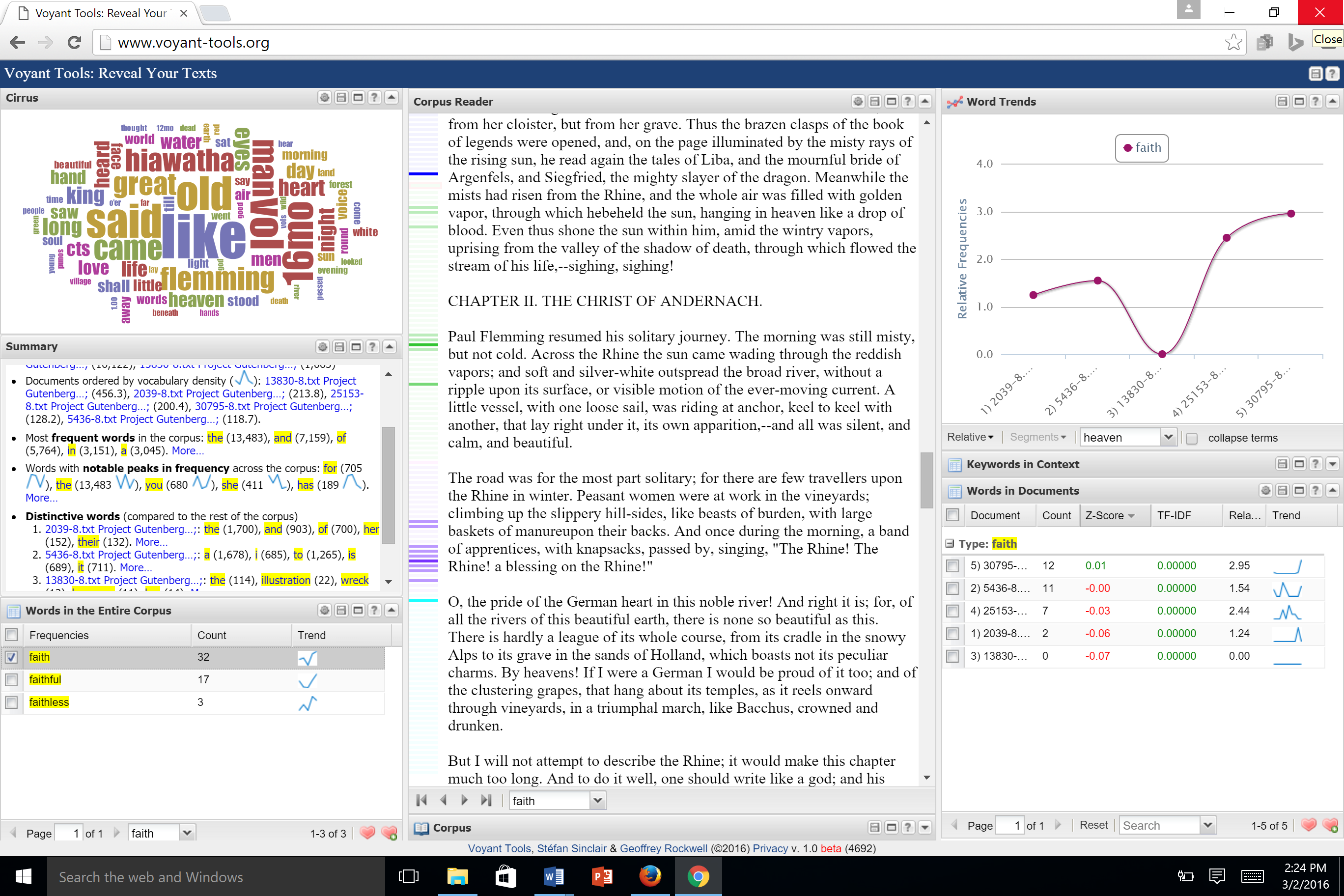
I knew there are strong religious themes throughout. So, my hypothesis was that there would be a lot of religious terminology, and I would be able to find some of the more religious aspects or themes in the poem through the use of words like “God,” “faith,” “heaven,” and “prayer.”
As far as my hypothesis, the word “God” was pretty consistent at 92 throughout, “prayer” at 32, “pray” at 20, “faith” at 32, and “heaven” wins at 166.
However, in my analysis of the corpus, I think some of my most interesting findings was the use of “eyes” and “love.” I found eyes and love in the section about “notable peaks in frequency” eyes being 191 and love being 165. It was extremely interesting to see this in a chart form too because his use of “eyes” definitely shifted throughout the works but his use of the word “love” stayed more or less the same: http://www.voyant-tools.org/tool/TypeFrequenciesChart/?corpus=1456946127804.185&type=eyes&type=love&mode=corpus
(For the chart 1) Evangeline, 2) Hyperion, 3) The Wreck of Hesperus, 4) Tales of the Wayward Inn, 5) Song of Hiawathia)
Call me a romantic but I liked how the word “love” was a pretty steady theme throughout the works based on the word trends graph. (Also I found out later that heart was even greater than eyes at 202). And, I think this is interesting in terms of Longfellow’s works because even though religious themes are present, this data calls for another reading of these texts to analyze the contexts for these words. Perhaps more close reading could show that these themes are perhaps more prominent than his underlying religious themes.
And, after doing this project, I don’t see how Fish is so upset about data analysis tools like these. True, I did not close read – as that is not what this tool is – but this only inspired me to want to go back and close read. But because of Ted Underwood’s section in his article about having a hypothesis and trying to prove it, I was hyper-aware of my hypothesis, and even though I did test my hypothesis, I tried not to let it color my analysis or do any “data dredging” that Ted Underwood talks about.
I played around with Voyant a bit more, mostly because I was dying to try out the other tools! I did play with the collocate clusters. It would not do all of the texts, but I did type in the keywords I found earlier to see how they would link up. Maybe these words and their connections could demonstrate how these themes of love and religion are interconnected or maybe how they are connected to something else entirely?
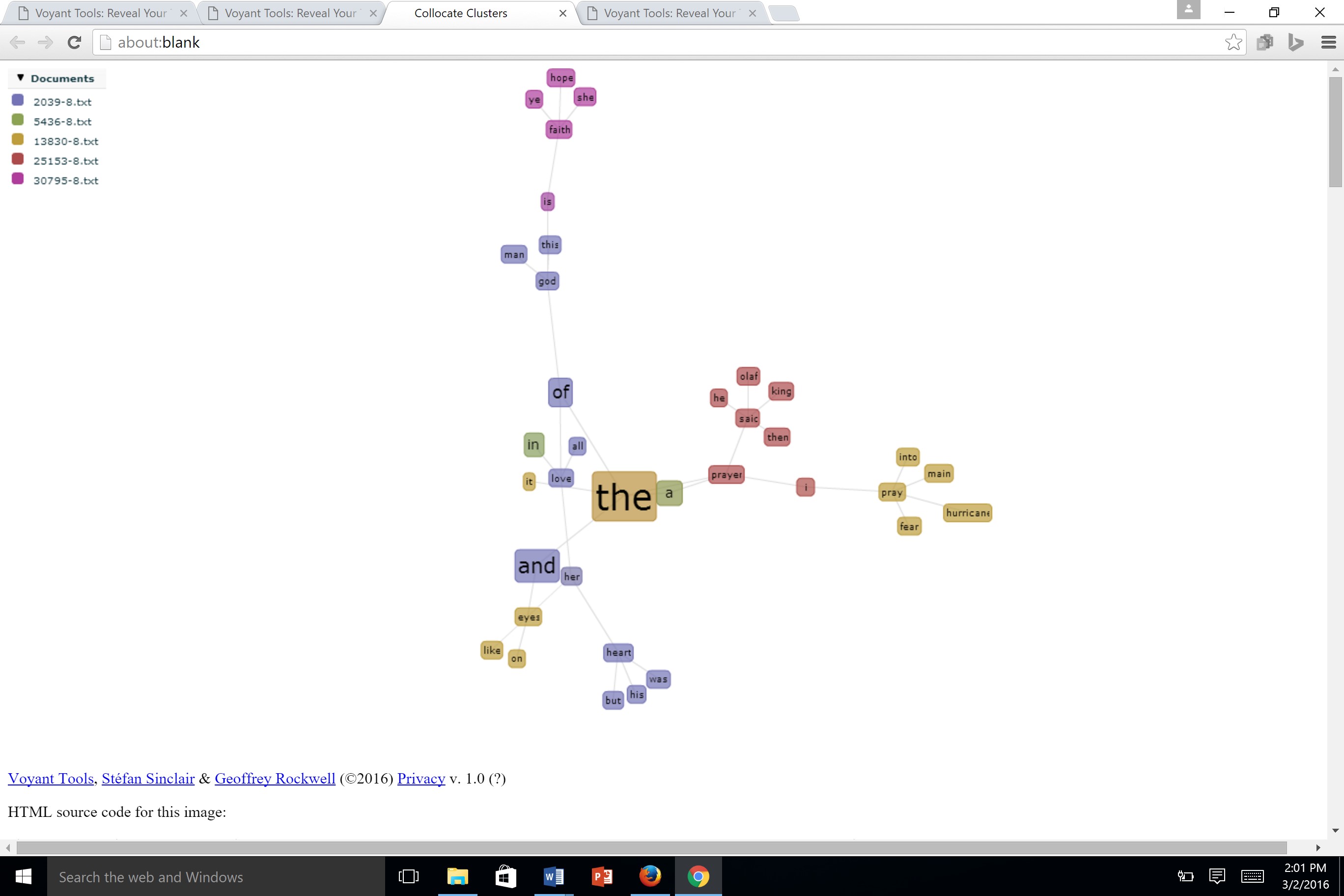
I thought Voyant was interesting. I would love to close reading where Longfellow has these words and how the meanings of these words evolve from the beginning of the tales to the end. Next time I experiment with this, I would want to compare just his two epics and then his narrative or dramatic poems separately to analyze the differences as well as compare all of his different styles individually, i.e. epics, narrative or dramatic, poems of places, romance, and lyrics, versus all in a clump to see whether his writing is drastically different in each subgenre of his works or if there is a consistent pattern that marks Longfellow as an individual writer.
For my HathiTrust Research, I actually created two worksets to experiment with because I could not decide what I wanted to use as my dataset. For my first dataset, I pulled 30 different texts from various American authors, including Henry Wadsworth Longfellow, who wrote in the nineteenth century. I tried to make these writers mostly around the time of Longfellow, but some are a few years after him. For this dataset, I wanted to see if some of the themes I found in Voyant were evident in other writers of the time, and/or if these writers had similar themes or patterns or words in their writings.
For the second data set, I devoted the dataset only to Henry Wadsworth Longfellow. I gather 17 texts by Longfellow including the narratives I already did in Voyant as well as poetical works, other narrative poems, ballads, and lyrics. Like the first dataset, I wanted to see if I could distinguish any distinct patterns or themes overall in Longfellow’s writings. And, I wondered if any words would match the other dataset and what I found in Voyant.
From the topic modeling I found that Longfellow’s pieces dealt with nature, night and day, light, as well as life and day and great. But, it seemed like from the data that he dealt with time a lot and the changes of the day. In the larger set with all the pieces from various authors, dealt with a lot of the same stuff, with perhaps a greater emphasis on time, men, and the world than Longfellow’s.
As far as drawing concrete conclusions, I felt like this was more of a keyword search, for me in the stage of my project. It was interesting but demands closer reading and re-evaluation of themes and context.

