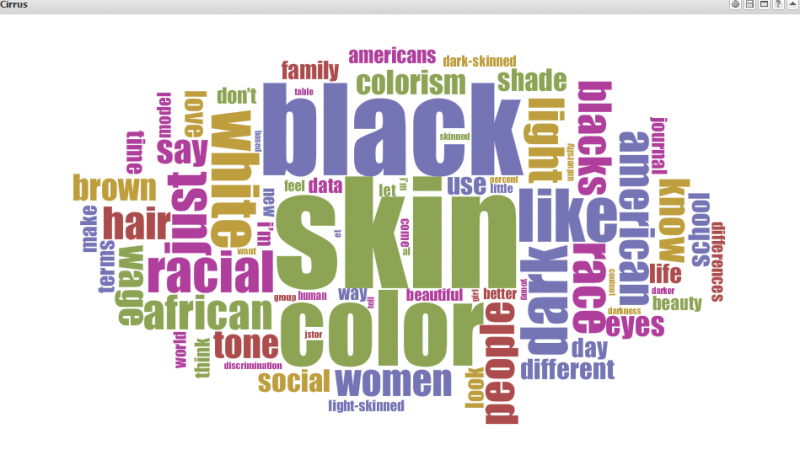
Voyant: My Digital BF
I used Voyant before and found it super helpful, but I really came to love it after the DSL text mining workshop last week. My corpus for this experiment included 5 academic research articles on colorism and a couple hundred poems about colorism. An initial question is simply, How do the two corpuses or genres of texts compare and contrast?
In general, the poems had a much lower word Density than the academic articles. The older age group of the poetry divisions only had a minimal increase in word Density (161.7 vs. 162.4).
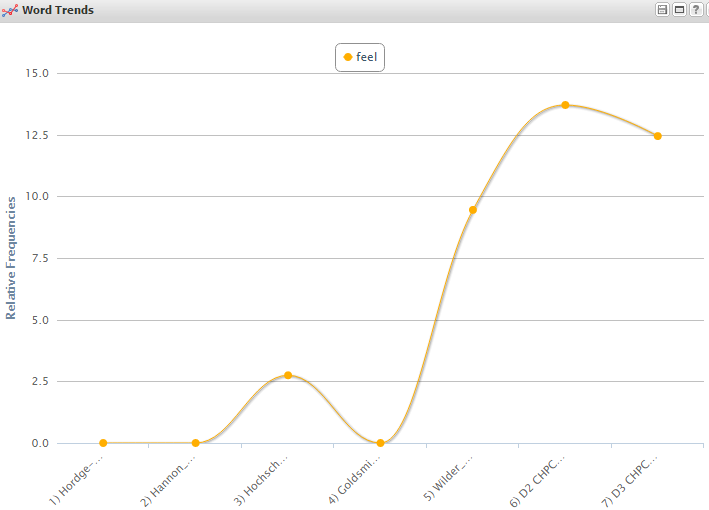
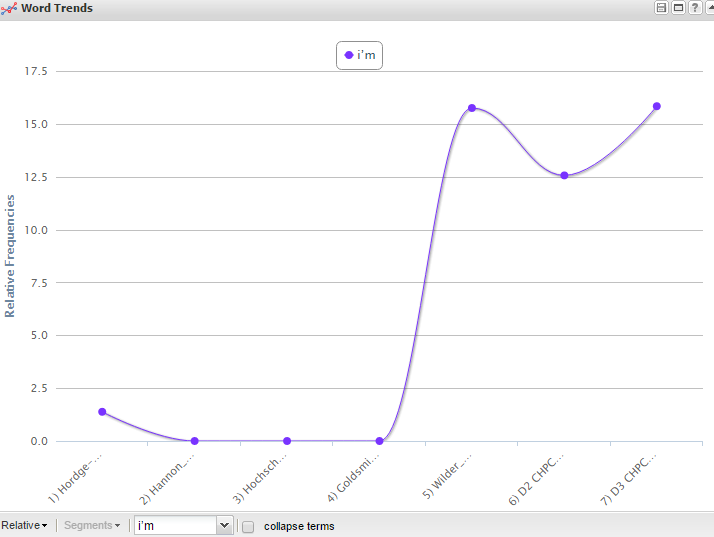
Notable peaks in word frequencies- “I’m” and “Feel” occur at significantly higher rates in poetry than academic prose (surprise!). Would this remain true in a larger sample of both academic and poetic works? Does it matter given the typical genre conventions of academic prose and poetry? I hypothesize that it might, especially if we don’t also see similar peaks in other similar words like “you” or “we” or other “feeling” words.
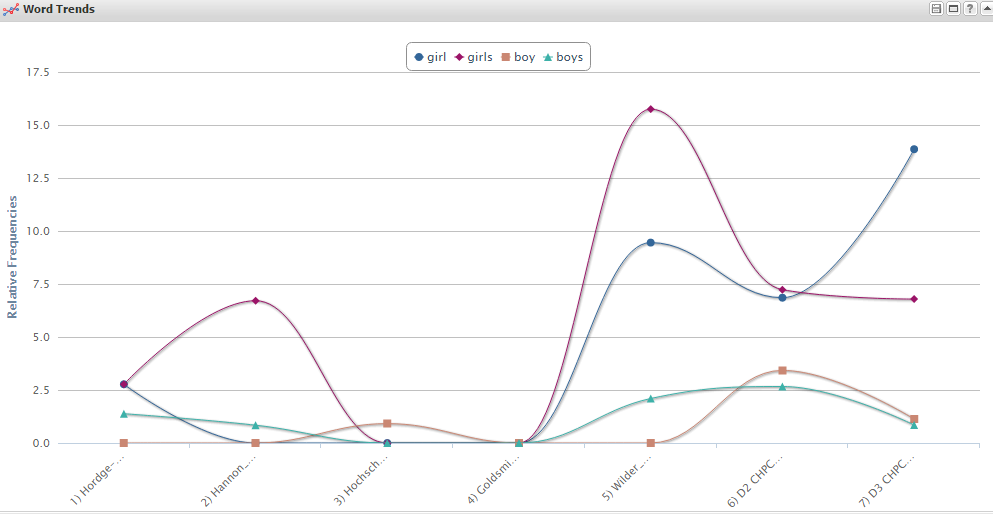
The terms “girl” and “girls” appear at much higher rates in the entire corpus than “boy” or “boys,” but particularly in the poetry. Why is that? Why a greater presence of Girls in general, but also, why in the poetry in particular? Would this finding remain unchanged if I tested the entirety of my collection of academic articles on colorism? Other data I’ve collected as well as plenty of data from other sources show that women and girls have a significantly higher presence in the colorism discourse, both as participants and subjects, than men and boys. Does the content of the poems illustrate why this might be the case? It might be interesting to focus on the instances of the words “boy” and “boys” since they are the anomaly in the pattern of female centric texts. Another interesting question to ask would be a comparison of the gender of the authors for academic vs. poetic texts. I could then also align that data with data about male or female subjects.
I often worry about confirmation bias when studying a subject I have such intimate familiarity with. Ted Underwood indirectly mentions confirmation bias, and I’m wondering to what extent does computer aided reading help to buffer against confirmation bias. As Fish notes, the element of surprise is very important in DH work. For me surprises in the data are sort of reassuring me that I am indeed mitigating confirmation bias. The level of familiarity I have with my topic almost necessitates an equally significant level of deformation made accessible by computer assisted reading in order to push myself to continue seeing and understanding new things.
HathiTrust: My Digital Frenemy
I have not yet completed my HathiTrust experiments due to technical difficulty. I spent hours to get the collection I wanted only to not be able to save it. (HathiTrust should allow you to store selected items without converting them into a workset. This would have allowed me to try and fix my technical glitch without having to go back and find all 37 of my texts all over again, which I had to do a few times.) I took some time finding an interesting topic with a rich enough data source to gather 30 interesting texts. I realized that part of the problem was that I simply did not know what sorts of texts HathiTrust makes available. After having no luck finding texts with the keywords most relevant to my research interests, I browsed preexisting worksets in order to see what kinds of data were possible, and I found one with a collection of 10 or so slave narratives, which is broadly related to my research. I was finally able to gather enough items using various searches in TITLE and SUBJECT with key terms +slave AND +narrative OR +memoir OR +autobiography. I found plenty of interesting texts and was quite eager to mine them, only to repeatedly get a message saying “system error” each time, even on multiple browsers on different computers. Now that I’m intrigued by this interesting collection of 3 dozen slave narratives, I still want to text mine the corpus. I have not given up on HathiTrust just yet. I emailed them about my problem and am awaiting their reply. I assume it’s something I’m doing wrong because I haven’t been able to find any discussion of problems like mine online.
Finally, I just want to note that I’m a huge fan of mixed methods.


UNC has a collection of North American slave narratives online that might be of interest to you – and they make it easy for you to download all of them as .txt files. http://docsouth.unc.edu/neh/ (see the “Download all…” link). Perfect for use in Voyant or Mallet (which we’ll talk about next week).