For the Voyant portion text mining exercise, I wanted to look at a sample of texts that range across a long time span. This was initially an idea prompted by grasping at straws (where does one begin, am I right?), but turned into a pretty exciting research endeavor, I think. For my corpus I collected 6 novels, fairly evenly distributed across the past 3 centuries, which directly address “insane” women. (Jane Eyre, 1847; The Yellow Wallpaper, 1892; Rebecca, 1938; The Bell Jar, 1963; Misery, 1987; and Girl, Interrupted, 1993). I thought this topic befitting to the exercise of text mining because female insanity – and the vocabulary surrounding it – inhabits such a burdened historical narrative. Moreover, this narrative is directly related to words. The concept of female insanity is embedded in a vocabulary (namely, the concepts of “wandering womb” and female hysteria as a medical diagnosis ) that has doggedly effected the way we understand female protagonists. So my experimentation with text mining was driven by the vocabulary of “hysteria”: how has it changed over time? Has it? How do these texts variously locate the source for insanity? In the mind or body? Have any trends emerged or receded since the mid 19th century?
With those research questions in mind, I found some pretty interesting trends, especially regarding the usage of the words “mind” and “body”. My objective with this concentration was to distinguish whether/how the ideology of female madness in fiction shifts from the 19th-20th century from the notion of a corporally-based madness to one located in the psyche. Here’s what I found:
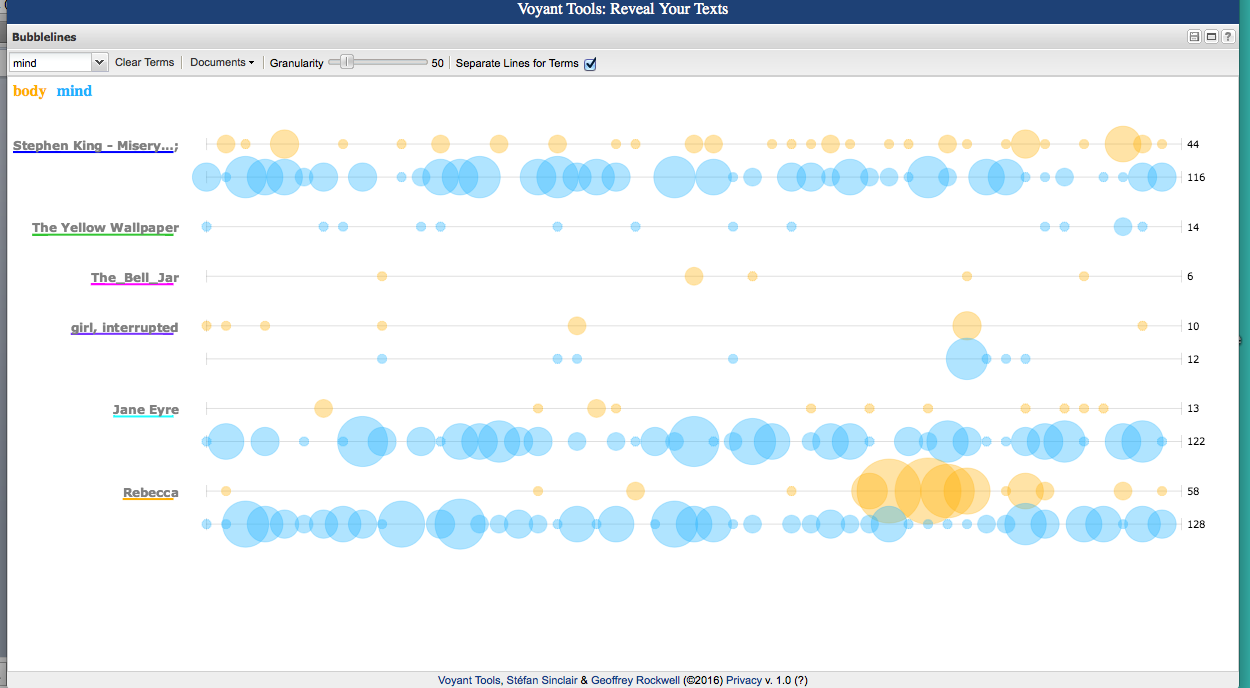
This chart is striking to me because it displays a significant absence of the word “mind” in the two works that deal most directly with the concept of a sick mind (The Bell Jar and Girl, Interrupted). I would have assumed the opposite to be true because these two are both first-person narrations of madness, but this data suggests that the idea of mental illness as located in the mind is incompatible with these types of narratives.
Another interesting trend I noted was the prevalence of proper nouns in the works published after In the latter half of the 20th c. By viewing the Cirrus word cloud for each document individually, there is a clear uptick over publication dates in the quantity of people’s names in Misery, TBJ, and Girl, Interrupted. If I were a gambler, I would be inclined to bet that this has to do with the increased association with social factors’ impact on mental illness.
But I’m not really a gambler….. honestly, at times, my experimenting with these tools felt like I was fishing (no pun intended) for proof of a hypothesis that I’d framed and then tailored my findings to prove. I think this is because of the labor (am I the only one?) of the process behind tools like Voyant. I think that there is something to be said (theoretically) for using tools that, do the work for you, like SEASR or Paper Machines, so we can see the results without having to curtail the text load as much. I’ll explain some of these tools in class during my presentation.
When I took this topic to HathiTrust, I wanted to use the workset to compile vocabulary used about hysteria in the early 20th century. This exercise eased my qualms about hypothesizing arbitrarily because there was a much larger corpus available for algorithmic investigation. I think the vocabulary displayed in the topic model top tags cloud is really telling if we think about the above frequencies of the word “mind” in the texts published in the early 1900s:
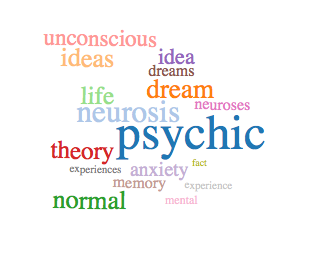
Obviously, this cloud is influenced by my workset’s inclusion of Freud’s writings; but all the same, I think there is something valuable about the use of these two tools in conjunction to paint a broader picture of the cultural moments whence texts emerge.

