Voyant
Dataset
I chose a set of Robinsonades (aka “desert island stories”) from Robinson Crusoe itself (1719) to The Blue Lagoon (1908). I confined my selection to novels and semi-historical book-length narratives set on actual islands which were written, translated, or adapted into more or less modern English and are available on Project Gutenberg. In addition, I found copies of Hatchet (1987) and The Further Adventures of Robinson Crusoe (1719) but chose to exclude them from this initial exercise because neither concerns stranded protagonists on an island. My full list of texts is as follows.
Robinson Crusoe (1719) by Daniel Defoe
The Swiss Family Robinson (1812) by Johann David Wyss
The Coral Island (1858) by R. M. Ballantyne
Godfrey Morgan aka School for Crusoes (1882) by Jules Verne
The Blue Lagoon (1908) by Henry De Vere Stacpoole
Research Question
My research question, which I hope to hone over time, is how the language of Robinsonades changed over the nearly 200 years represented by my dataset, and to what extent later Robinsonades relate on a textual level to Robinson Crusoe.
Results
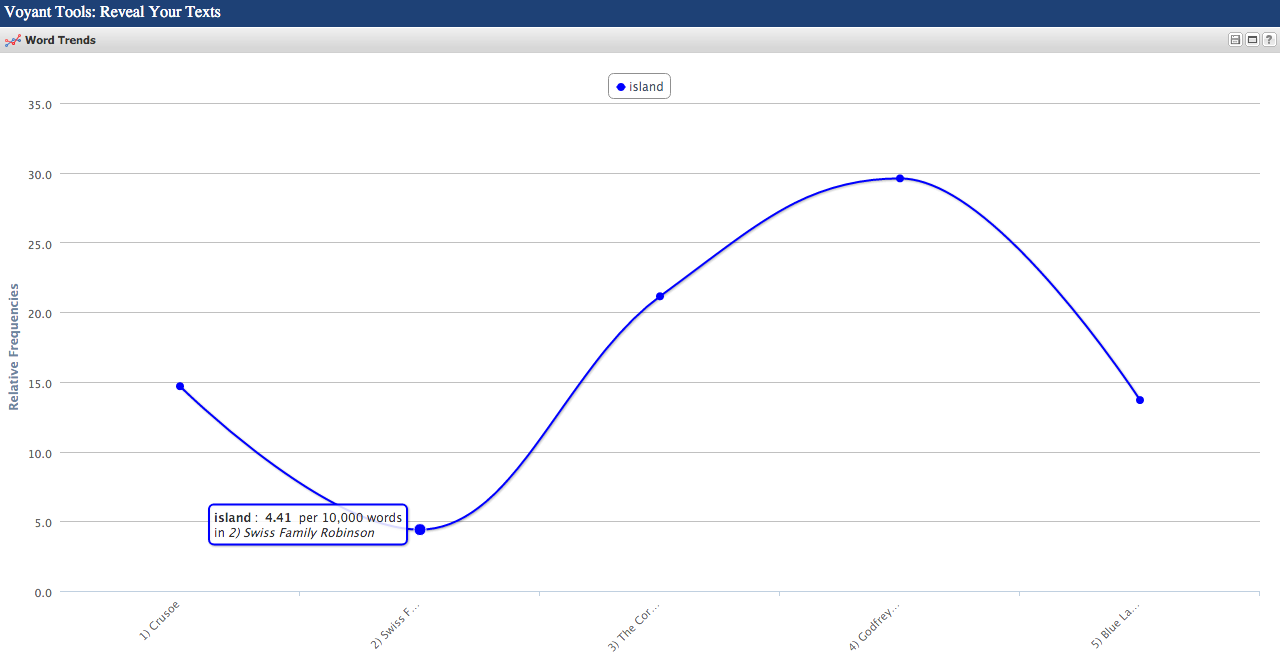
“Island” frequency across corpus (Word Trends tool)
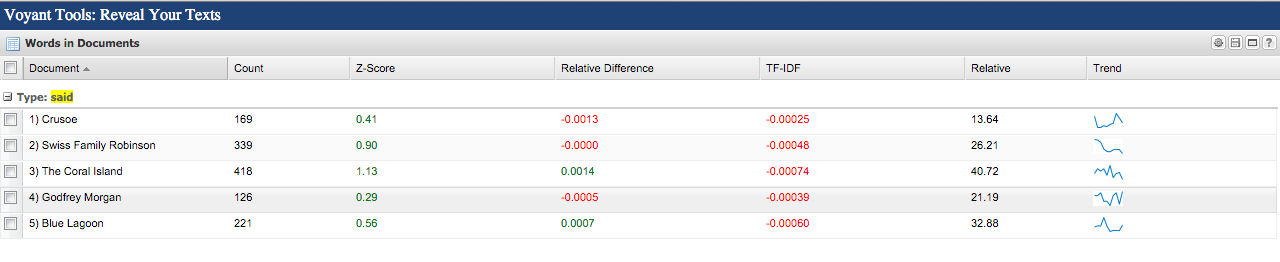
“Said” in corpus (Words in Documents tool)
Hathitrust
Dataset
I chose 88 works with the string “in words of one syllable” in the title. These were largely late 19th century British and American history books and “great works” of fiction for children.
Results
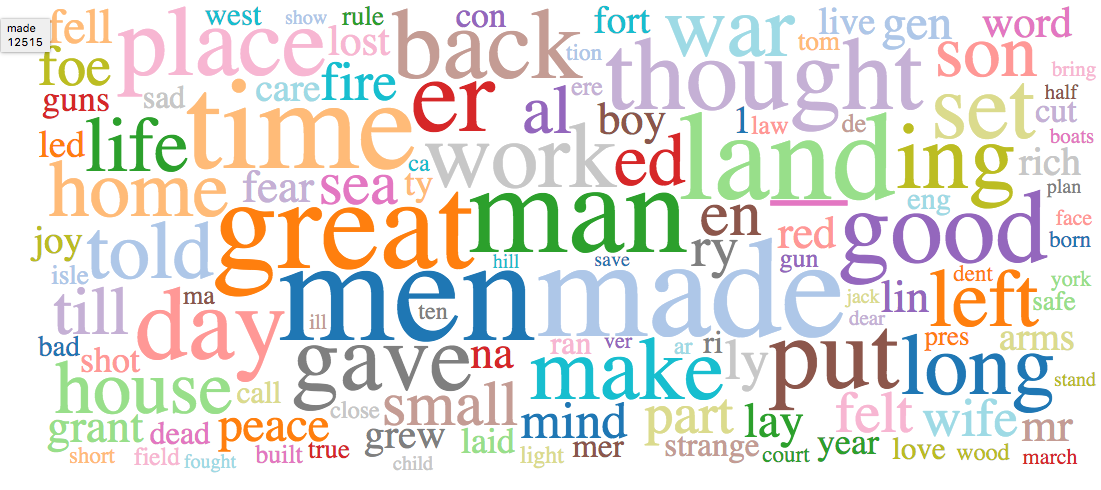
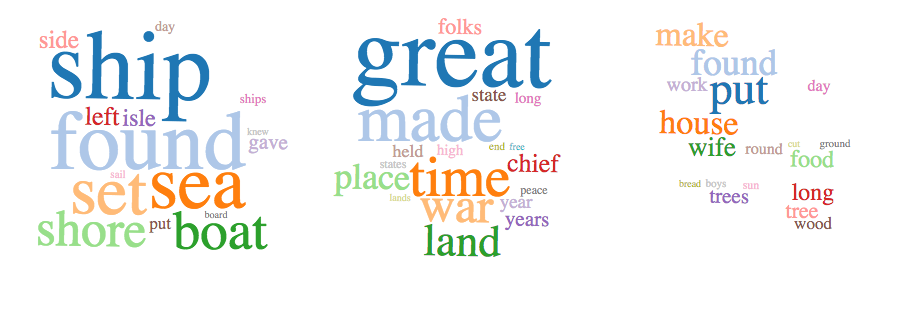
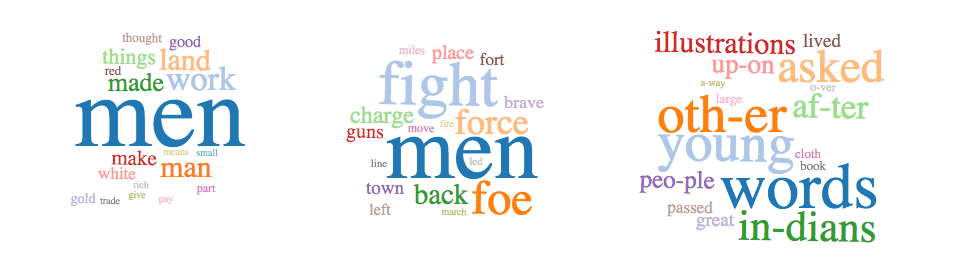
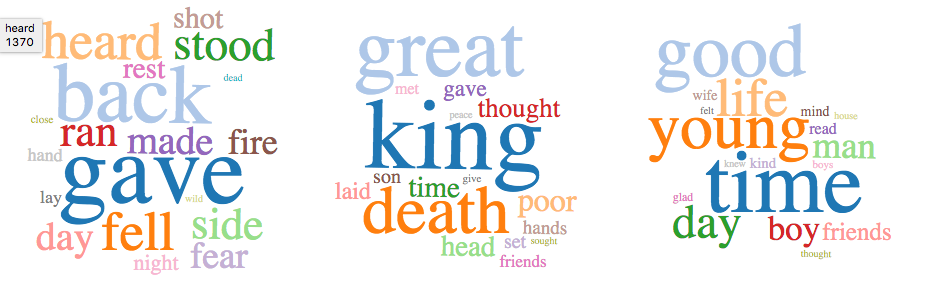
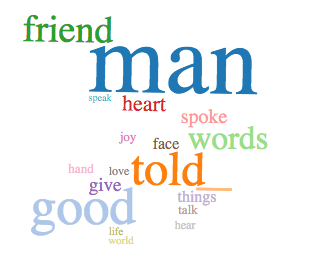
Overview
New Research Questions
One question that I hope to pursue is how subsequent editions of Robinson Crusoe, legitimate or otherwise, differ from the original over its very long publication history. For instance, I was able to find about a dozen versions of Crusoe on Hathitrust that had been abridged and censored for “little folks.” Crusoe, of course, has a long legacy of retellings, responses, and other derivative or related works far beyond the 5 Robinsonades I looked at in Voyant. I wonder what text mining could tells us about that legacy.
Reflection
I was surprised by how labor-intensive this processed ended up being. I had to change my corpus several times in Voyant before I found five texts that fit my criteria and worked well. I had hoped to use postwar texts but found every source that wasn’t from Project Gutenberg did not work very well in Voyant. As a student of contemporary literature, I find this troubling. I’m excited by the possibilities of text mining but would rather not wait 100 years to begin studying works in my field.
That said, I found these tools very useful. They allowed me to pose questions that I would have difficulty answering without them, such as “how important does this word seem to be in this particular book as opposed to the rest of a related corpus?” I was especially surprised and interested by what I didn’t find. Certain words that I imagined were prevalent and distinctive in various texts or across the corpus, such as “cannibal,” “Providence,” and even “castaway,” were in fact very rare, especially compared to words like “great,” “little,” and “time.” I think any critical tool that is capable of really surprising a researcher is useful—it gives us something to spark new questions, challenge our intuition, and allow new ways to look at texts, especially those, like Crusoe, that have been studied seemingly to death.


Your sense of generative surprise echoes Ramsay’s sense of play as a potentially “illuminating and useful activity” (Ramsay, “The Hermeneutics of Screwing Around”) which as we saw in this week’s readings is dismissed by Fish.
I am intrigued by the HTRC workset you built — and look forward to hearing in class about what is in this set.