The Faces of Evangeline

For this week, Caroline Fisse and I collected 10 of Howard Chandler Christy’s illustrations of “Evangeline” in both the Omeka Net and on Weebly, where we reflected on how we would build an ideal archive/digital collection!

We wanted to archive a 1905 ed of Henry Wadsworth Longfellow’s “Evangeline” except instead of scanning the text, we scanned the illustrations. This way we could analyze the visual representations of the poem.

Check it out:

http://longfellowsevangeline.omeka.net/

http://longfellowsevangeline.weebly.com/

Propaganda Materials

STEP ONE: Define the content of your collection.

I decided to create an archive of some of the graphic propaganda materials distributed for war efforts around the time of WWII. The first collection I compiled focused on the Malayan Emergency, a period right after WWII ended, when the Imperial British returned to Malaya and attempted to readminister the region. They were faced with insurgency from the guerrilla Malayan Communist Party (MCP). Many of the propaganda materials distributed during this time focused on vilifying the MCP, cajoling the MCP to surrender, and threatening the citizens to turn in any known MCP around their regions.

http://propagandamaterials.omeka.net/


STEP TWO: Build your collection

While Omeka wasn’t fairly self-explanatory as a tool, I found that it wasn’t very intuitive or time-saving in terms of building a collection. Since my collection focused on images and posters, many of the fields could have auto-populate previous answers (just as the “tags” box autopopulate previously used tags) in order to streamline the categorization. It was difficult to ensure uniform language across every field in every new item I added. I did like the simple interface and straightforward language presented by the free version.


STEP THREE: Explain alternatives

The free version of Omeka felt somewhat archaic or constricted in comparison to free WordPress, Weebly, Tumblr, etc, many of which could have probably easily taken the place of Omeka for the purpose of building a simple collection. (Omeka’s more complex offerings might be useful for more advance archive-building or collaborative work). WordPress is sortable/searchable through tags and metadata as well, and WordPress’s interface is a lot more customizable, with a bigger collection of free themes and tools. I can see the mini archive I built through Omeka presented beautifully in WordPress as well (with every ‘collection’ presented as ‘pages,’ for instance). I wondered too about the function of building archives in general, if it’s a holdover of presenting curated materials through a sort of ‘objective’ lens (even after now that we know to be never the case) (for instance, my voice, when filling the “description” box, took on an uncomfortable unsituated/unpositioned/disembodied voice), and how might DH–as a field that purports to revolutionize the humanities–take that into account and consider alternative methods of curation that goes beyond categorization.
The Multimodal Occult — Shannon and Jeremy

Shannon and I created our Omeka archive collaboratively. We framed it around the occult, which we will talk more about today in class! Here is the link: Multimodal Occult.

 
Our project has many facets, which we bring together through historical trajectory and important occult connections. But, another way to go about this would be to create a social media page where we follow certain groups, and share their posts. Tumblr works especially well for webcomics, whereas other resources might be more inclined to have facebook pages (such as the poetry journals). We could create a different social media platform for each section of our website, and then post links to them in that section of the archive. This way, we create a foothold in larger unfolding conversations, and generate a diverse field in which to interact with this scholarship and art through a social media platform. Does anyone have any other useful social media platforms which our site might work better with?

Humanities Amped Collection

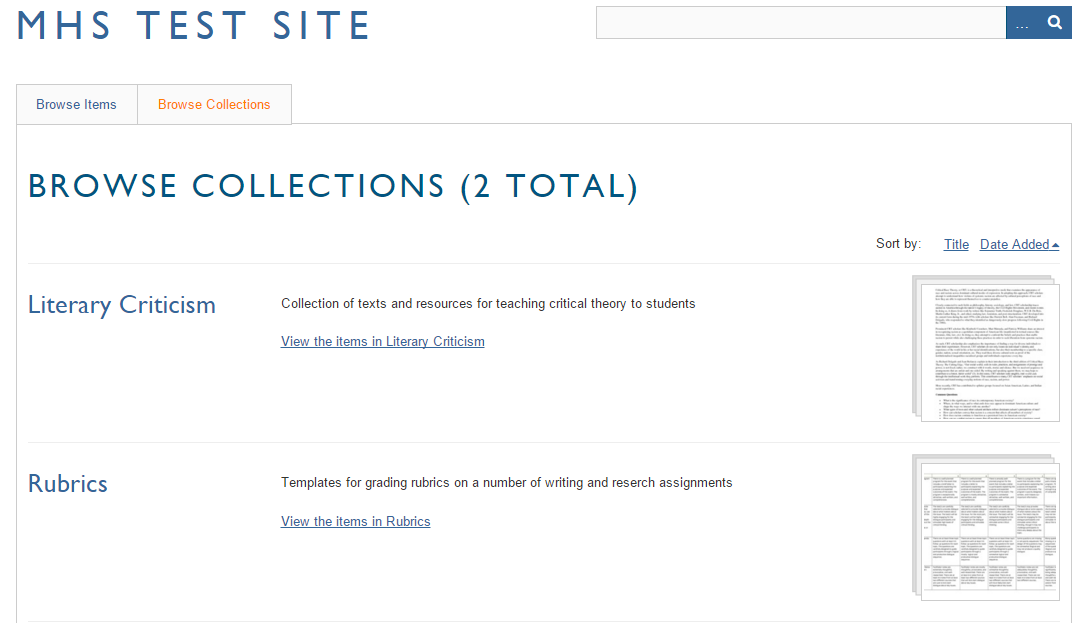
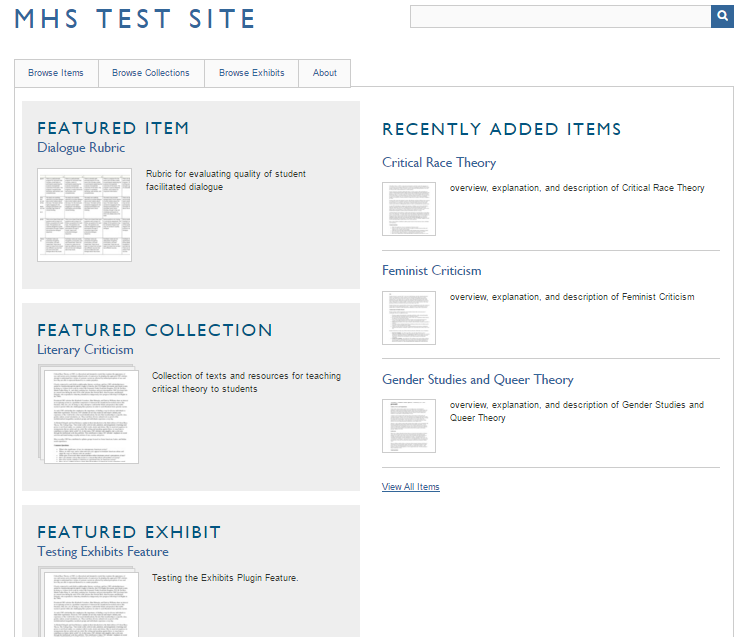
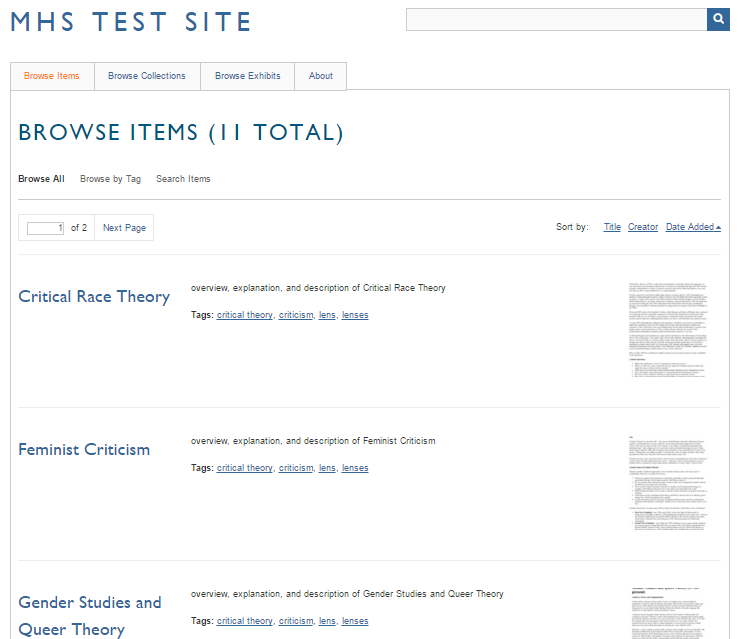
I’m collaborating with teachers and students of Humanities Amped at McKinley High School to organize (curate? present?) the educational resources they’ve created or accumulated over the past couple of years. One of the primary concerns they have deals with framing and narrative. The reason I can’t post a live link is because my partners aren’t comfortable making an incomplete site public, particularly while they’re still in the phase of deciding exactly what this project should be. In order to get a better since of how Omeka might work for them, though, I’ve taken some of their files and created a “test site.”

MHS Test Site Items screenshot


MHS Test Site screenshot

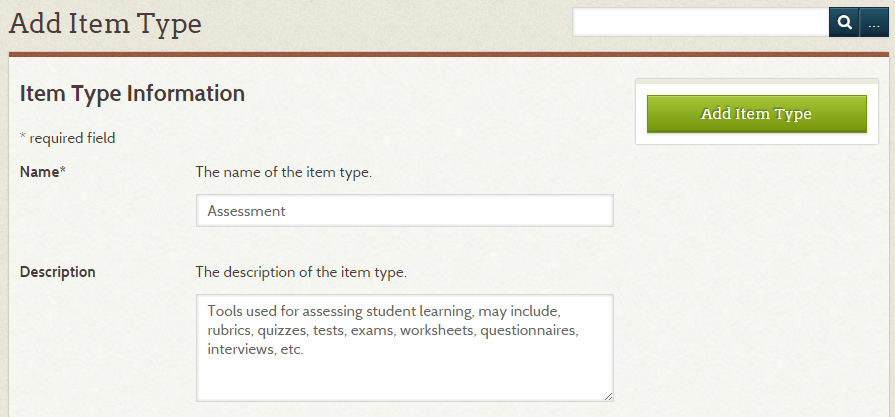
Omeka Add Item Type screen shot

Omeka could be useful for the MHS-HA project because they can gear it toward practical organization and access (I need a rubric to grade x assignment), but they can also use Exhibits to highlight the theoretical underpinnings of the Critical Pedagogy and Participatory Action Research that drives all of their work and resource creation.

An interesting alternative to Omeka is Zoho. The obvious limit is that Zoho is not free, but it is extremely affordable. I’m currently using it for a database on my blog. The reason it’s useful is because rather than the collection model Omeka uses, which imposes a rigid organizational structure, Zoho allows for the flexible table model that removes some of the organizational burden off of the curator and allows users to organize the collection according to the metadata they deem relevant or important. This approach also allows curators to build collections more quickly.

Günter Grass Omeka Collection

Continuing from my last foray into the digital humanities, I decided to collect ten interviews with Günter Grass conducted by various groups and individuals throughout his career. I gathered these sources, but was unable to upload HTML files, so they are provided as hyperlinks. The short-term goal of such a collection is to create central online space for Grass resources. However, it doesn’t seem that Omeka is the easiest or most accessible way in going about this due to Dublin Core’s unintuitive nature and the lack of certain formats supported by Omeka.

Interestingly enough, an open source entity like Zotero seems more appropriate given the textual nature of this project and the very intuitive nature of Zotero. However, Zotero is not anywhere as “public” as Omeka. As such, if one could take Zotero’s functionality and WordPress or Tumblr’s presentability, this could be a great boon for digital collections projects for many scholars.

Link: http://herecomethesnails.omeka.net/

Undergraduate Doodles

Hello hello,

So I made a digital collection of doodles I did in class during my freshman year of college. In the description of each doodle I tried to situate the works relative to the critical tradition that has grown up around them while also respecting popular reception.


Ici: http://doodlezolot.omeka.net/


Andrew, artist, digital humanist, digital art human


Polyglot Sources for News Articles about Freya Stark

Intrepid: Freya Stark in the News

My main goal was to create a news archive containing contemporary information about the life and work of British explorer Freya Stark (1893-1993). I wanted the archive’s materials to be a) free for the casual researcher, b) digitized, searchable images, c) displayed in their original contexts, and d) irrespective of source language. There are hundreds of articles about Freya Stark online, but most of them are hidden behind paywalls or subscriptions, and simple Google searches in English fail to turn up articles written in other languages. Since Stark was a polyglot nomad, I think it’s more fitting for researchers to be able to read about her in several languages instead of one.

A thought: I wasn’t able to upload any source that doesn’t use a Latin alphabet (my limitations, not necessarily Omeka’s), nor could I decide whether or not I should include tags in respective languages for foreign articles. I decided to stick with English, since my metadata is written in English, but, in the future, I would like to think of ways to tag effectively in several languages at once.

Here’s my final Omeka project.

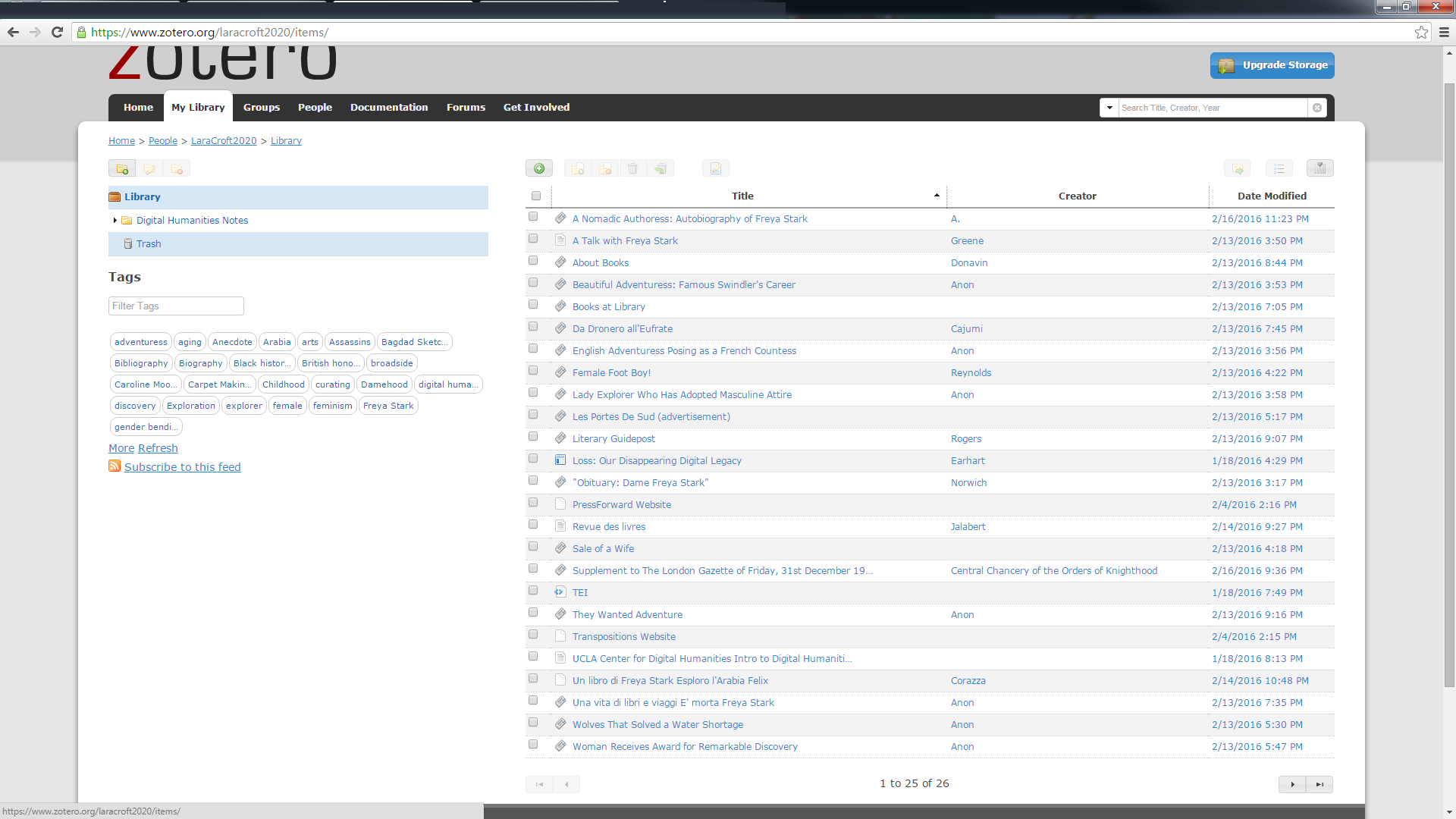
My second, alternative archive is simply my Zotero collection, which I used while building the Omeka archive. It’s not visually impressive, but using Zotero to catalog sources made writing metadata so easy. I’m hooked on it now.

Here’s my Zotero collection. (And a screenshot of it below, for those who aren’t Zotero users.)

Zotero SS


Let’s Play to Learn

maxresdefault

Click here to access the archive

Overall, I enjoyed the ease of access and overall structure of the Omeka platform. However, given the subject of my archive, it is probably not the best choice of platform, since I could not figure out a way to embed a video from YouTube, and had to resort to linking each channel and playlist via hyperlink. But even if embedding videos would have been possible, I still think WordPress would have been the better host for my archive. (I did not have time to create this archive, unfortunately. Because Minecraft Educators are spread out to numerous social media platforms, and do not tag their videos consistently, finding the materials was half of the battle….hence the need for an archive like this!) My ideal platform would be a combination of Omeka’s sorting system and interface, and WordPress’ embedding platform and comment integration. The latter is something I was especially disappointed to see Omeka lacking, since for a DH/Game Studies project like the one I was attempting, feedback from others is the best way for potential new items to be discovered.

css.php