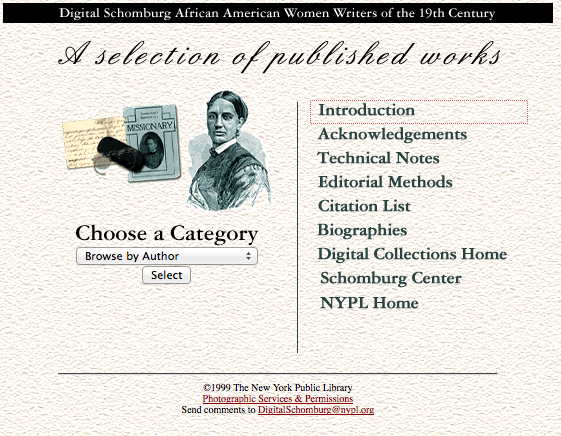
Thinking about the issues of access and presence of a “feminist” archive as proposed by Jacqueline Wernimont led me to thinking about, obviously, what actually counts as feminist scholarship in the digital humanities. The idea of content, though important, is too “murky” to be a primary criterion when looking at feminism within DH. So projects like WWO, though of course laden with content by women, is generative of new ways “to probe women’s literary history”. With this concept in mind, I found New York Public Library’s archive of African American Women Writers of the 19th century (http://digital.nypl.org/schombu/writers_aa19/toc.html). The homepage pictured below advertises a selection of published works; but works by black authors were widely unrecognized and invisible before the civil rights and black power movements of the 1960’s, and even then these works were largely “by and about black men”. This archive seeks to simultaneously acknowledge this history of silence and to put forth materials that can generate new understandings of the lives and thoughts and perspectives of black women in America prior to 1920.
In Tara McPherson’s article, she discusses the concept of fragmentation, the separation between digital humanities technology, and the ongoing political, social, racial, gendered, etc. conversations essential to understanding the climate this digital technology is produced within. Essentially, history stratifies into linear, bifurcated storylines that focus on only one aspect of the construction of our world, and the construction of our digital humanities projects/tools.
http://maps.e-diasporas.fr/index.php Today, I found a mapping system of diasporic communities in a university’s award catalogue for the digital humanities. This project looks, in terms of structure/design, like something that we might produce by the end of this class (in the sense that it’s not exactly polished or complete). And so, I thought to analyze how this system plays into McPherson’s view of fragmented reality, in an attempt to avoid that pitfall in my own DH project construction. I hope to discuss the problems with globalization, DH focus on complicated tech (as opposed to content, accessibility, etc), and the importance of context in our seminar conversations.
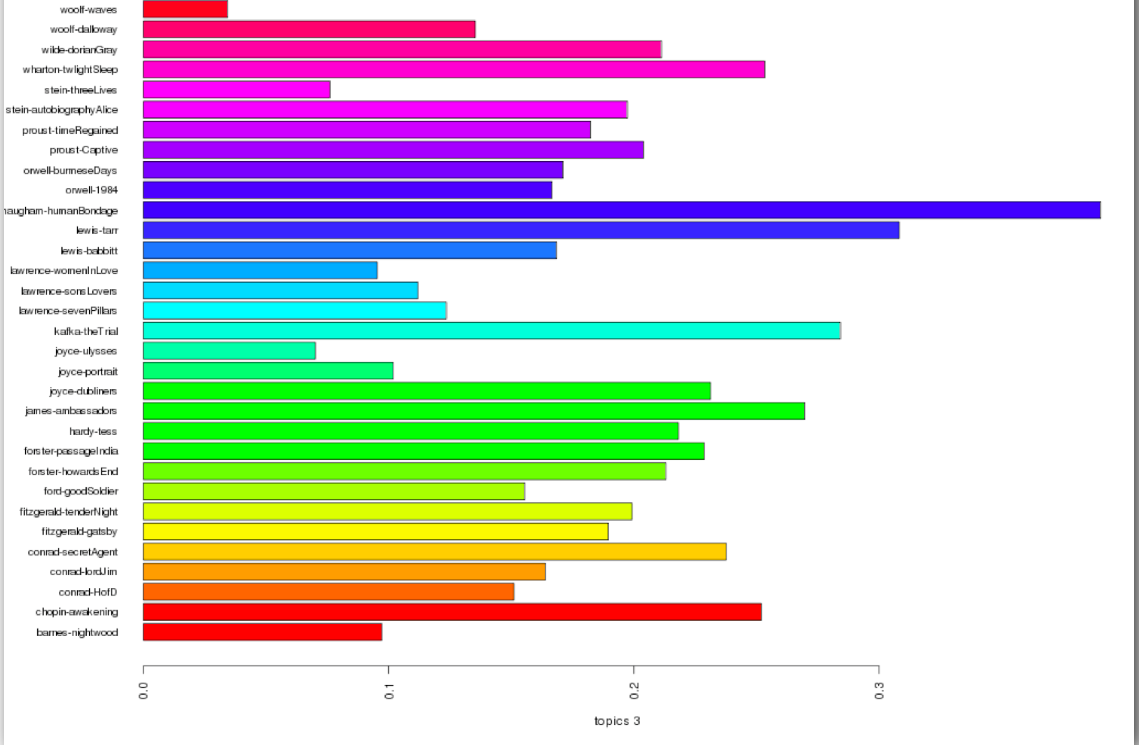
Looking through the DH Resources for Project Building, I found a project through the Maker Lab at University of Victoria, where Jana Usiskin along with the Modernist Versions Project and the Maker Lab developed an interested research program for tracing themes in modernist literature. They describe the specific computing process (topic modeling) for generating their results here: “authors create documents using collocated clusters of words. By working “backward,” computer algorithms sort the words from a set of pre-processed documents and generate lists of words that comprise these clusters. In our work, we are using the LDA (Latent Dirichlet Allocation) probabilistic model. This rather popular model operates on the Bayesian method of inference, a mathematical concept that works backward from an observed set of data to calculate the probability of certain conditions being in place in order to produce that set of data. In other words, it depends on a notion of causality and asks what circumstances need to be in place in order for certain results to occur.” – See more at: http://maker.uvic.ca/mmm/#sthash.6LS1zN2w.dpuf
The graphs generated were interesting in terms of what themes they were able to quantify based on the word clusters. They describe the algorithm as “interested in finding the topics that can be used to correlate all the texts as well as the topics that can be used to distinguish between individual texts.” – See more at: http://maker.uvic.ca/mmm/#sthash.6LS1zN2w.dpuf.
So the project is searching for recurring themes throughout modernist literature in order to show the similar trends in subject material through clusters of words. The resulting charts focused on temporality displayed in three separate graphs: “temporality past,” “temporality embodied,” and “the temporality of place.”
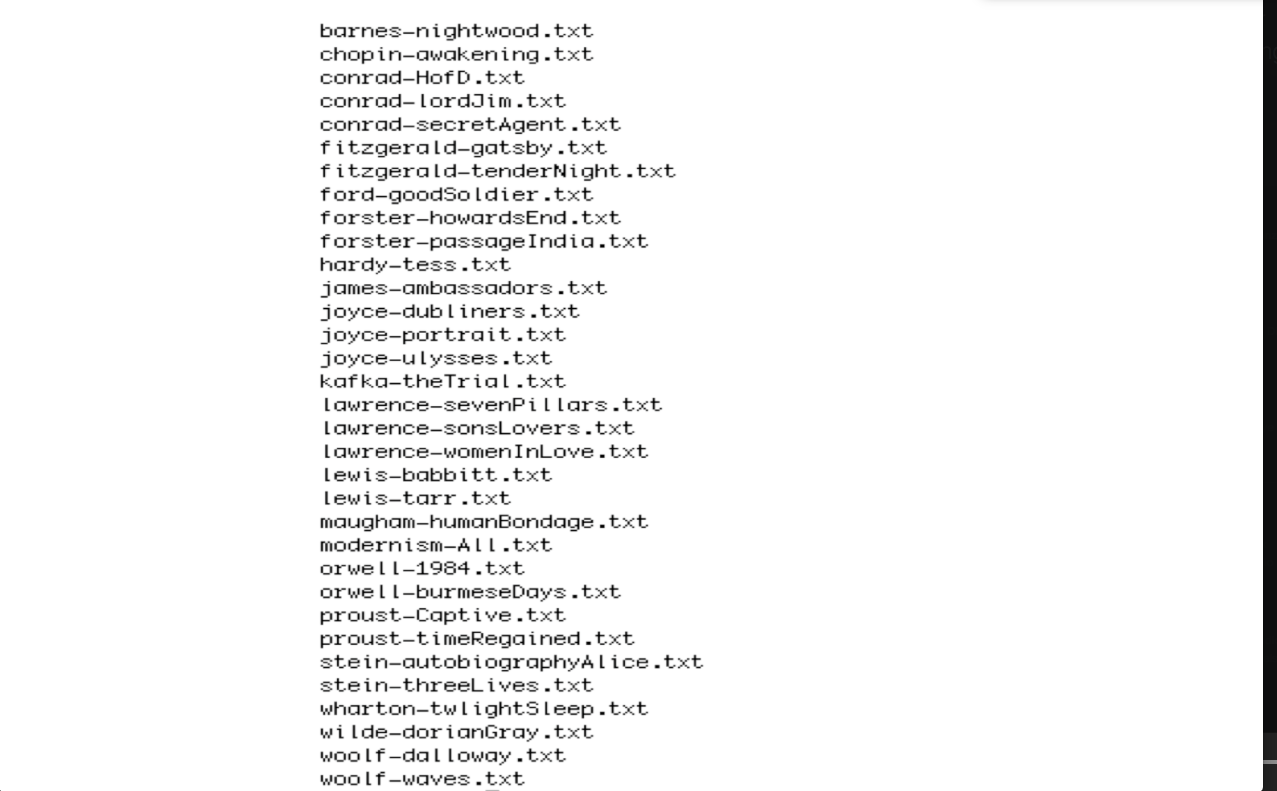
So after reading the basic overview of the project and somewhat understanding their methods, I was a curious about how and why they chose the texts that they did. They admitted to having a narrow selection of 32 modernist texts.
And this is project is a preliminary study using the methods described above. However, I was curious about why these authors. Mcpherson mentions the whiteness of digital humanities, and all of these authors are white and predominantly men. But the topics of temporality would also apply to writers in the Harlem Renaissance, particularly Nella Larson and Langston Hughes or Jose Garcia Villa. They did include quite a few queer authors (Virginia Woolf, Djuna Barnes, Oscar Wilde, and Gertrude Stein), but I was curious if this project were to begin to think about what McPherson outlines and argues in her essay on the whiteness of DH, then where could their research approach take critical race studies in modernism through a DH project? How might they outline racial politics evident in the modernist texts using a similar study?
Yale’s “Robots Reading Vogue” highlights some experiments done with the Vogue Archive, which is fully digitized and marked up as both text and images. I assumed the site would brand itself as feminist, or at least explicitly political, but the archive and project is framed as fairly neutral.
Can we consider this a feminist project anyway? I think so–an undertaking like this assumes that a women’s fashion magazine can provide significant cultural insight. It also functions as Wernimont’s “‘testbed’ for digital humanities tools and technology.” Many of the experiments highlighted on the site reflect Wernimont’s idea that a test bed of women’s writing reveals “invisible effects of gender in tool making.” Topic models show the prevalence of political topics vs. beauty topics. N-gram searches suggest patterns in discussion of women’s health. Image averages provide a visualization of beauty standards.
We could, however, question whether Vogue really constitutes “women’s writing.” It is certainly for women, but I am not sure about the gender make-up of the editors/staff.
My focus this week turns to a brief comparison between two digital resources on the 19th century American philosopher, William James. One of the popularizers of the Pragmatist school of thought, James’ writings have been applied to questions of social justice in the 19th and 20th centuries, most notably by the philosophers and social activists, W.E.B. DuBois and Cornel West. The reason I wanted to look at these two archives is twofold: one, because many of the readings for the week, particularly the Earhart and Wernimont pieces, explicitly deal with issues of race and gender in digital spaces and the discussions this phenomenon brings about in terms of canonicity and institutions. One of these archives is hosted by the University of Kentucky, the other by Harvard University.
William James, Image Courtesy of Wikipedia
Earhart’s piece relates to these two archives insofar as questions of race and canonicity are concerned. James, a white man, was by training a logician, psychologist, and philosopher, whose writings, while not explicitly about race, could be applied to certain questions of the experience of race as they relate to questions of perception and experience. To James, individual experience and what he terms “common sense” constitute the construction of truth – thus, black writers such as DuBois West are able to apply James’ writings in new contexts, in racial, as well as religious dimensions. In a word, James is usually seen as an unmistakable member of the philosophical cannon, whose importance in contemporary philosophical discourses is not brought into question. Yet, the works inspired by James are typically not brought to the forefront. This is very much reflected in the Harvard James archive, which, while containing more exclusive material such as correspondences and manuscripts, does not discuss James in broader discussions relating to race, class, or gender.
What’s striking is that the non-Ivy league resource (the one from Kentucky) is much more inclusive in the sense that essays in the Pragmatist traditions are linked to and discussed. Moreover, works by James on aboriginal peoples are more prominently displayed. Yet, conversations of contemporary political importance are not highlighted. This is partially due to the lack of updates to the site, but due also to the institutional limitations and the unconscious use of an exclusive cannon that Earthart mentions.
For my post, honestly, I had no idea what project to pick so I picked two.
In my exploration of digital humanities tools and projects, I wanted to find projects that dealt with the concepts of transcendence and what it means to not only be human but to be a “digital” human resonated with me the most would mean, and to me, this would mean being connected and understanding networks like Katherine Hayles states, “Information, like humanity, cannot exist apart from the embodiment that brings it into being as a material entity in the world” (49). I wasn’t sure if we could as Wendy Hui Kyong Chun states, “transcend the physical limitation of your own body” (6). So, I wanted to find projects that had networks or created connections, tried to transcend the physical body, and/or challenged the “canons” because I think if we are more connected then we would not stand for only one perspective.
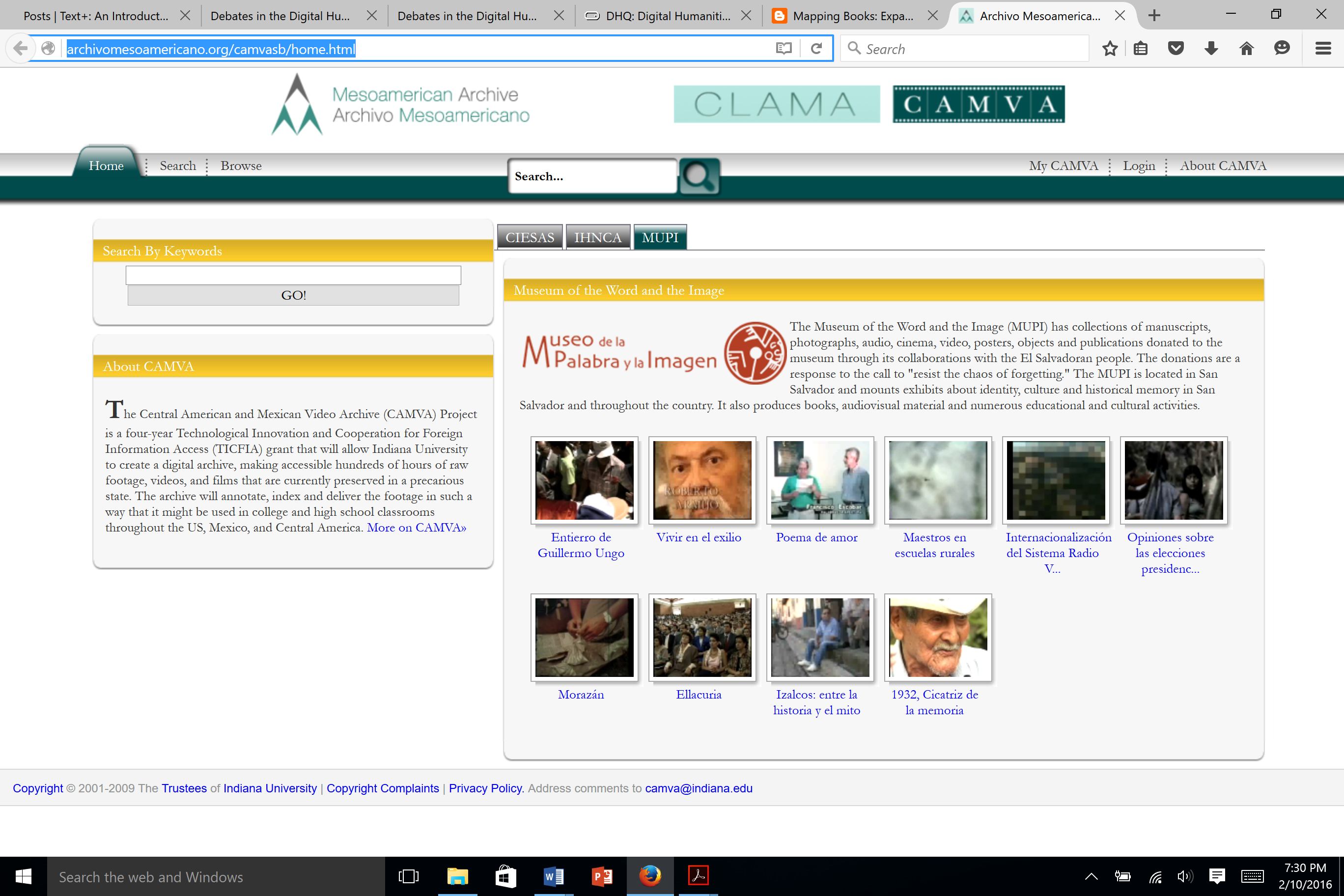
I first chose the Mesoamerican Archive because it is trying to preserve memory, particularly video and audio, to inspire cultural activities and to tell their narratives, perhaps even foster connections with others who are outside of this network but still interested in it. Additionally, ironically, this embodies the idea of literally transcending the physical body by preserving a representation of the physical.
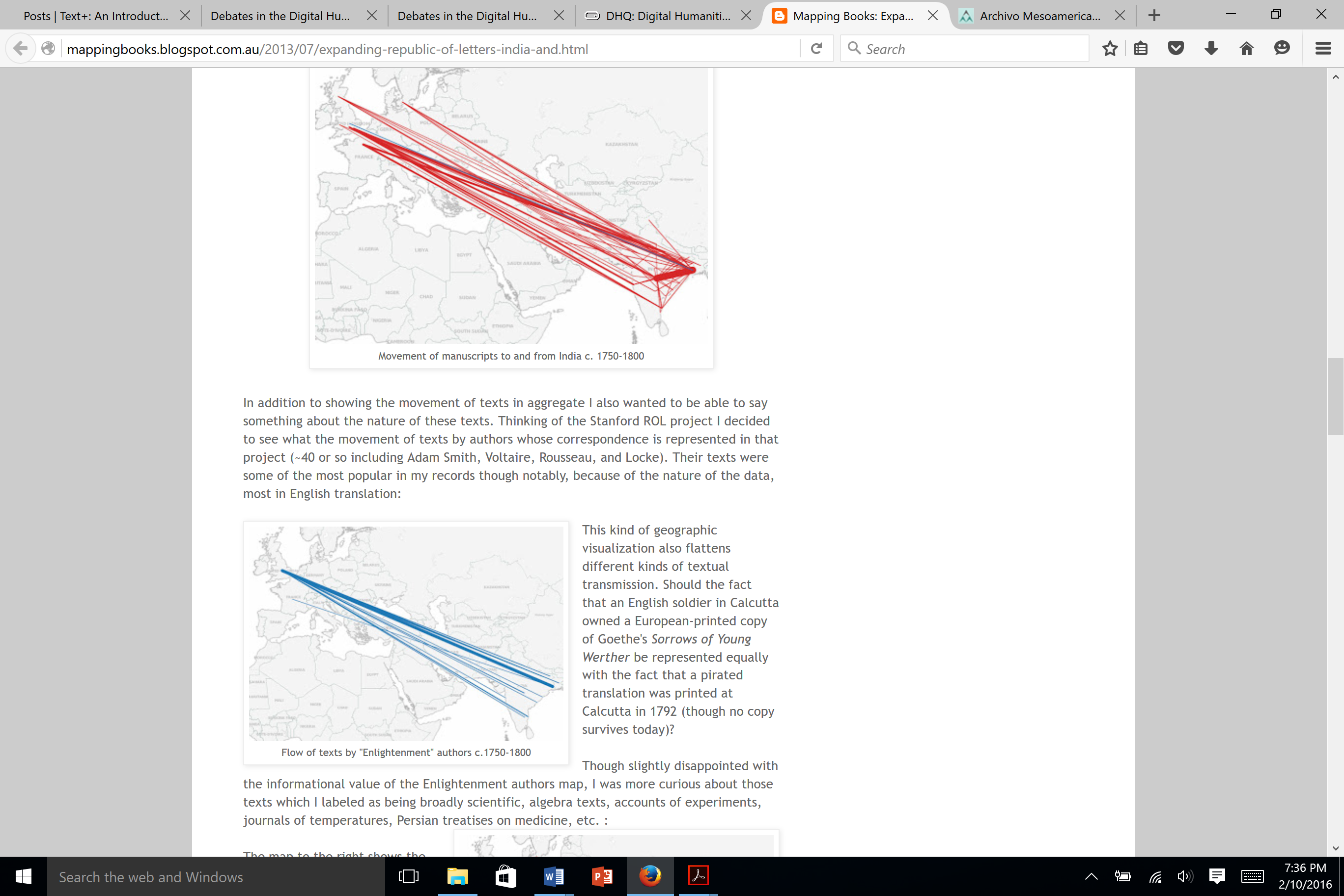
I also found a really cool project/article that connected with Mapping the Republic of Letters! Mitch Fraas created Expanding the Republic of Letters: India and the Circulation of Ideas in the Late Eighteenth Century to include India in the Republic of Letters! I thought this was cool because he is working outside of the canon but also enhancing a project by pointing out other parts of the network that were left out!
And the end of Mitch Fraas’s article fit with this week’s readings as they examine what we archive and earlier readings about being self-aware and self-critical: “At the end of this stage of work I realize just how central absence and omission are to any visualization of historical information. No matter how much I tried to “fill in the gaps” my visualization remains constrained by data available and historical uncertainty and I’ve come away knowing that while I may have added a useful addenda to the vision of the Enlightenment that ROL offers, it is far from complete and perhaps offers its greatest value in forcing us to ask what is missing.”
I’ve been looking at Stanford’s Spatial History Project. They have many teams working on various projects that fall under the “spatial history” umbrella. Most of the projects take “spatial” to imply “geographical,” and some of the visualizations and subjects are enthralling. I’m looking right now at a visualization of the Rio di Janeiro slave market in the 1860s. Small purple dots represent the distance a given slave was forced to move as a result of being sold. Seeing a mass of dots rearrange across the city (or zoom in from off-coast, off the edge of the map, I assume after months as cargo in some ship’s hold after being kidnapped from their homes), reinforces a central problem with McPherson’s essay’s implied metaphor of social consciousness as societal operating system—that computer software is a dense layer of abstractions rooted in the fixed or changing states of binary logic gates, while a social construct has, at root, human lives. The visualization of the slaves’ movement is visually similar to watching electric flows in an educational video about circuits, transistors, computer chips…but I feel something watching the slave trade visualization because there is genuine human meaning underneath. I had a lot of problems with McPherson’s essay, but this might sum it up best. I think her comments about modularity and computer systems are uninformed, all surface, and cheapen both social criticism and computer engineering—in the former case because social life is ineffable, complicated, imbued with human significance, and not easily wrenched into service of vague metaphor; in the latter because the dizzying complexity and imaginative feats and pansocietal efforts that comprise the history of computer development are disserved by essays that avoid seriously grappling with their technical and historical elements.
The Spatial History Project also brings to mind an inherent tension in Earhart’s essay. It’s hard to put in words, but I think it has to do with an impulse unique to our digital moment. The impulse is to aggregate and preserve cultural documents and artifacts with the aid of developing technologies that are only in the last couple decades really approaching the sheer memory capacity to allow such work to be done exhaustively. The tensions are weird. One impulse is to preserve as much as possible before pre-digital texts are lost to decomposition, misplacement, and misadventure. This impulse implicitly acknowledges that cultural artifacts are limited and being lost. But it is just as true that we are developing technologies that can digitize in new ways—new software and new digital approaches themselves constitute new artifacts to create and archive. What we can do with new software is limited more by imagination than the amount of data—so when I see something like a visualization of a city’s slave trade, I’m pressed to ask of Amy Earhart how we choose not only what we install in new canons (literary and otherwise), but how we install them, in what form, by what criteria do we decide. Is it enough to elevate neglected writers to parallel status with “great men,” or should we create new methods for analyzing and representing their work that has nothing to do with the way we treated writers in the past? Should there be parity in form or bandwidth share, or both? Should there be no parity? Does parity mean anything in the virtual landscape? There is both not enough and too much to ingest and put out, too few inherited structures privileging historically dominant hierarchies and too many options for moving forward. It seems that in such an environment the focus shouldn’t be constructing a new canon but promoting the idea that there is no canon, never has been, never will be—there have been institutions promoting and laying claim to canons, but they were speaking more loudly, not more truthfully. Replacing their hegemony should be an anti-hegemony. This runs up against the question of whether anarchy is the only thing that can truly replace racist/sexist/other hierarchies…and I don’t know.
Michigan State University has a very cool “center for digital humanities and social sciences” called Matrix. Matrix is quite interesting because it features significant archival projects on African and African American studies, namely the American Black Journal and the African Activists Archive. In this regard MSU’s Matrix relates to Earhart’s comments about the digital cannon: “In digital humanities, however, we have much theoretical work to do in the selection of materials and application of digital tools to them.” However, in looking at the racial demographics of the Matrix team, I ask the same question as McPherson: “Why are the Digital Humanities so White?” But I ask this question more directly than McPherson’s article articulates: Why are DH teams, conferences, meetings, etc. filled with all white people, even when the subject matter is “documenting history from African American perspectives.” Can it really be from an “African American perspective” when the digital storyteller/curator/narrator/coder/programmer/archivist (alluding to Hayles) is not African American? We have to acknowledge and critically consider our positionality, even for something as seemingly innocuous/objective as compiling image files and creating hyperlinks. The digital divide is most apparent in who has transformativeaccess to digital tech, and it’s most apparent in these Matrix photos. I hope the people in these photos and the folks of DH more broadly are as disturbed by the racial homogeneity of this space as I am.
The Nicest Kids in Town, alsopowered by Scalar, traces the realities behind Dick Clark’s claims that American Bandstand was integrated in 1957 through examining the early use of color-blind rhetoric in texts, news interviews, and other media, to maintain racially discriminatory policies, thus engaging with the intersection between technology and color-blindness brought up by Chun and McPherson’s articles.
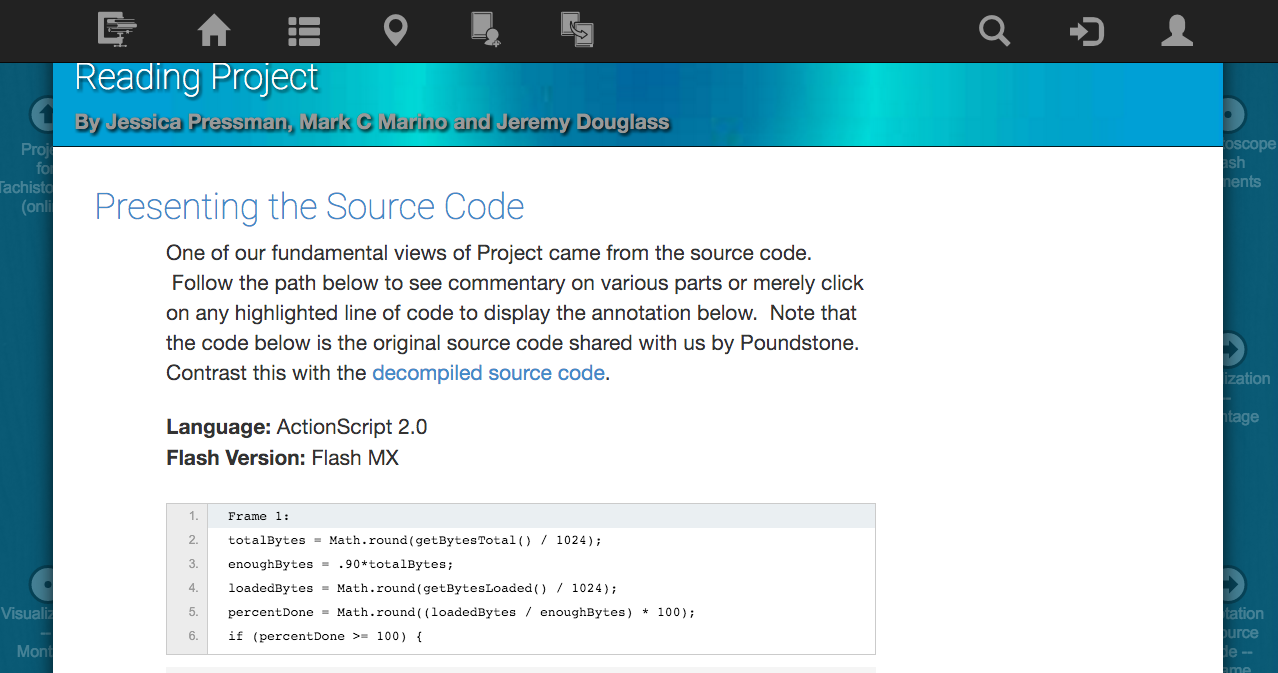
The ACLS Workbench is a platform powered by Scalar for the creation and publication of born-digital collaborative projects (“books”) in critical code studies. It has four main features: users can view, clone, join, or create a book. In addition to Scalar’s standard multimedia features, the ACLS Workbench allows users to annotate source code. More information is available here.
P.S. Another interesting thing I found is a book called 10 PRINT CHR$(205.5+RND(1)); : GOTO 10. According to the website, “this book takes a single line of code—the extremely concise BASIC program for the Commodore 64 inscribed in the title—and uses it as a lens through which to consider the phenomenon of creative computing and the way computer programs exist in culture.” If you go to the book’s website you can find links to purchase the book, as well as a free PDF provided under a Creative Commons license.
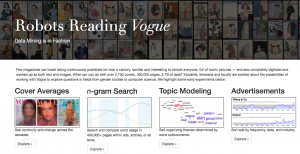 Yale’s “Robots Reading Vogue” highlights some experiments done with the Vogue Archive, which is fully digitized and marked up as both text and images. I assumed the site would brand itself as feminist, or at least explicitly political, but the archive and project is framed as fairly neutral.