Reading Access through Historical Artifact

People of Color in European Art History (http://medievalpoc.tumblr.com/) uses art to correct the notion that med/Ren Europe was not inhabited and heavily influenced by people of color. I chose to explore this project because I am interested in the possibility of reading access through (implied) presence in artistic representation and how that reading might complement or complicate Hayles’s distinction between access/pattern and point of view/presence in cyberpunk novels.  


Prompt for Week of 2/11

Find a digital humanities (specifically) tool or project that exemplifies, troubles, or addresses a key concept from this week’s readings.  Share your choice in this forum with a very brief explanation (can be as short as 50 words) identifying the concept.

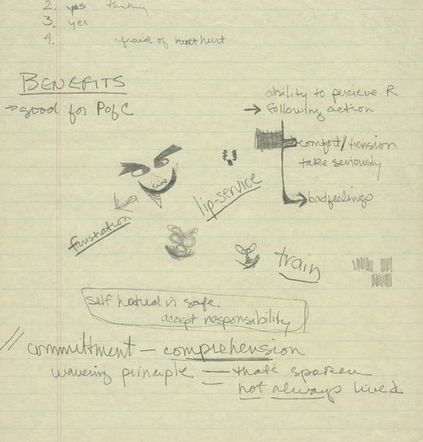
transcribing doodles?

Screen Shot 2016-02-02 at 10.13.22 PM

For this week’s post, I was excited to dive into the “database” (scared to use that term without scare quotes, yawl) of letters and diaries within the University of Iowa’s DIY History project.  The transcription process, especially of handwritten documents or interviews that evoke a sense of the document’s idiosyncrasies, I think, is important work.  For the most part, I felt that contributing to this project was straightforward, aside from illegible diary entries here and there.  However, when I came across someone’s (anonymous) notes from a 1982 conference, “Women Against Racism”, I was flummoxed as to how to convey the documents’ personalities.  The image above depicts the most pronounced example of this issue, with most of the page containing doodles that make the notes feel more like somebody’s private notes than an all-text document.  Not wanting to disregard it completely, I ended up transcribing this drawing as “cartoon face drawn in center of page”.  But still, I felt that my intervention here was taking away from the document’s character.  This issue, for me, is a reminder that (though the digital is material) the process of digitizing something like these notes carries with it the peril of reducing a text’s original layers.

Disabled Voices in the Digital Humanities

For this week, I wanted to explore how disability interacts with the digital humanities, and how conversations around disability can transform how we currently process knowledge. I know many disabled persons use online resources, like blogging, to present information about how they negotiate with disability.

I found the following article in my online travels: “Crippling the Archives: Negotiating Notions of Disability in Appraisal and Arrangement and Description” http://americanarchivist.org/doi/pdf/10.17723/aarc.75.1.c53h4712017n4728 Although it has its problematic pieces, it pointed out many of the issues I saw in terms of knowledge collection, and who’s knowledge/story/etc. gets privileged.

As I continued, I found this amazing resource called #transformdh

Transformative Digital Humanities: Doing Race, Ethnicity, Gender, Sexuality, Disability, and Class in DH

http://transformdh.org/about-transformdh/

From the website, “#transformDH is an academic guerrilla movement seeking to (re)define capital-letter Digital Humanities as a force for transformative scholarship by collecting, sharing, and highlighting projects that push at its boundaries and work for social justice, accessibility, and inclusion.” (#transformDH Tumblr)”

Jeremy, they have a section on comics and zines!

I’m thinking about submitting a video that could be considered for their conference in Maryland this year: “Videos between three and ten minutes in length that share new ideas about gender, race, sexuality, class, region/nationality, and disability in digital humanities/digital studies.”

When I searched “disability” on their site, I found this sick nasty archive (yes, sick nasty!!):

“Digit(al) Shakespeares brings Deaf studies perspectives to bear on both disability studies and digital humanities. Deaf studies focuses on what the experience of deafness enables, rather than disables. Just as we can reconceptualize hearing loss as deaf gain, so we can reframe Shakespeare’s works as being at heart visual rather than auditory. This can lead to a richer experience of Shakespeare for everyone, regardless of hearing status. Throughout the video, clips illustrate the power of sign language to convey the Bard’s virtuosity in creating images through words. New media and technology allow Deaf people to share translations and performances of Shakespeare’s works across the globe. Digital archives can collect and preserve these, so they are available for Deaf, hard of hearing, and hearing people to study and appreciate. Deaf and hard of hearing people also need access to digital Shakespeare archives based on spoken language via high quality captioning. Access should be built into digital archives from the start, so that it becomes a central element of the overall project design, rather than a problem to be solved at the end.”

http://transformdh.org/2015-video-showcase/digital-shakespeares-tyrone-giordano-and-jill-marie-bradbury/

And so, I posted the following comment on their site: “Very new to digital humanities (I’m currently getting my MFA at LSU and taking a grad seminar on Intro to Digital Humanities, where I hope to generate a web-archive of visual poetry by the end of the semester). As a disabled scholar, I LOVED the “Digit(al) Shakespeares” archive, and how it positioned deaf studies and visual studies, as well as challenged how we might orient to a longstanding literary work. I was wondering if you guys know of any similar archives/databases which center around or strongly include disabled voices? Doesn’t have to be in visual studies; I would love to look up anything you might offer. Thank you!”

So, we’ll see what happens! Looking forward to a response:)

Also, through #transformdh, I found this forthcoming collection that we can still all submit to (by April 1st haha), and I think it would be kind of awesome: http://buzzademia.com/

From the website: “This forthcoming edited collection will present a cross-section of international scholars using these new digital genres to articulate their ideas to undergraduate and general audiences. We describe this activity as Buzzademia, which we define as scholarship in the vernacular of the Internet. Consisting of a print book and digital companion, the collection will offer an archive of digital artifacts that represent the best of Buzzademia. Our aim is to contribute to the ongoing reimagining of the ways in which scholars and philosophers convey their ideas.”

Lessons in DIY History AND Programming!

For my DH project this week, I explored a couple of contributing options that I found in DH Commons. First I looked at the Programming Historian site: http://programminghistorian.org/contribute. In this site, there are lessons and articles on digital research for history. There were lessons on programming, preserving data, and even a beginning lessons on network visualization like Mapping the Republic of Letters. There was also a strong contributing component and a couple of different ways to give feedback and contribute, whether you wanted to email or tweet, fix minor errors and make comments in GitHub, or submit your own lessons. I just wanted to fix a couple of minor errors and clarify a couple of sentences, and to do this, I had to make a GitHub account. While there were instructions on how to do this, the instructions weren’t extremely clear. I successfully made a GitHub account, but I fought with the site on how to actually post a comment or fix an error for a long time. Eventually, I gave up.

 
But, this experience was still beneficial for me when figuring out digital humanities and was interesting in terms of Martha Nell Smith’s “Democratizing Knowledge” and Peter Suber’s “Open Access.” Being able to just jump into a collaborative project that is completely open was both exciting and terrifying. In “Democratizing Knowledge,” Smith points out that in having research and archives that are open in this way, scholars can have multiple perspectives on their projects from a variety of perspectives, like students. She even says, “Believing that it is better to have more, rather than fewer, pairs of eyes looking at and evaluating primary materials (a writer’s manuscripts, for example), many scholars have argued for editorial practices that are more collaborative and transparent.” This was exciting because as someone who had no idea what this project really was or wasn’t deeply involved, I could still contribute in a meaningful way, even on something small like a typo or clarifying a sentence.

 
However, this experience was also terrifying because I was not deeply involved in this project nor, I felt like, qualified. I felt the discomfort of collaboration that Nowviskie talks about in her transcribed lecture, not in the sense of someone who created the project but as someone who is an outsider. I understand why giving credit can be difficult. Do I really deserve credit if I only made a simple edit one or two times? Where is the line? So, while various scholars are pushing for collaboration and transparency, in some way, I realized that even my fresh academic habits run deep: it was intimidating to just jump into a project, and I wondered too about the significance of my contribution.

 
And, contributing wasn’t extremely easy either. As the reader, I was exciting to interact directly with the writer, but in fact, just working on GitHub was somewhat intimidating, which made me think of Suber’s “Open Access.” Suber claims, “OA makes work more useful in both ways, by making it available to more people who can put it to use, and by freeing those people to use and reuse it” While the Programming Historian was open for anyone to contribute, there was a certain degree to the open access. How “open” is this project when the everyday person has to fight to actually access it? I understand that this site is gratis OA and libre OA, but I just wonder what degree of open access it really is?

 
After my hiccups in the Programming Historian, I decided to try out DIY History: https://diyhistory.lib.uiowa.edu/, in which users can just pop in and transcribe various historical letters. To me, this site was much friendlier and even the name was inviting and exciting. Do It Yourself History. This made me feel like I was taking a much more active role in the site, beyond just providing feedback, and that this history, this archive was created by the people, for the people.
DIY History
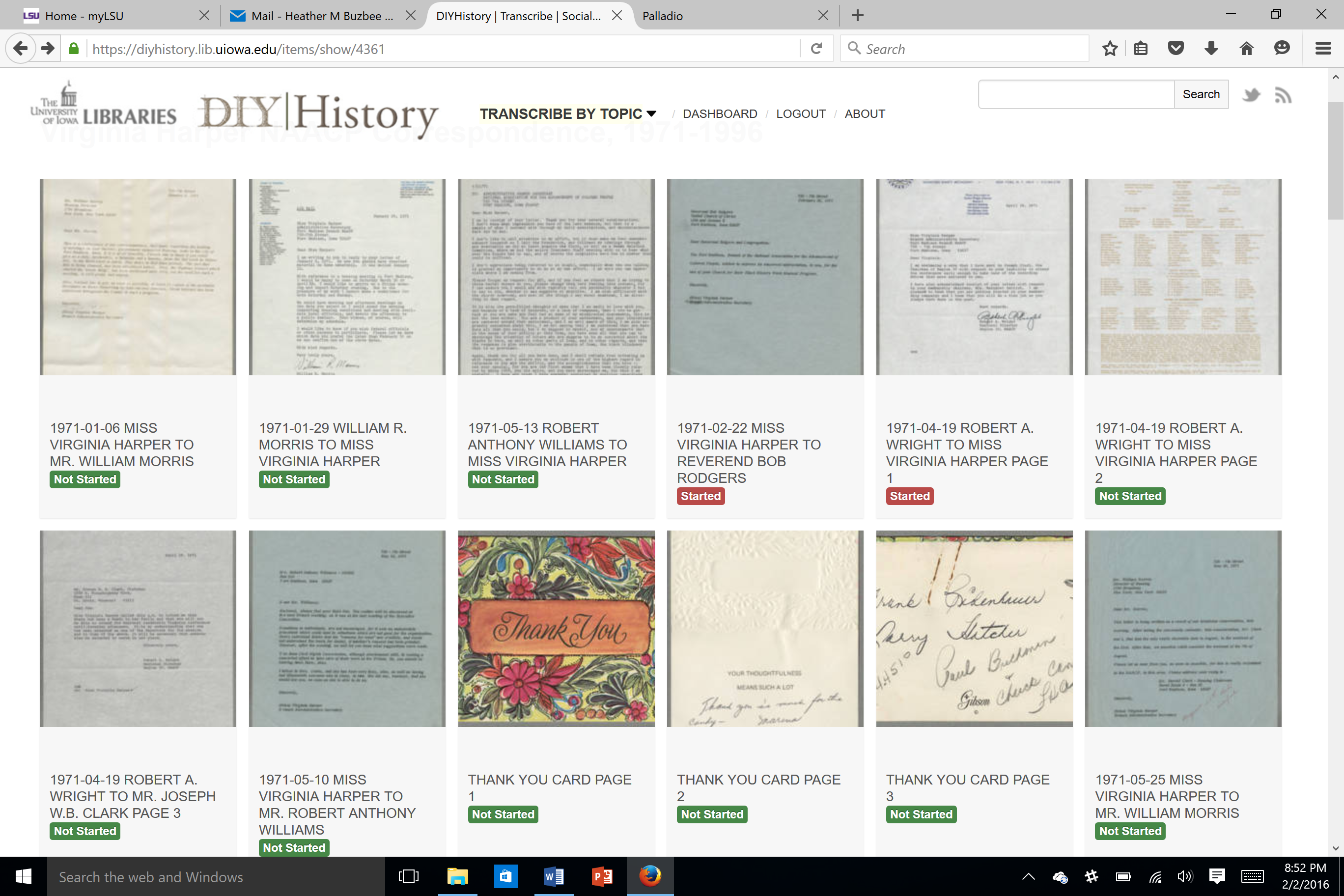
Although it took me a minute to figure out which letter to transcribe, especially because the first one I chose looked impossible:
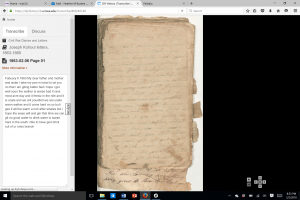
screen shot of transcription website

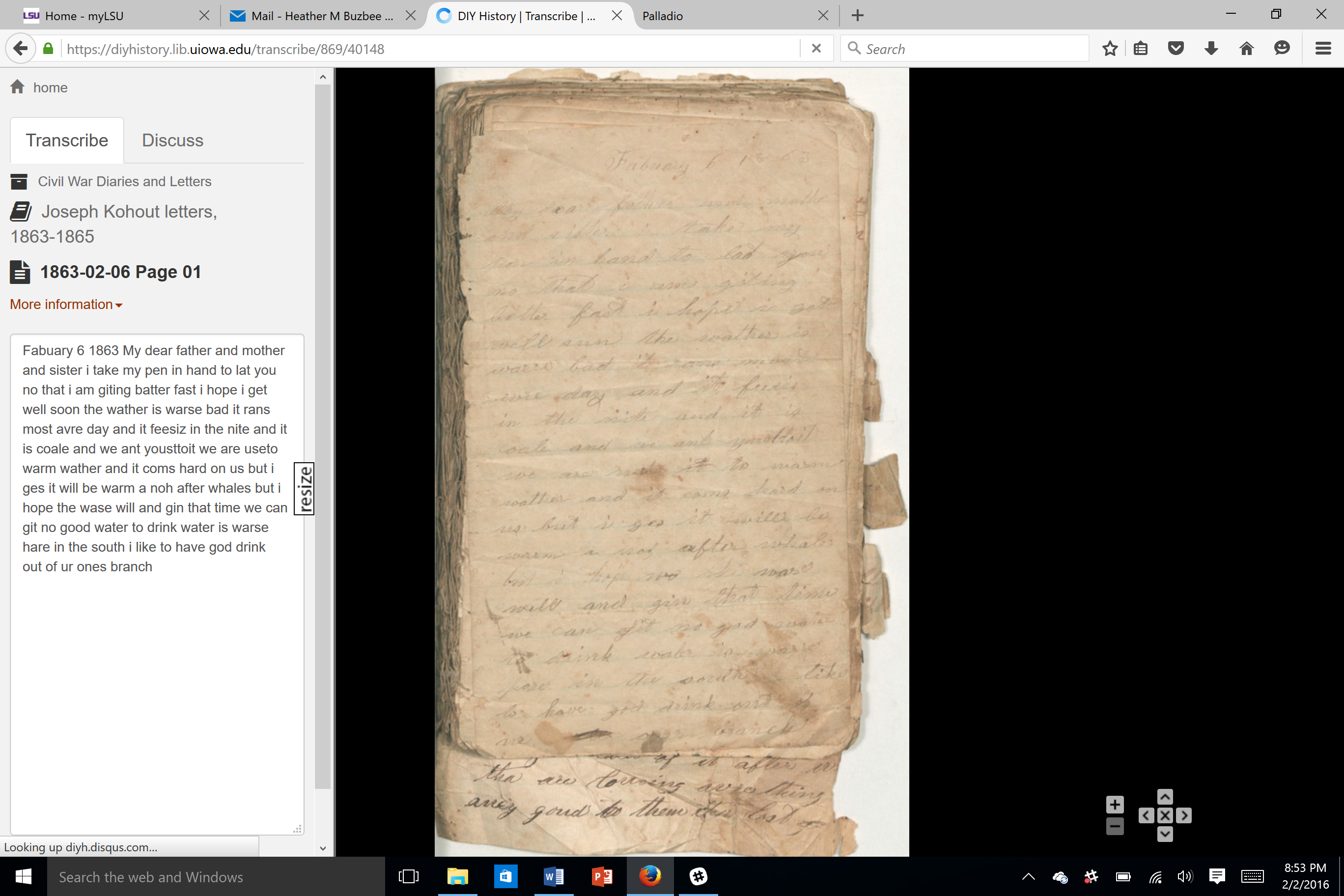
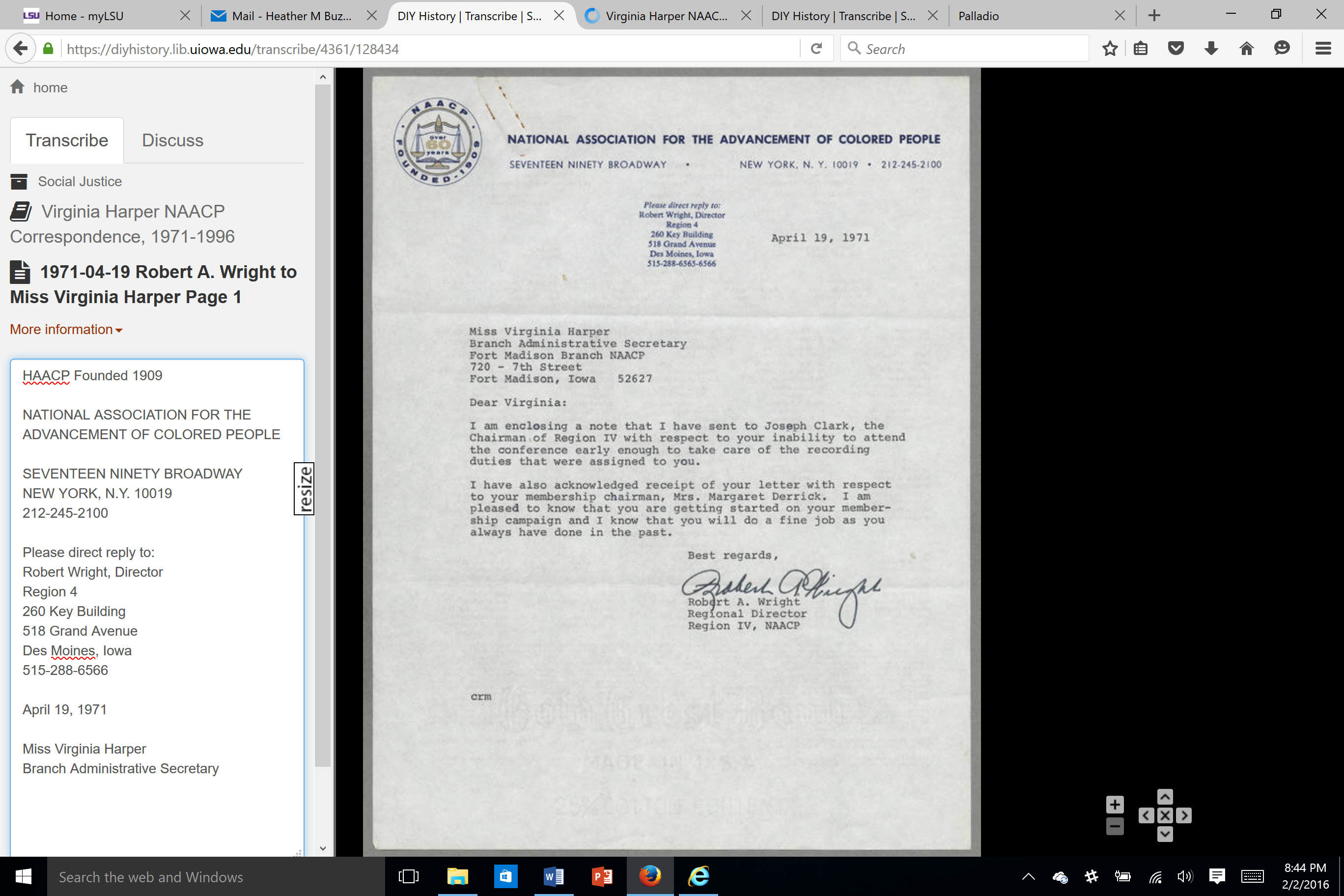
I picked one and set to work, fairly quick, painless, something to do if I was bored but also wanted to be productive.
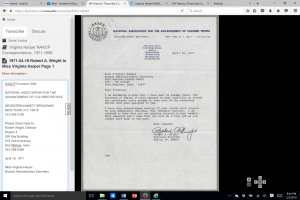
Transcribed Letter


I thought this was really cool, and I felt I was contributing like Smith states “it turns students into researchers, and the teachers and primary researchers into students. A digital environment opens up research territories reserved for those most advanced to beginners and makes use of intellectual and social networks.”

In this site, you can also post comments and discuss the letters, which I thought was extremely exciting since it would really give the archive or database a critical edge, and we could see the thoughts of the people transcribing and archiving these works like the Google Fingers from last class. (This also made me think of Irish manuscripts, since some monks who copied the texts would write their own comments and poems in the margins.) And, while archiving the letters were important or beneficial, I thought the discussion component was critical to, as Mark Sample and other scholars have been writing about in our readings, build networks and analyzing what we are doing instead of blindly copying away. However, when I posted my comment, it did not pop up right away and had to be moderated. So, while I understand that not everyone can just say whatever they want, I was still disappointed that this was not completely open, that not anyone could just write anything, and that the golden vision of collaboration must still be moderated to some extent. So who gets to decide what comments are appropriate, which can be shown, and doesn’t this still change and modify even the discussions we have about these archives?
Still, in both trying to contribute and contributing to two different DH projects, I better understand the issues brought up by the readings we have done so far in the class, and these projects are addictive. I am excited to see what else I can find.

Also if anyone is interested in network visualization, I also found a free site for this too: http://palladio.designhumanities.org/#/

 

Comics Cross with Digital Humanities

I started this week’s assignment with the hope of somehow starting a dialogue about the potential crossovers between Digital Humanities and comics, however, to my own surprise, I found many, many current crossover projects already in existence! I ended up doing three smaller engagements with various websites and projects.

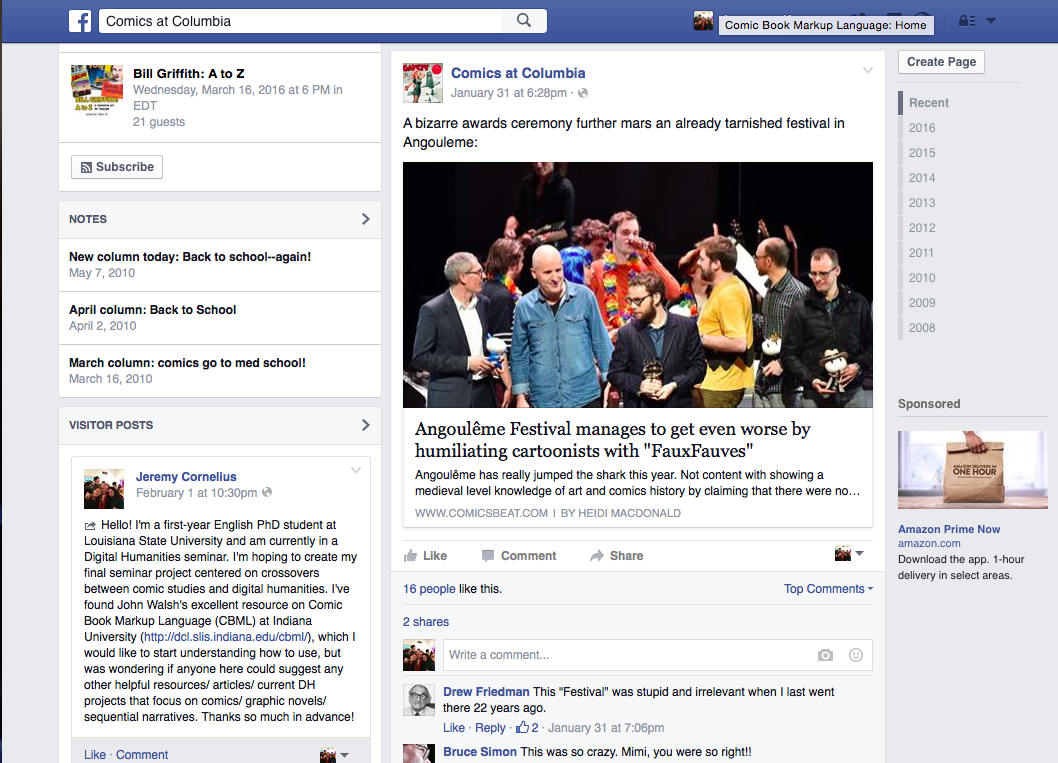
First, I went to the Comics at Columbia Facebook page, which is a well followed page (2,029 likes) on the large graphic novel collection and comics archive at Columbia, which is maintained by Karen Green, a librarian who works at Butler Library, where the collection is held. Over the weekend, I posted a link on the page for Comic Book Markup Language (a processes created by John Walsh, who works on a lot of DH projects centered on comics at Indiana University) and asked for any DH projects/ articles/ information on comics.  Unfortunately, my post was a bit more hidden on their page, which hasn’t yielded many comments since only the moderators of the page have seen it. I decided that maybe Twitter would be a better route for starting a discussion about other comic/DH projects.

Comics at Columbia

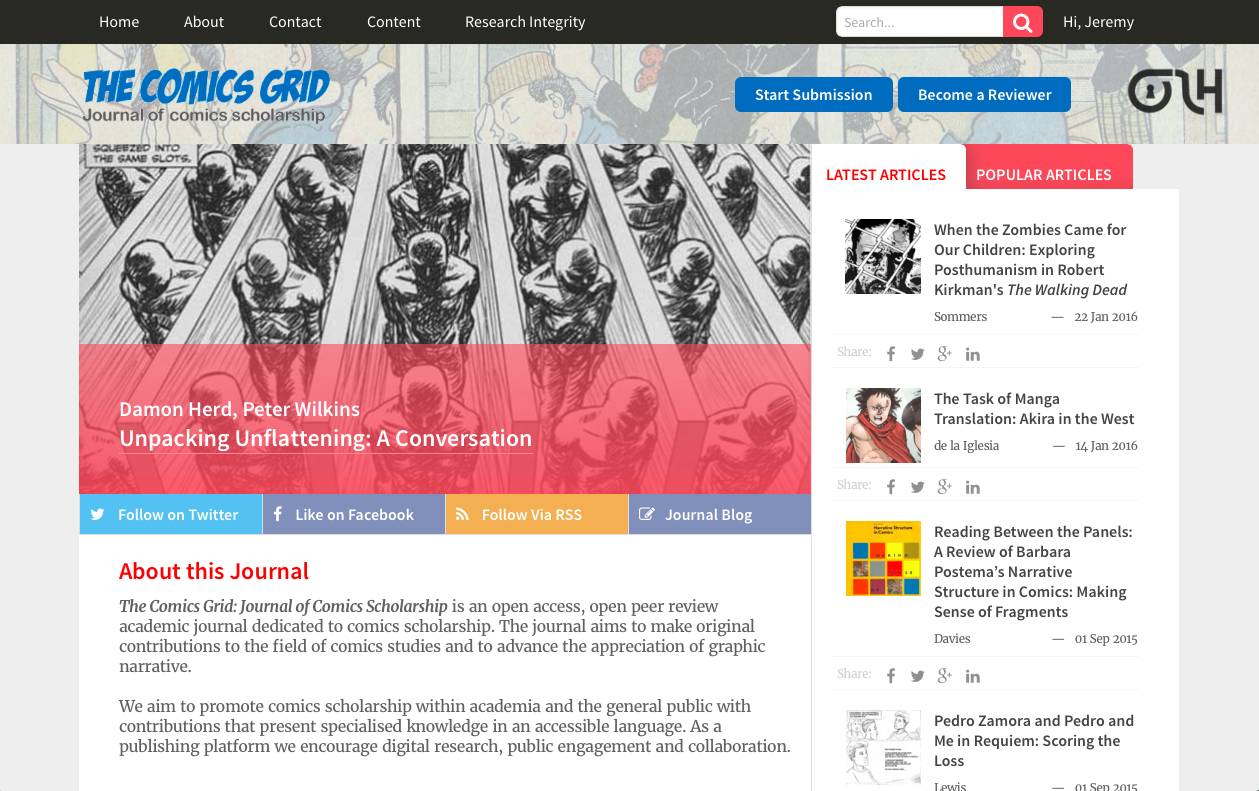
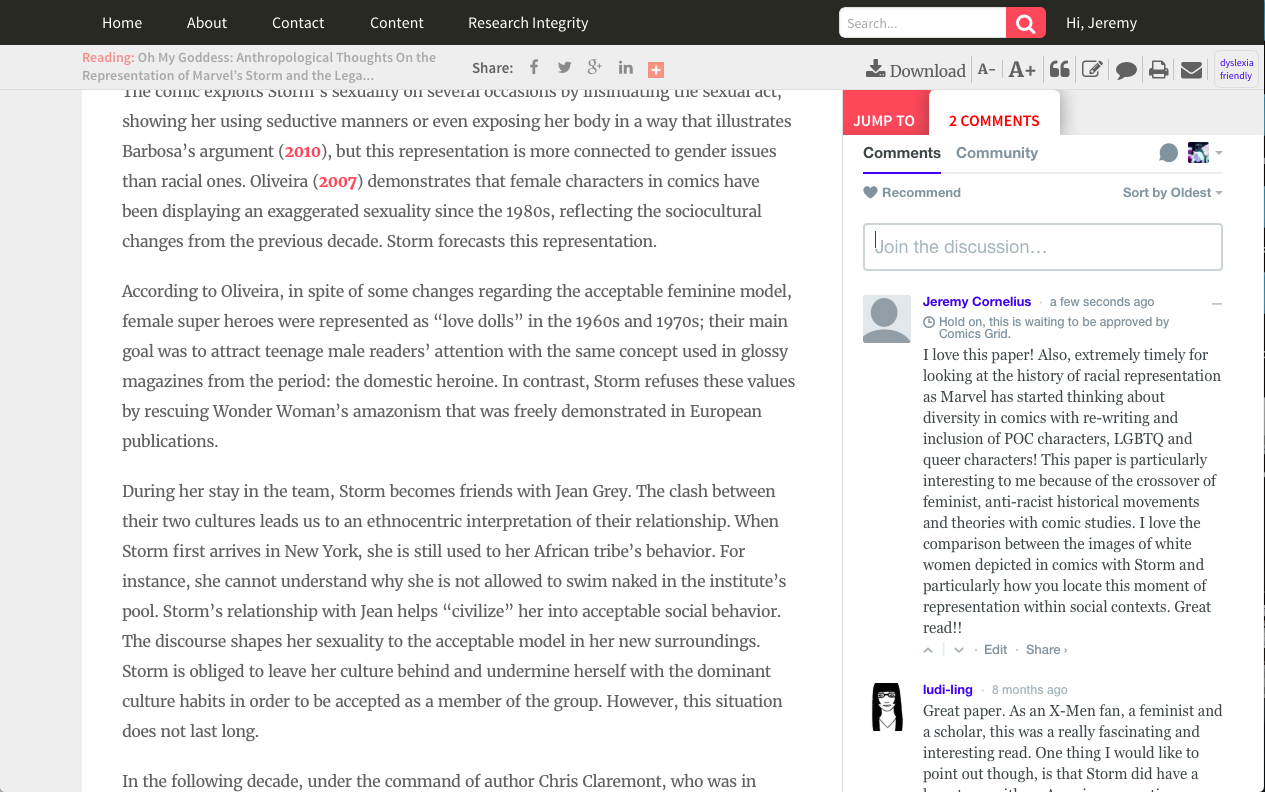
Comics at Columbia doesn’t have a Twitter account unfortunately, so I wasn’t sure where to go from there. I turned to Twitter with a vague idea about searching for other similar comics archive and DH projects online. I randomly stumbled upon an amazing open access, open peer review journal call The Comics Grid: A Journal of Comics SScreen Shot 2016-02-04 at 8.43.17 AMcholarship, which is currently maintained by Dr. Ernesto Priego, who has his PhD in information sciences and now works on many DH projects on comics. I created an account on their website, where I can submit articles online and contribute to their blog. I was hoping to submit something as part of this assignment, but the requirements for a blog post were more extensive than I had time to put together. Although, I have say this website is amazing because it’s focused on comics scholarship, but also has smaller articles from the blog about the comics world by contributors. It’s a super easy site to navigate and also very visually appealing. I commented on one article, “Oh My Goddess: Anthropological Thoughts on the Representation of Marvel’s Storm and the Legacy of Black Women in Comics” by Lucas Delbeto and Ana Oliveira.

Screen Shot 2016-02-04 at 8.57.23 AM


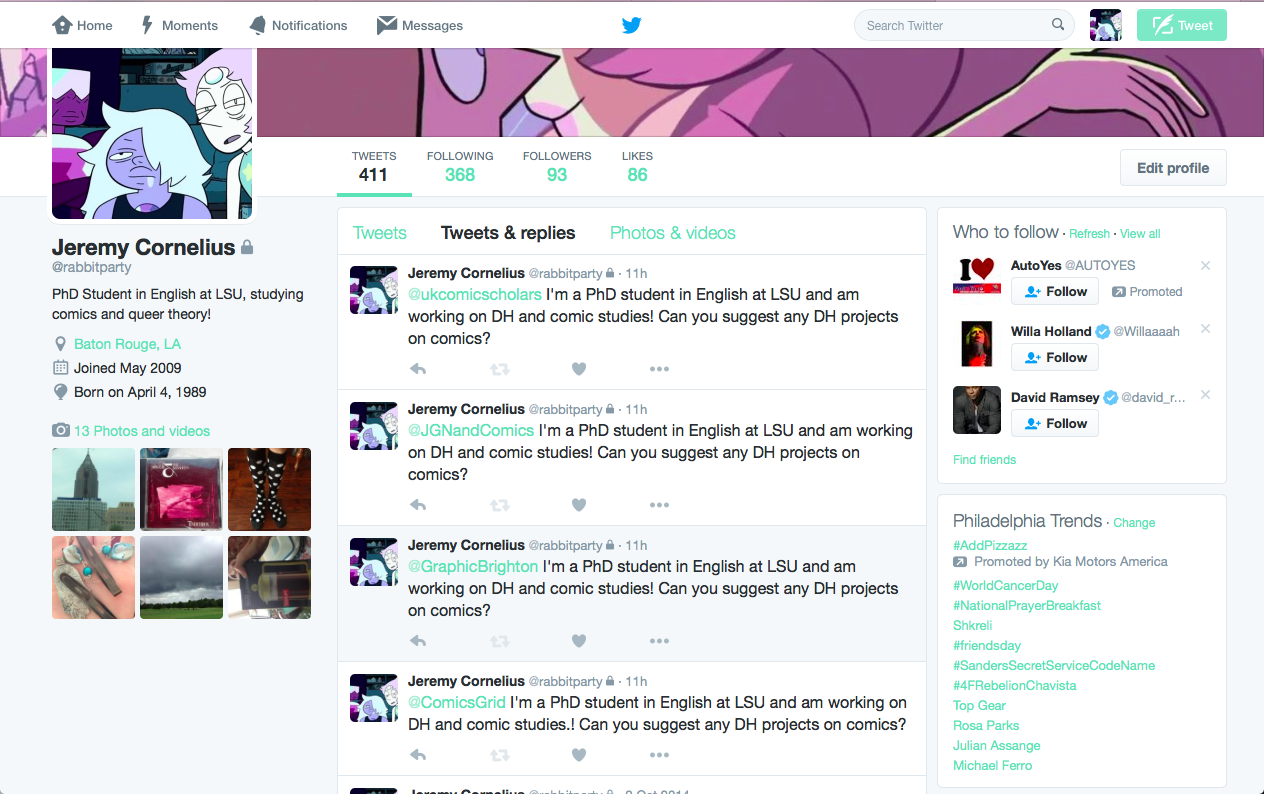
Lastly, I still wanted to engage in some discussion about comics and DH project like my initial idea with posting on the Comics at Columbia Facebook page, and noticed that the Comics Grid have a section on their homepage for Twitter discussions, so I went to their Twitter (and actually revived my Twitter account, which I haven’t used in years) and tweeted at them asking about other DH resources. I additionally found and followed other comic studies Twitter accounts from their following list. Along with the Comics Grid twitter, I tweeted at three different comic studies Twitter accounts: The Journal of Graphic Novel and Comics, Graphic Brighton (comic studies at University of Brighton), and BCCS (a UK comics scholar account).

Comics Twitter

After this rabbit hole exploration, I’m waiting for replies, so hopefully someone will get back to me with some additional projects and resources, as I am hoping to incorporate this into my final project for the class because I would like to create some sort of database that features online comic project in various forms: webcomics, open access journals, comic archives (which I found a ton of!), etc.

@DHanswers for the lost and confused

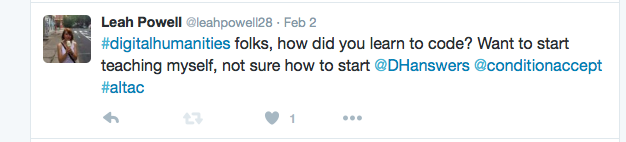
I have more questions about DH than ideas about how to meaningfully contribute, so I decided to find an effective way to ask questions of experienced DHers online. Although in class we’re learning a lot about DH values, politics, terminology, etc, something I’ve been wanting to know is how scholars in the humanities learn the practical skills (coding, programming, etc.) to actually do DH. So, I experimented with the question, “How did you learn to code?” My first attempt on twitter was, as I expected it to be, both nerve-racking and unsuccessful. I searched around to figure out which accounts/hashtags might generate a response, but my question required a longer answer than twitter makes easily possible.Screen Shot 2016-02-04 at 8.14.12 AM

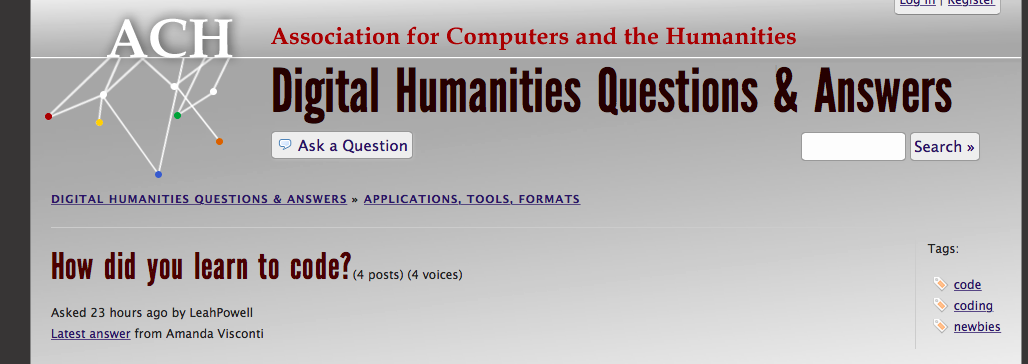
The DHanswers twitter page led me to “Digital Humanities Questions & Answers,” a board sponsored by the Association for Computers and the Humanities. I registered and posted my question there:

Screen Shot 2016-02-04 at 8.00.14 AM

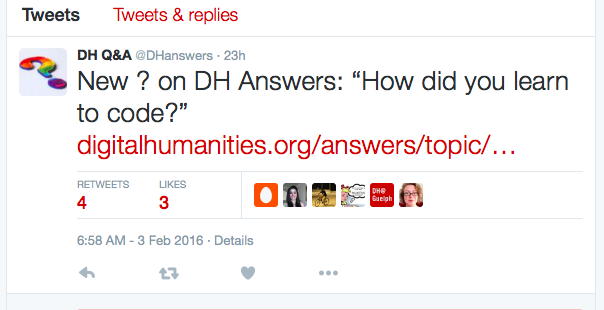
A cool thing about this board is that it automatically generates a tweet on the DHanswers page. Needless to say, this tweet received much more attention that my first tweet on my own page recieved.

Screen Shot 2016-02-04 at 8.29.05 AM

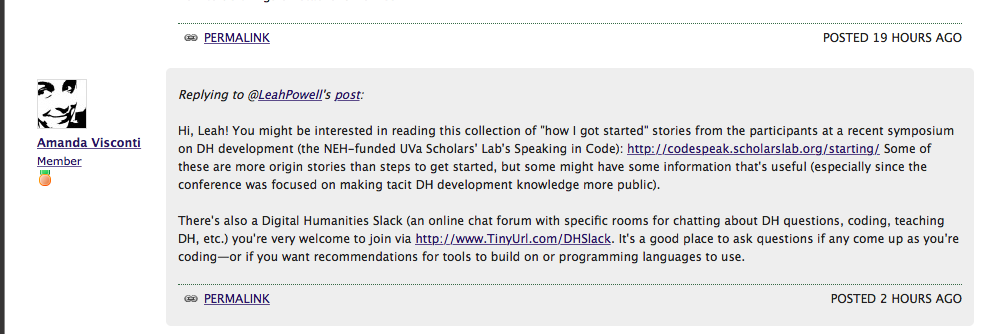
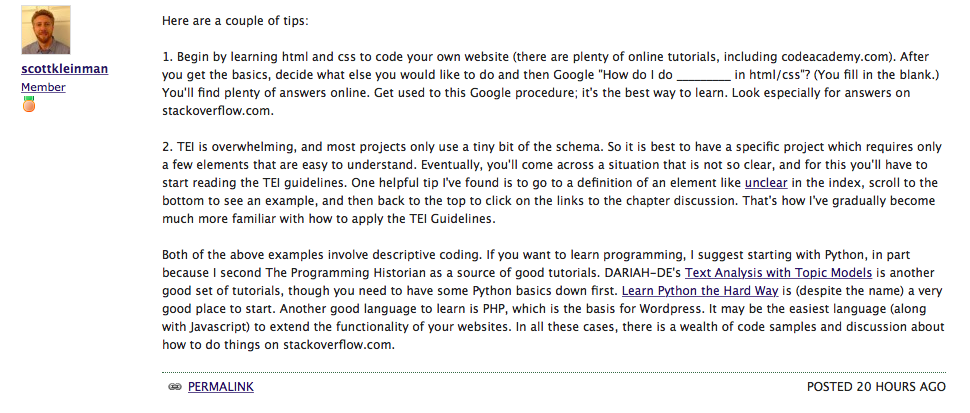
I was encouraged by a very prompt thorough response.

Screen Shot 2016-02-04 at 7.59.42 AM

Screen Shot 2016-02-04 at 8.27.26 AM

Responders note that the vagueness of my question makes it hard for them to provide a specific answer, but they suggest resources that I am excited to explore. I was highly skeptical that anyone out in cyberspace would take the time to provide a thoughtful response, especially to some grad student they’ve never heard of. However, I’m now motivated by the availability of this resource.

Collaboration and activism

As a poet, I am perpetually interested in shifting the margins and locating community, particularly surrounding increasing gender and racial equality in the production, publication, and dissemination of poetry. Here are a few venues that are rooted in activism and collaborative in nature, to which I have either made contributions or paid attention:

  1. VIDA Count

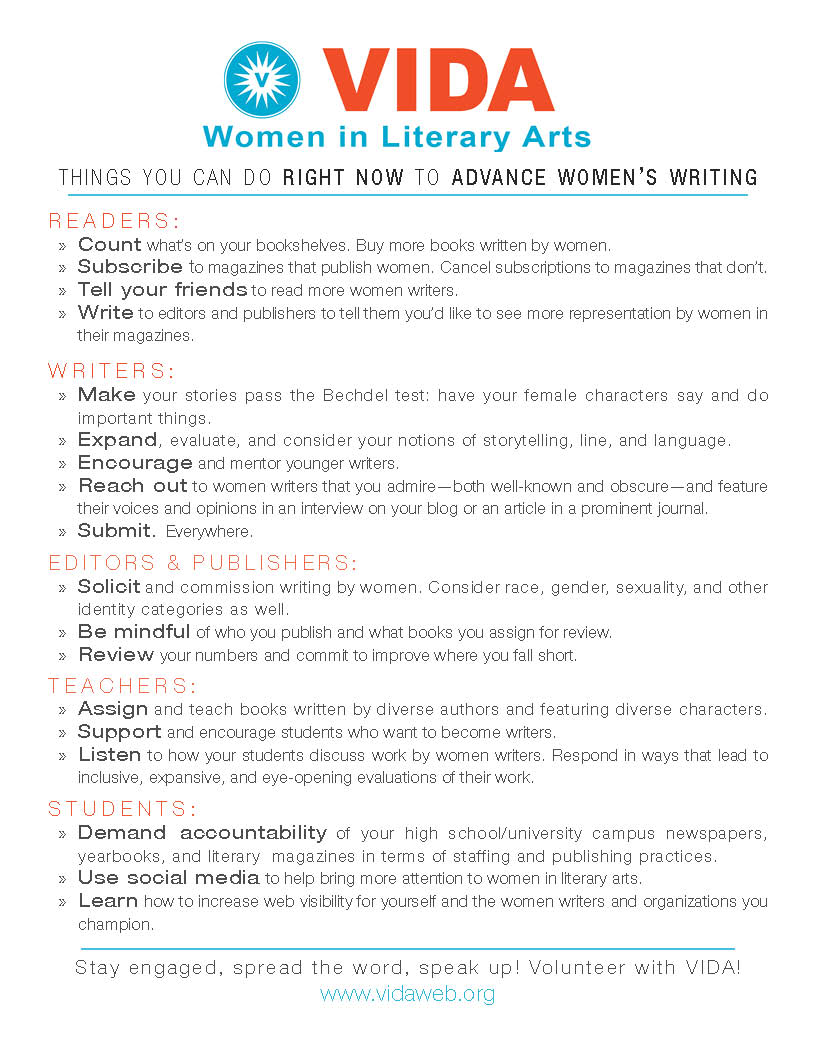
Every year, a large group of volunteers manually perform a “VIDA Count,” tallying major publications’ author bylines according to gender representation, in order to increase awareness of the gender disparity prevalent in publishing. In 2015, they added a “Women of Color Count” to account for ethnic disparity. VIDA-Handout


For the charts:

http://www.vidaweb.org/2014-women-of-color-vida-count-2/#The 2014 Women of Color VIDA Count

I am not currently a counter (someone who volunteers to count), which requires a certain time commitment, but I have plans to join later this year.

2. Journals That Pay

There are various listicles or single-authored resources pages on possible venues and markets for publication, but this open-access google drive spreadsheet allows for everyone to add their own knowledges and populate the list, and I have added to the list myself.

3. Writers of Color

This is another open access effort to increase the visibility of writers of color. I have not added myself to the list (yet), but I have suggested to friends that they do.

From the website: “Don’t you hate when editors use “I don’t know enough writers of color” as an excuse to back up the homogeneity of their publications? We do too. Here’s a fix, brought to you byDurga Chew-Bose, Jazmine Hughes, Vijith Assar, and Buster Bylander. Need someone to cover politics? Here you go. A correspondent in Chicago? We’ve got you covered.

We aim to create more visibility for writers of color, ease their access to publications, and build a platform that is both easy for editors to use and accurately represents the writers. The response so far has been overwhelming (thank you!) and we welcome further feedback from both camps, but please realize that this site is run by volunteers and is a work in progress. We still need help fixing mistakes and keeping things running smoothly.”

Live Tweeting Peter Suber’s Book

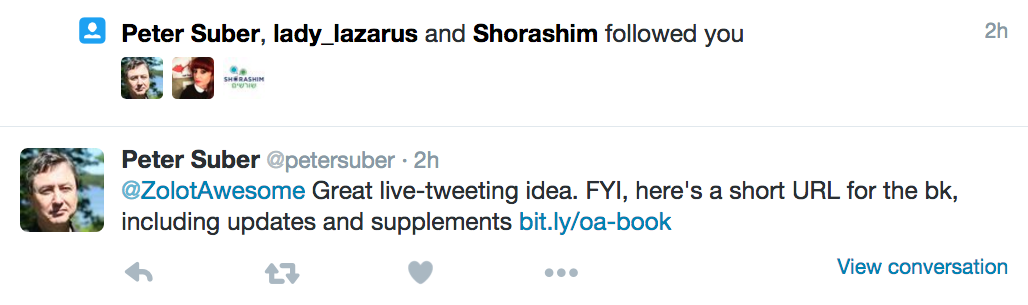
UPDATE: Peter Suber (@petersuber) replied to my tweets and followed me! Am I a digital humanist now?


Screen Shot 2016-02-04 at 12.13.04 PM


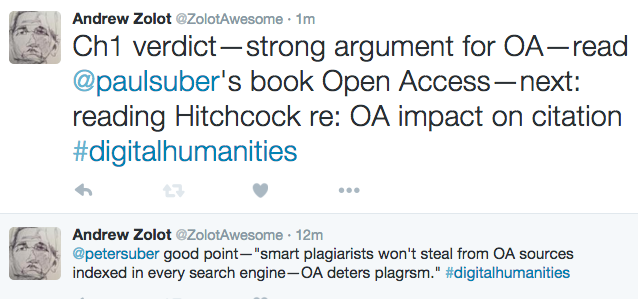
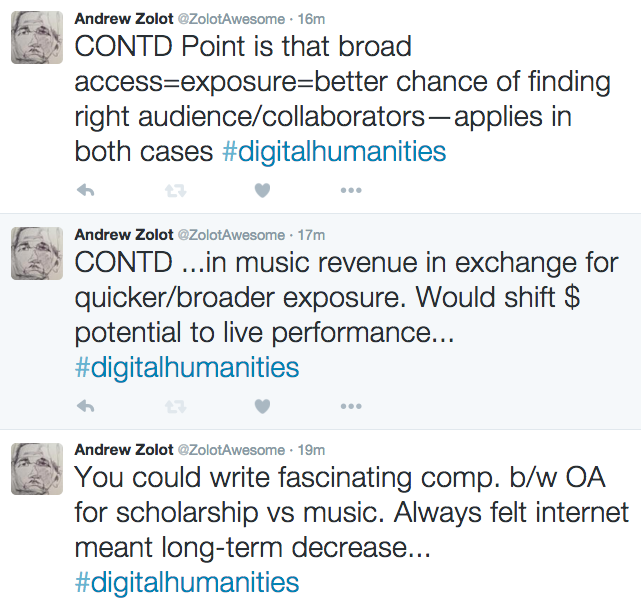
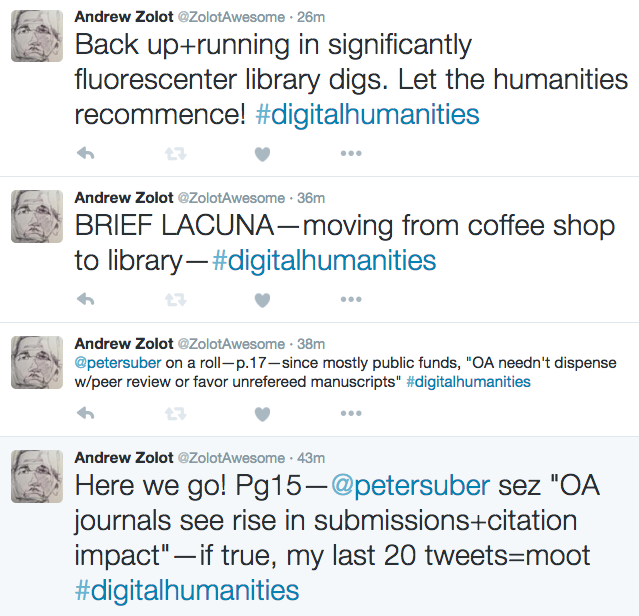
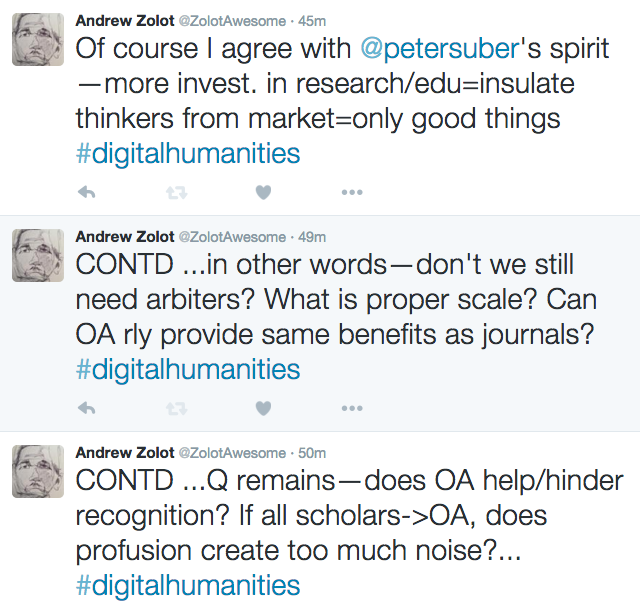
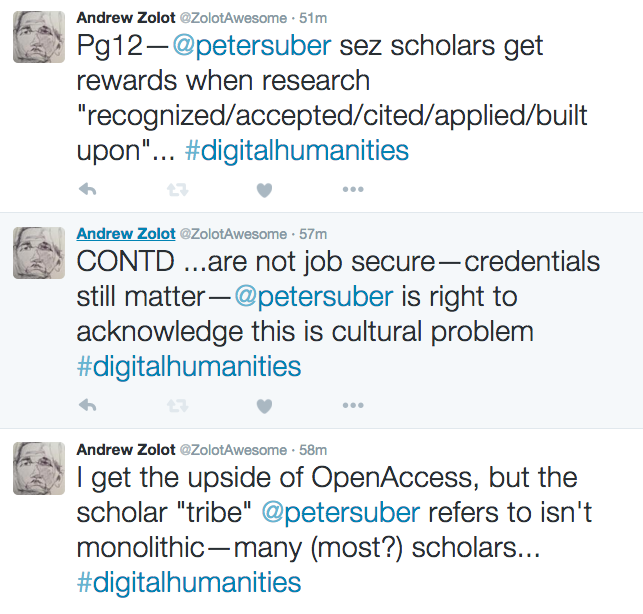
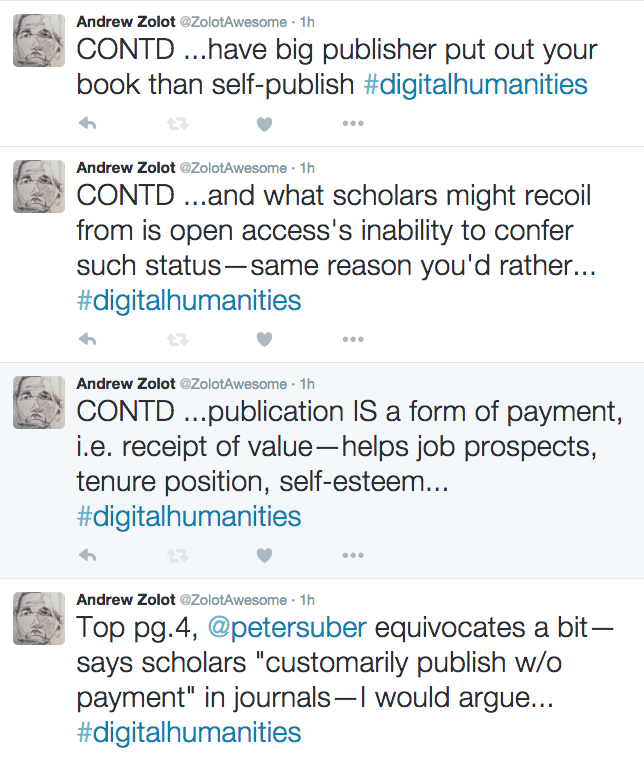
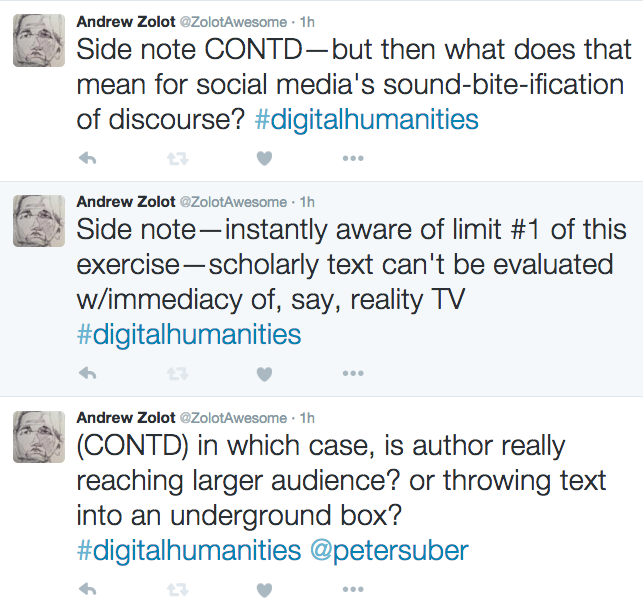
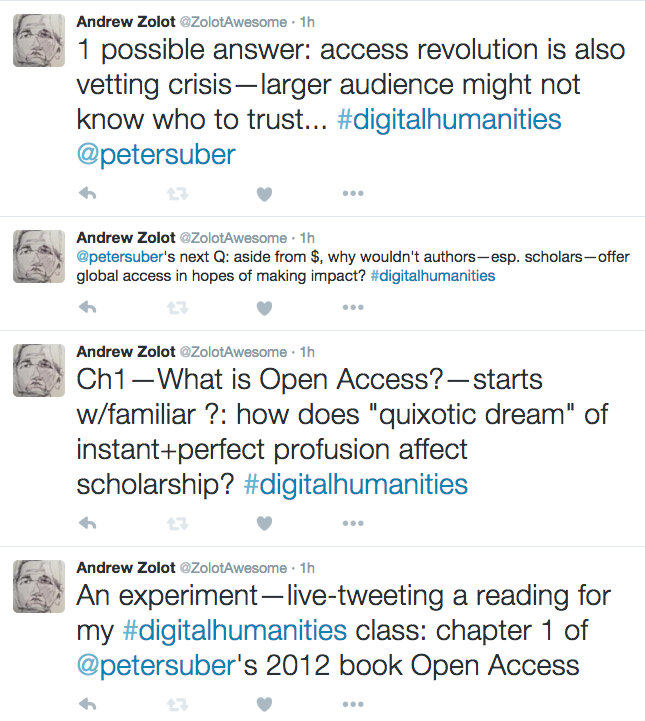
I decided to live-tweet my reading of chapter 1 of Peter Suber’s book. I figured this would be a neat entree to the concept of socially connected scholarship. I’m including the full tweet stream in images below, but a couple observations are in order. First, I was (and continue to be) extremely nervous about addressing my responses directly to Peter Suber. It forced me to be accountable in a way I wouldn’t have in a normal online post for the class. It also caused a bit of anxiety—I was well aware that my blow-by-blow reactions and questions were likely to be addressed by Suber in the course of his arguments. However, I thought it would be a betrayal of my experiment’s premise to read through first and then go back to tweet it. This, of course, forced me to formulate some sort of premise out of what was, at first, a gut feeling. I came up with this: What effect does socially networked discourse have on what is, traditionally, a non-immediate discipline? In other words, what could go wrong tweeting reactions to a work before you’ve actually read it through? In other words, what do drunk celebrities with twitter access and (sober) digitally enabled graduate students have in common? There is a partial straw man flavor to this exercise—it is possible to formulate one’s thoughts on a topic and then let the world know—and a disciplined scholar would do well to take that route. But, just as surely, instant technologies introduce instant reactions and incomplete methodologies into the discourse. Twitter (and other networked technologies) should undoubtedly be explored for potential to enhance scholarship/discourse/etc. But pitfalls are inevitable. My verdict, roughly, is that a certain decorum of generosity and politeness must be adopted in these kinds of instant, partial, rapid conversations—something that is extremely hard to do in 140 characters, especially when addressing @petersuber AND including the tremendously cumbersome #digitalhumanities hashtag. Nonetheless, the experience was edifying and bizarrely scary. Mr. Suber has not yet responded, and I dread the thought that he will. The nightmare is a resounding smackdown on my incomplete analysis and amateurish methods. In order to militate against such a coup de tweet, I threw in an endorsement of Suber’s book for my pitiful 56-tweep public. Welcome to the academy, I suppose. To weet (get it?)(also, they’re in reverse order, so scroll to the bottom and read up to most recent):

Screen Shot 2016-02-03 at 11.28.09 PM

Screen Shot 2016-02-03 at 11.28.04 PM

Screen Shot 2016-02-03 at 11.27.56 PM

Screen Shot 2016-02-03 at 11.27.48 PM


Screen Shot 2016-02-03 at 11.27.40 PM

Screen Shot 2016-02-03 at 11.27.33 PM

Screen Shot 2016-02-03 at 11.27.24 PM

Screen Shot 2016-02-03 at 11.27.15 PM


Guenter Grass Digital Resource

Screen Shot 2016-02-03 at 10.36.45 PM

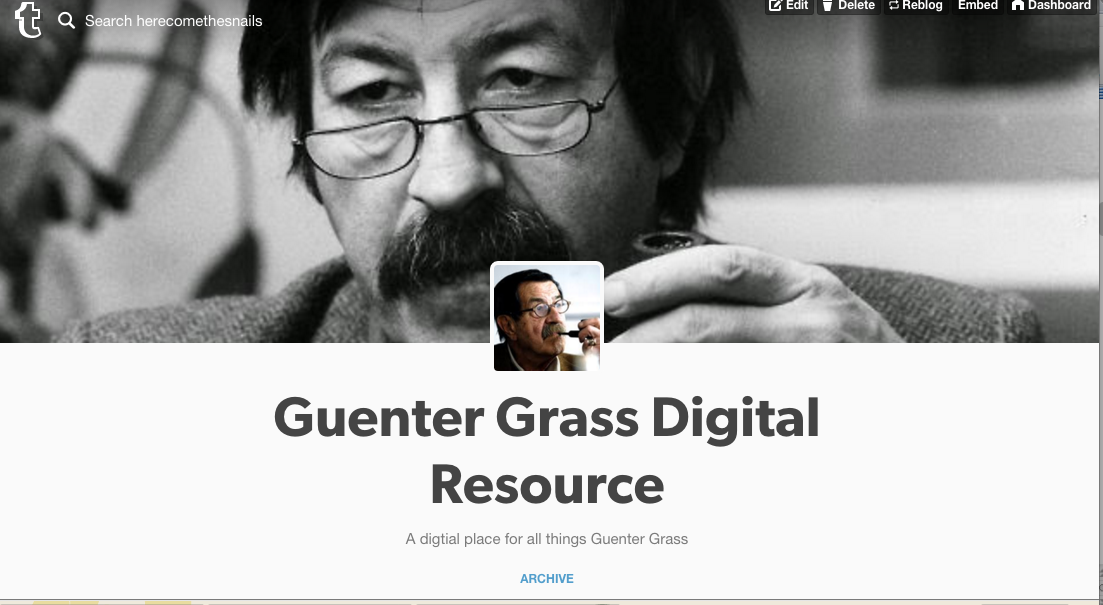
For this week I transcribed an interview with the Nobel Laureate and Kashubian-German novelist Guenter Grass. The interview was conducted by another digital archive called “Louisiana Channel,” which is a Denmark-based museum that hosts interviews with famous artists such as Grass, Patti Smith, Umberto Eco, Joyce Carol Oates, and others. With their permission, I transcribed a 38 minute interview with Grass and posted on what I am dubbing the “Grass Digital Resource” at herecomethesnails.tumblr.com. I hope to involve and reach out to other Grass scholars and expand this project as the semester goes on. This resource will hopefully include interview transcriptions, interviews links, critical essays, and other documents relating to the late Nobel Laureate.

Criticism and comments are welcome.

css.php