dh collaboration

For this week’s assignment to participate in a dh project or platform, I went broad rather than deep. I did three things (or more, depending on how you count them):

Screenshot 2016-02-03 22.00.43
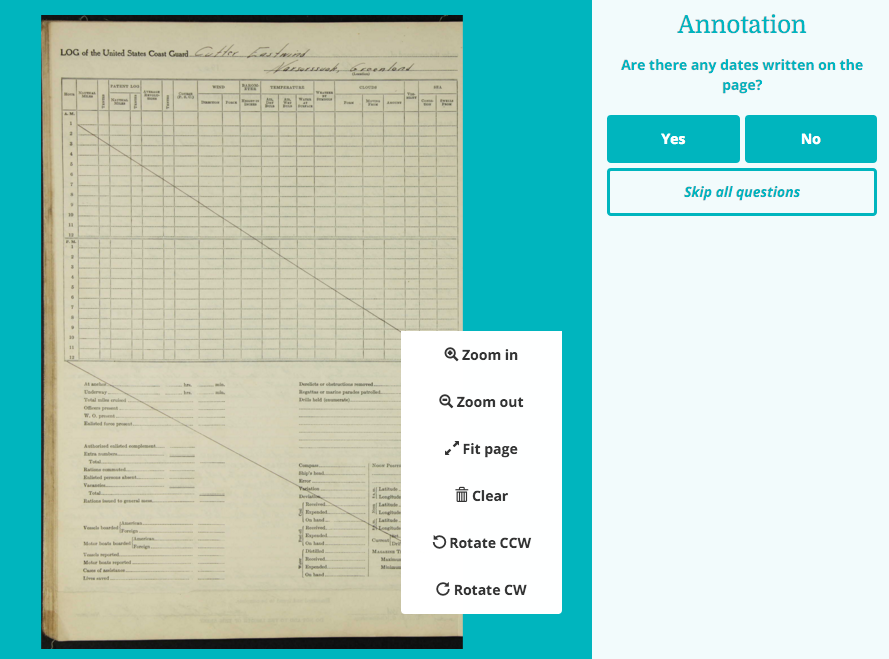
Old Weather

First, I created a Zooniverse account and participated in three Zooniverse projects. Zooniverse is a platform for “people-powered research.” In practice, that means it’s a collection of disparate projects in the humanities and sciences that invite non-experts to participate. The web interfaces for the projects vary. For instance, some require brief training sessions before participation, while others do not, and all three that I looked at required different kinds of participation and input modalities.

Old Weather prompts participants to “help scientists recover Arctic and worldwide weather observations made by United States ships since the mid-19th century by transcribing ships’ logs.” Logs must be annotated before they are transcribed. The interface presents the user with a series of simple questions (such as “do you see a date on this page?”). If the user indicates that he sees tabular weather data, he is prompted to outline the shape of the table and transcribe the data. I also contributed to two non-humanities projects, Condor Watch and Plankton Portal.

Screenshot 2016-02-03 22.01.49
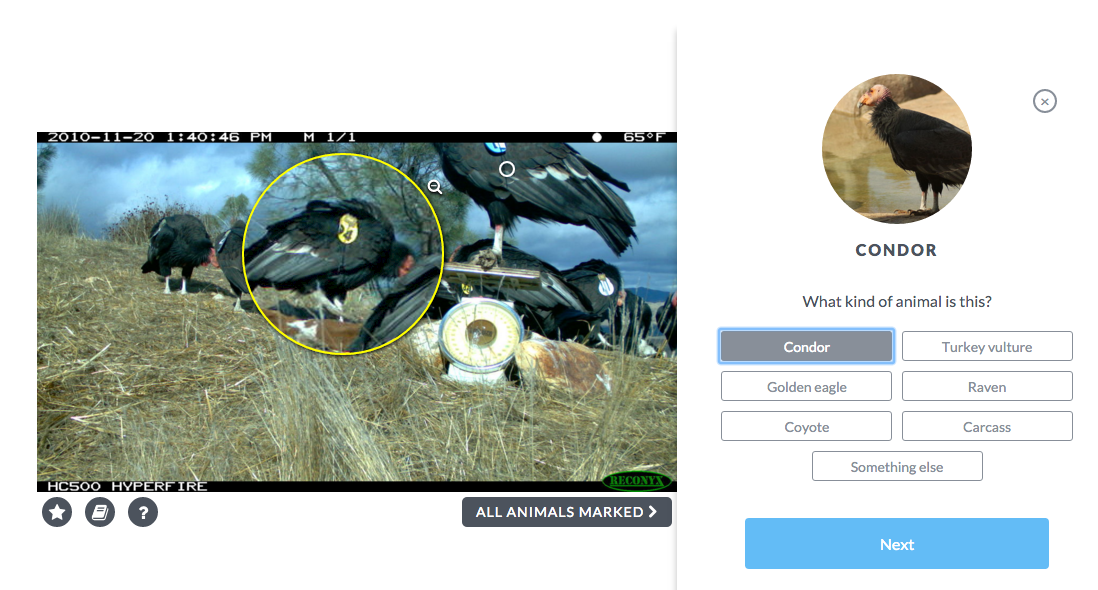
Condor Watch

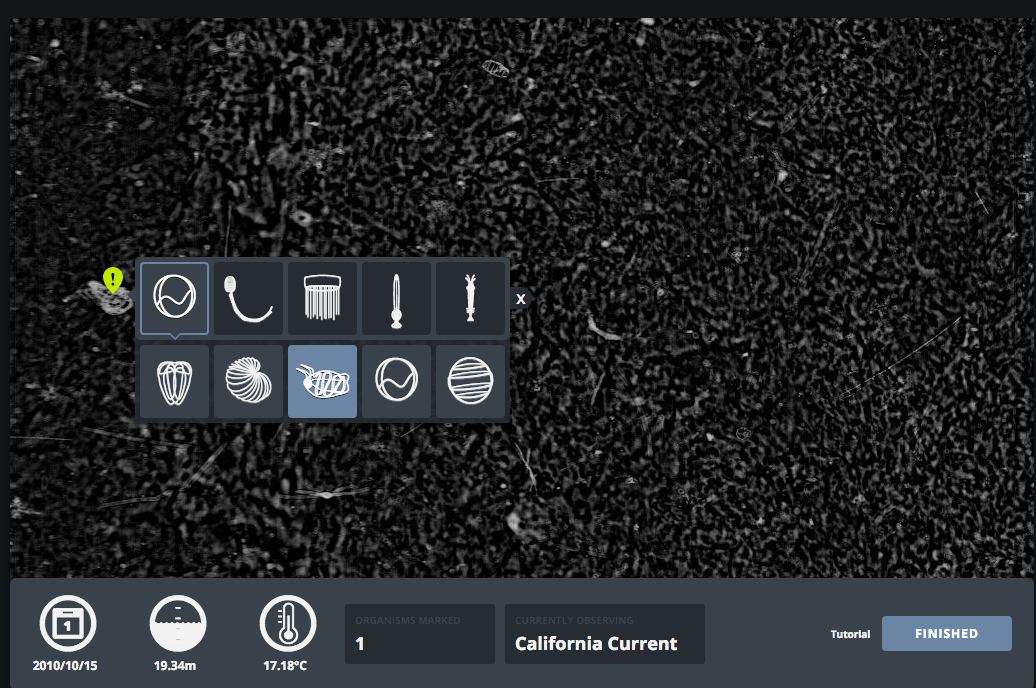
Condor Watch allows users to participate by marking condors and answering questions about photos from camera traps, while Plankton Portal similarly prompts users to mark and categorize plankton in images from two different regions.


Screenshot 2016-02-03 21.58.33
Plankton Portal

Second, I created the “Digital Humanities at LSU” Facebook group. I added most of the class to the group; if I missed you, please request to join. Hopefully this group will lower the barriers to communication among students in this class, as well as (eventually) other interested scholars at LSU.

Third, I created a personal WordPress site called Fleetmeat. I intend to use it to communicate my ideas in an informal but still “published” form through the blog, as well as to provide information about myself (such as my CV). I haven’t done much with it yet but hopefully its existence will spur me to build it up.

#MinecraftED Twitter Party

minecraft-egypt-adventure-map-1024x68420160203_005637000_iOS

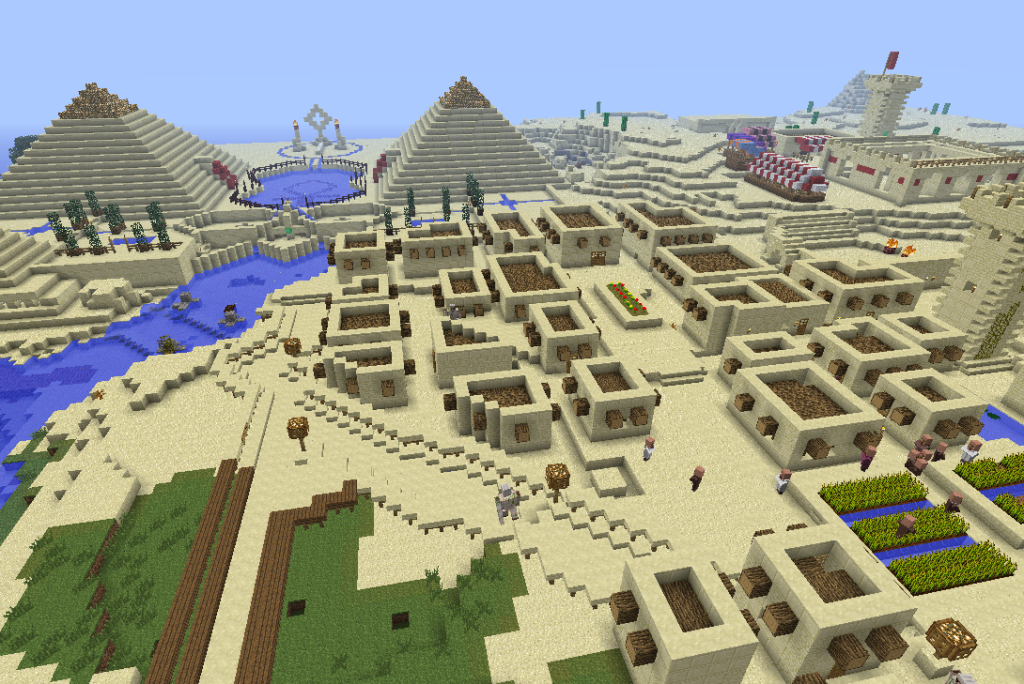
For our post this week, I wanted to participate in the community of educators using Minecraft as a pedagogical tool. Minecraft is, at its core, about placing and collecting (or “mining”) blocks which represent various world materials such as dirt, stone, wood, and ores such as iron and gold, among others.

A screenshot from a typical game of Minecraft.
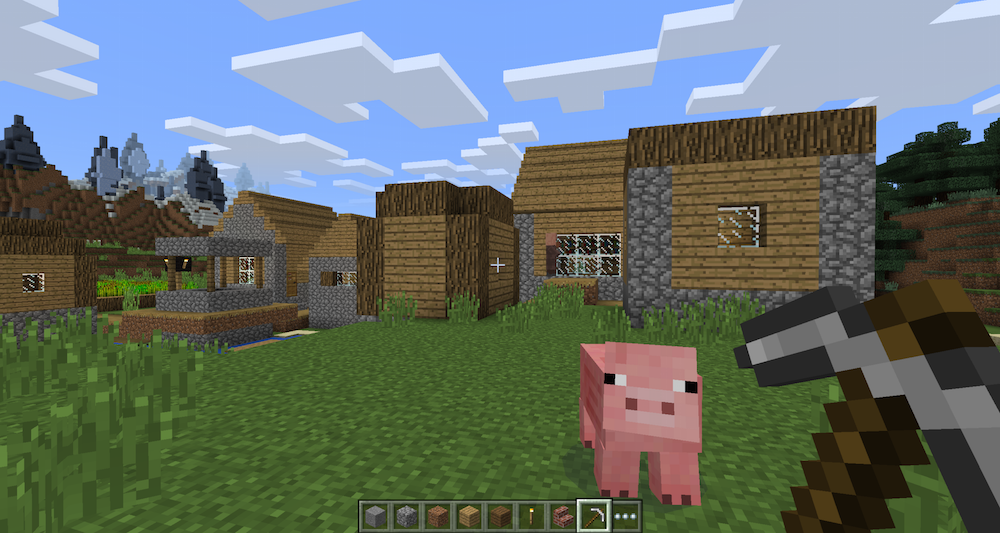
       A screenshot from a typical game of Minecraft.

Using these materials, players can build anything they can imagine, or explore the pre-generated terrain and discover Minecraft’s friendly and hostile creatures.

To me, pairing Minecraft with education seems like an obvious choice: children already enjoy playing Minecraft in their free-time, the game inspires creativity and literacy through its interactive mode.

20160203_000033000_iOS

I’m not alone in this mindset (Mineset?). Perhaps because of the kid-friendly, Lego-esque design and open world functionality of the game, educators have been using Minecraft as a learning tool practically since the game’s inception.

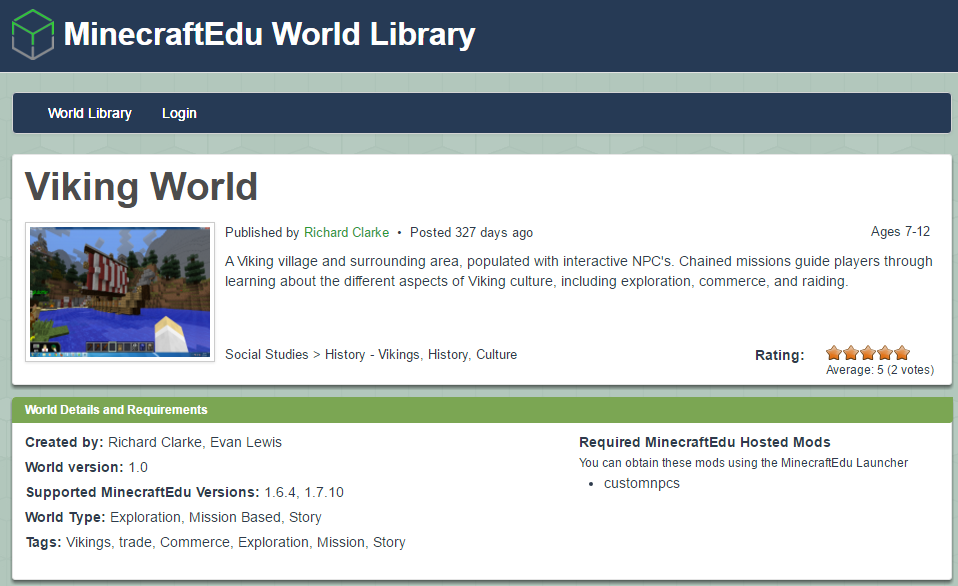
TeachersGaming created MinecraftEDU, a mod created by teachers, for teachers wishing to use Minecraft in the classroom. The MinecraftEDU website includes forums where educators can troubleshoot issues, ask for coding advice, and share lesson plans.


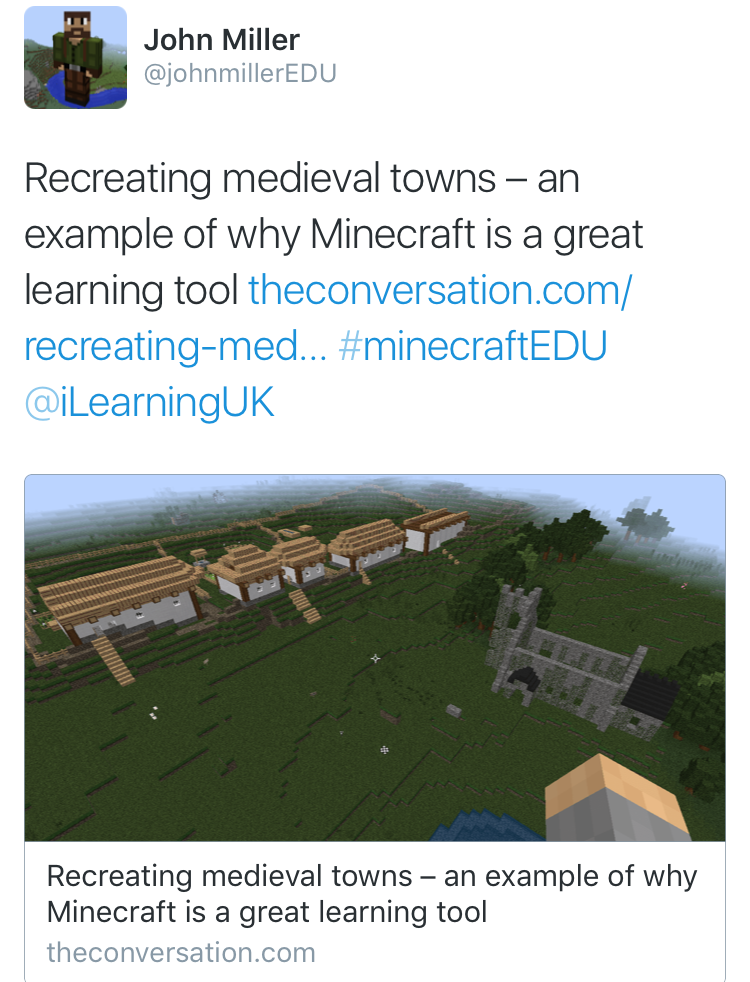
A MinecraftEDU world and lesson plan in which students can explore a viking village.
A MinecraftEDU world and lesson plan in which students can explore a Viking village.

The MinecraftEDU mod has become so popular that it was acquired by Microsoft, the company who now owns Minecraft, on January 20th, 2016, and became Minecraft: Education Edition (MinecraftED), a full-fledged unique version of the original game. Understandably, there was some apprehension from the MinecraftEdu community regarding this change. Many educators and their students have been working on these MinecraftEdu worlds for years, and educators worried that the lesson plans and maps they have come to rely on would no longer be accessible.

Continue reading →

Volunteering for the Smithsonian Transcription Center


Smithsonian Image


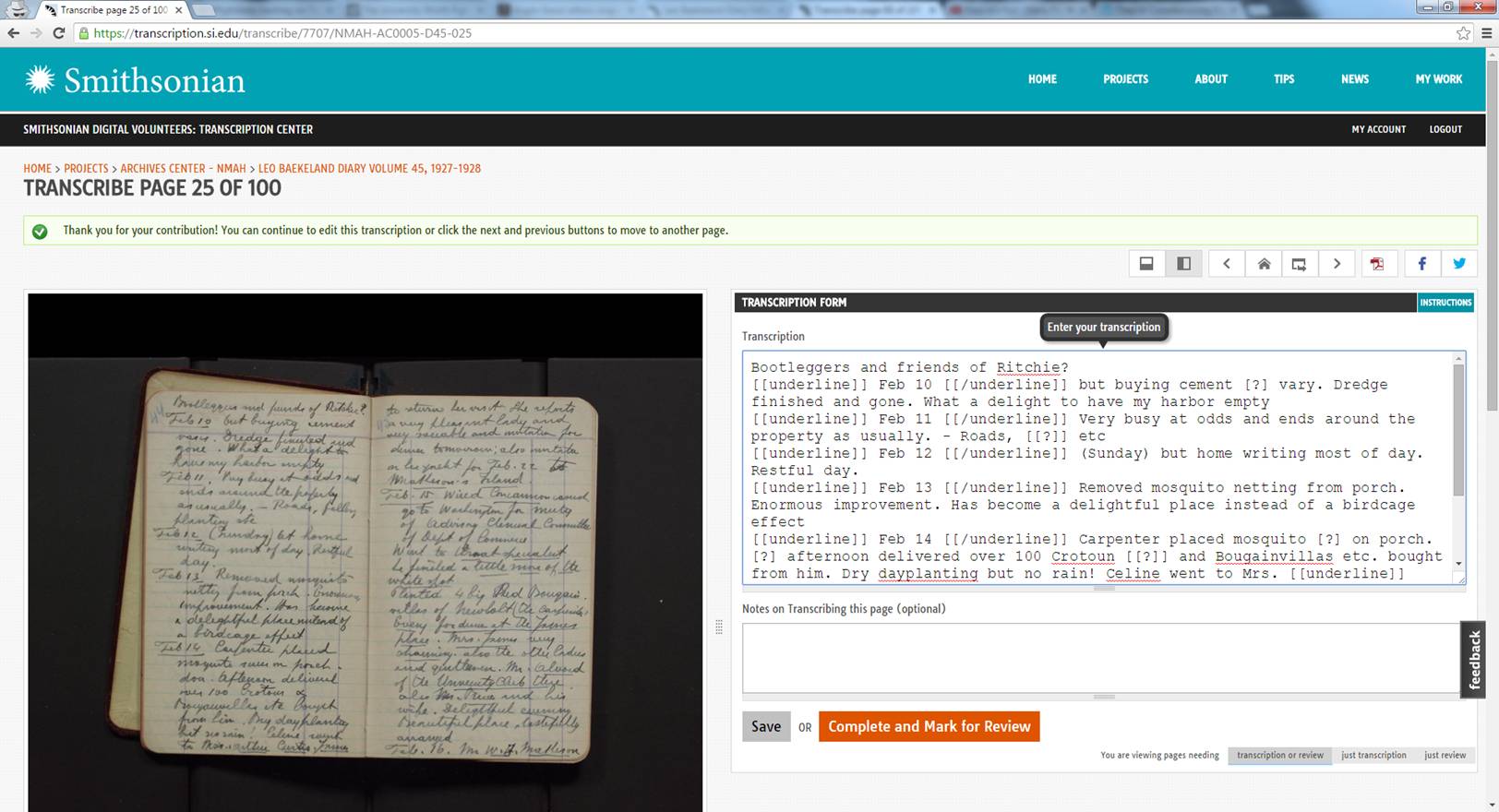
The Smithsonian (https://transcription.si.edu/) is currently crowdsourcing an impressive number of transcription projects, and I was curious to see how their transcription process works. I created an account and read the new users’ instructions, which were surprisingly simple. More advanced users have the option to add additional tags and notes to their transcription pages, but users don’t have to transcribe anything they can’t read—they don’t even have to indicate underlined or stricken text, as volunteer reviewers can add those notations during the text review process. I was surprised at how streamlined the whole process is.

The only difficult part of the transcription process is actually deciphering the text you’re trying to transcribe. I chose to transcribe a page from Leo Baekeland’s diaries, thinking it would be fascinating to help reveal the famous chemist’s personal life to the world. (If you don’t recognize his name, you probably recognize the name Bakelite, an early plastic he created.) However, the page I transcribed is a shining example of just how unsexy crowdsourced transcription work can be: the crabbed script on the page was sometimes illegible, and the text chronicles home improvement projects and dinner invitations—no astounding discoveries or profound thoughts. It is interesting to think, though, that Baekeland found it important to diary his daily activities, no matter how mundane. Did he find the process grounding, perhaps soothing, in the midst of an academic career that hurtled from one award to the next at breakneck speed?

Perhaps Baekeland’s thoughts on the value of mosquito netting—he hated having it on the porch, apparently—will be the breakthrough a future researcher needs to connect previously indecipherable data in one of Baekeland’s lab notebooks. Probably not, but the gusto with which other volunteer transcribers have taken up the Smithsonian’s many transcription projects implies that valuable hidden information has, in fact, been unearthed in these scans over time. There isn’t an official forum for Smithsonian transcribers, but one can get a sense of the exhaustive care taken by volunteers when scrolling through the scrivener notes typed underneath individual pages. This is the harvest that feeds academia, it seems—painstakingly curated, cultivated, and illustrated crop that only ripens when an entirely unpaid community tends it.

Response, Week 2

When products “go digital”, when resources or knowledge become part of the digital space, they’re supposed to undergo a process of democratization (at least according to the ideals of DH studies). But, if anything, the articles we read for today highlight the falsity inherent to this viewpoint, putting accessibility values in juxtaposition to real practice. In the beginning of the McPherson article, she discusses how much of what’s archived today moves away from association with larger, conglomerate powers, onto more public, distributed use: “Less and less does it signal rigorous institutional practices, dedicated spaces, or a devotion to physical (let alone dusty) object”(483). And yet, the forces which shape access, resources, and the creation of knowledge hierarchies are deeply saturated in normative structures, which rely on stratified discourse and literacy disparities in order to retain power. McPherson acknowledges this, and goes into its structure, later on in the article, having us (the reader) look at these imbued power dynamics.


Questions we need to be asking: What is accessed by large groups of people online? How do websites, and DH projects, get promoted? What determines the shape of these projects? Cohen talks about his participation in the Whitman archive, and how the choices made around that endeavour had much to do with institutional constraints. Whitman was chosen for his already elevated position in the academy, because it was easier to generate funding for this type of work. This is what get’s money, what get’s the resources to go digital: an expensive and time-consuming process. Although getting information online isn’t necessarily difficult, the ways in which knowledge spreads, becomes advertised, and is categorized in larger discourse is highly controlled. And so, democratization can exist as veiled outer layer to the more subversive dynamics at play.
What I did like about the transition to digital space, discussed in the Gitelman article, was the creation of various digital universes, where process (as opposed to polished product) becomes apparent: “Even the most exactingly self conscious, intensively authored and attended publication on the web, those scholarly electronic editions and archives, tend to exist in a sea of installment, versions, and revisions, works continuously present and yet constantly subject to change”(145). Transitions, and change, as part of the process towards creative, epistemological work, can be seen.

Digital Immediacy

In his response to Ed Folsom’s “Database as Genre,” Jerome McGann notes the importance of considering interface and user interaction as influential components of the process of text remediation, insisting that digital notation systems “function most effectively when they help to release the resources of the human mind–in short, when their interfaces are well-designed” (McGann 1591). Likewise, Jay Bolter and Richard Grusin write about the use of photorealism in digital enterprises such as gaming production in order to help users achieve a sense of hypermediation, in which a gamer can disregard the medium in order to experience content. Consumer demand for hyperrealistic, fictional experiences drives significant competition among media providers: “Whenever one medium seems to have convinced viewers of its immediacy, other media try to appropriate that conviction” (Bolter and Grusin 9). Popular first-world culture is, in other words, in a race to design invisible interfaces, not facsimiles. The same human longing that insists on the inclusion of impressive physics engines in video games requires the creation of high-definition digital textual archives. What is that longing, though? I think it would be naïve to reduce the desire for digital realism to mere escapism. Current European and North American trends in tabletop gaming, particularly in the homes of younger, internet-savvy “analog” gamers, may imply a shift in expectations for digital hypermediation and interface design—a shift that recognizes the digital interface but demands a more personal experience with other human beings through distinctly human immediacy.

Erkki Huhtamo acknowledges that “‘Technology is gradually becoming a second nature, a territory both external and internalized, and an object of desire. There is no need to make it transparent any longer, simply because it is not felt to be in contradiction to the “authenticity” of the experience [of digitized media]’” (qtd. in Bolter and Grusin 42). A digital plane intersects our daily lives, to the point that entertainment aimed at younger demographics no longer needs to be art imitating life. The advent of tabletop games such as Netrunner make this readily apparent—it seems odd for a card game to feature a cyberpunk “hacker” whose goal is to raid a corporate entity in order to obtain “agendas,” thus disrupting dystopian corporate power. (The hacker can raid corporate “archives,” a discard pile, for tossed agendas, but that’s an observation for another post.) One would expect such a game to be played primarily on the computer, but Netrunner is a surprisingly low-tech game that encourages an intimate competition between two human, face-to-face players. It is unique in that the game’s victory conditions do not depend upon the representation of physical battle (which usually features in both video and tabletop games), but upon the requisition of abstract ideals. The digital world manifested by the illustrations on the game cards is merely a stage, a passive bystander in the competition between the players. Games like Netrunner are much discussed online, but the popularity of the physical card game indicates a cultural need for physical human intimacy that is lost in digital worlds. The game, for all its cyberpunk fantasy, is hyperrealistic in a way a video game can never be, because players experience the immediacy of another human being during competition—but they imagine themselves to be in a digital world.

Lisa Gitelman writes, “the World Wide Web is more consistently a text than a market [with] rhetorical force [and] significant economic implications” (145). I would revise this a bit to say that the World Wide Web is more consistently a sought experience than a market. We design hyperrealistic digital worlds not because we’re looking for communication or information or even an escape from our analog realities. We design hyperrealistic digital worlds because we are acknowledging and sharing a human experience via a medium, and we long for an intimate connection with the human presence that haunts every line of code. We may not think of this when we log onto Expedia to purchase plane tickets, or when we log onto Steam to play Warframe, but our shared digital experiences very much define what is real to us—and, if Netrunner is any indicator—what is real to us does include digital life, visible interfaces, bad graphics and all.
genre and databases -Caroline 1/28

This week’s readings illuminated the problematic nature of generic categorization that is inherently involved with digitizing an archive of texts. Though the kind of generic pigeonholing that, as DHers describe as an inevitable aspect of archiving digitally, is necessitated by grand-scale digitization is not always bad necessarily, it is definitely something that calls for a kind of transparency, or at least awareness, in use. This is an example of Flanders’ position that DH is inherently a filed of tensions: though the digitization of an archive requires some degree of categorization (for example, the Whitman database’s division between poems essays, novels, and so forth); there is something immediately lost when we give something a genre unnecessarily (for example, categorizing Leaves of Grass as a “book” undermines the fact that it is “actually a group of numerous things – six books, three written before the Civil War and three after, each responding to different biographical, cultural, and historical moment”. This is a fascinating catch to me: the process of making an archive digitally accessible can undermine the nuances that made the archive valuable in the first place.

This problem (or not) of “denigrate[d] detail” (Folsom 1574) is further illuminated by McGann via an exploration of what can be gained from the inevitable change that text undergoes when it is digitized. Rather than seeing the digitizing process as a peril to the nuances of the texts, we can rather take a broader view with these databases, enabling “an investigation into the character and status of documents and their relationships”. So, again, we see the inherent dichotomies of practicing DH: macrocosmic theoretical assessment is made available, perhaps at the expense of the internal nuances of a singular text or author’s oeuvre.   So, here, the idea of “electronic hypertexuality” as an unambiguous benefit to scholars (via the self-reflexive exposures of information about the texts and about the texts’ digital bodies) needs to be addressed. The best example from the readings comes from McPherson’s description of the archive. Here, we are confronted with the notion that databases should be understood not as digitized version of physical texts, but rather as a new body: “not an archive that is erasing its objects [but] an archive without objects. Here, the unease of digitization’s propensity to remove context is alleviated with the proposal that digitization, instead, invites engagement that actually enriches its contextual grounding in a way that would be impossible sans digital assistance.

Visibility and Innovation in DH Archival Projects

While reading these texts, I was struck by the tension between the ubiquitous rhetoric of technological progress and the “actual” progressiveness of the databases, archives, and metatexts that the authors wrote about. Some of these databases, archives, and metatexts (I’ll just say “archives” from now on) focused on canonical writers or figures such as Walt Whitman, Rossetti, the founding fathers of the US, Emily Dickinson, Shakespeare, Chaucer, etc, or on widely-researched fields such as the Western 19th century (NINES). The idea, in these cases, seemed to be developing instruments (McGann uses this term) to allow scholars to approach these corpuses in new ways, or at least to make scholarly interpretations and literary texts by these authors more easily accessible and readily linked to each other. This is a laudable project, but I’m divided about its potential consequences for less canonical bodies of work.

McGann, Jewell, and Earhart seem more concerned with technological/intellectual innovation than social/political progress, while other authors mention archives that implicitly are oriented around some kind of praxis (the Shoah Foundation archive, the “Public Secrets” project, etc). It seems clear that digital archiving projects can do valuable work no matter their subject; however, I’m wary of projects that seek to uncritically increase the visibility of already-visible subjects. Do projects like the Walt Whitman archive pave the way for well-funded, technologically advanced projects that use the power of digital archives to increase the visibility of texts and artifacts that would otherwise be neglected? Or do they overshadow them– so that a scholar conducting online research might easily find all of Ben Franklin’s letters categorized by year, recipient, and subject, but next to nothing related to American women writers of the same century? An internet database may not have the limited space of a library, but will that lead to inclusiveness or canon-sprawl? The readings from last week brought up the fact that digital humanities projects are more likely to receive grants than traditional projects. It seems likely that these grants will often go to the safest bets: the projects that focus on already visible corpuses. If, as we read last week, many of these high-profile projects remain true to the promise of open-access and the “building” philosophy, will smaller projects focused on neglected corpuses have to settle with a trickle-down economy of dh innovation?

Reassessing Representation in the Post-Archival Moment

Representation stood out as a thread throughout the readings for me, and particularly how scholars can reassess representation during the turn to digital archiving. One enabling opportunity of digitalizing archival material is reinvigorating the political meanings and representations of archival work as Matt Cohen addresses in “Design and Politics in Electronic American Literary Archives,” “we encode protocols of power in the systems by which our literary past is circulated and accessed” (231). Scholars working on archival projects are able to ask questions of who and what get represented within archival collections, or better yet, who is not represented in these collections and why. The positionality of researchers and scholars should come into question as archives are becoming, as Tara McPherson refers to it, “post-archives.” As material objects are transferred into data, this restructuring of access and approach to how scholars interact with their research materials creates the opportunity for scholars to address the archival absences of representation beyond predominantly white men. McPherson points out that “scholars might alternatively track the silences and absences of the archive” (497). And what better time for this than during the transference from material object to digital data to reassess the foundations of power and representations in archives themselves?

If scholars move in the direction of digital archiving, then there is a humbling opportunity to reassess the privileged platform of scholar through unknowing and loss. Taking the suggestion from Jerome McGann, digital archiving allows the opportunity to “imagine what you don’t know.” He describes digital archives as “fashioned to reveal its various (and reciprocal) processes of knowing and unknowing.” This self-awareness that McGann addresses could potentially be a way of deconstructing the epistemological formations of archives by embracing loss and unknowing. McPherson addresses loss in her formulation of the digital archive without objects, “the database depends on the loss of the thing itself” (487). McPherson’s description of the “post-archival moment” is a moment of “dialectical possibility” where “it is up to us as the theorists of the (post-)archive and practitioners of the digital to seize this possibility” (486-87). So what exactly is lost? Is it just the material objects themselves or the representations (or lack of representation) in archives? Cohen addresses the potentiality of digital archives by theorizing the possibilities of different linguistic protocols for generating data and research within archives by asking, “what would interfaces informed by indigenous information protocols look like, and might American literature read differently through them?” (238). This fear of loss signifies to me more of a political investment in structures of power and imperial logics, while the post-archival moment allows for the possibility of reimagining and even reconstructing representation in digital data.

Post-Digital Dasein

The question of what is “lost” or “gained” in the age of digital archives is a multifaceted one. At first glance, the most intuitive item “gained” from placing collections online is that knowledge of whatever placed online can now be accessed, shared, and analyzed by more people and faster than ever before. However, it’s difficult to say that new knowledge is gained here so easily – the information itself is old, but placed in a new format.

However, placing information that was once tactile and ostensibly in the hands of only a few scholars in a (presumably) new digital home places it a new context, allowing new things to be said about it. Indeed, as Cohen points out, the ability to place it online in the first place takes a new language (his example is XML (p. 228). Thus, the knowledge of new, constructed languages is gained in the act of transferring information into a digital format. However, the transfer itself sacrifices tactility and “materiality” that changes the “interface” of textual information (ibid p. 229 – 30). A letter or a diary entry is now scanned and placed online rather than felt and held in an archive or study.
However, this isn’t a wholly new phenomenon. Transcribing journal entries or certain personal writings into books has been a common practice throughout academia. Some authors, such as Antonio Gramsci’s major works are, in fact, transcriptions of notebooks. In an unintuitive way, digital archives possess the potential to allow non-academians and non-established academians access to the actual texts themselves in an archival setting, rather than an accepted or prepared version of textual information.

This leads to the consciousness of something lost: notions of “editions” and “definitive presentations” have fallen to the wayside. Price (2009) and McGann point out that idea that a “definitive edition” of a text is a much harder sell in the post-digital age. New information is discovered constantly and the easy of updating information in a digital context makes curating digital archives far easier. Thus, the work of a scholar is never “over.” Updates to scholarly work can be made at a very rapid pace and in a very collaborative way, making the idea of individual personages in scholarly work ephemeral as well.

Such a restless conception of scholarly work is indeed, a double-edged sword. On one hand, the accessibility is a great boon to the amount, and hopefully, the quality of scholarly material in the post-digital world. However, the drive to know, curate, and interpret gives way to a great anxiety in the minds of scholars. Can individuated academic authorship survive; is there any clear way to contribute to the pool of knowledge that is seemingly ever expanding and changing; what new programing language do I need to know now; in five years? These are all pertinent questions brought forth by the rise of digital archives.
The conventional political answer to these tensions would be to tell technological information to “slow down.” However, this doesn’t likely seem to be an answer. The proper solution could consist in a critical reappraisal of criticism, literary or otherwise, in such a new and difficult age. This reappraisal should be conducted within the minds of scholars and as a scholarly community, incorporating many different voices in the conversation regarding the use of knowledge in an increasingly digitized world.

Authorship Behind the Screens

While reading the essays for this week, I kept returning to the idea of authorship. When I use a group of digitized artifacts, I am not usually aware of the “authors” of the collection, in the way that I am aware of the editors of a print-based literary anthology. My unexamined assumptions when using DH resources are that labor is so widely distributed that no one person requires credit, and that contributing to a digital archive is not the kind of work that receives scholarly credit; obviously, I now realize that these assumptions are not necessarily sound. Last week we discussed Ramsay and Rockwell’s argument that building is scholarship—does that make the “builder” of an online archive THE author, or is authorship shared with those who make smaller contributions? In other words, should there be a hierarchy of authorship? As Matt Cohen writes, collaboration within the digital humanities is a frequently touted value, but collaboration models do not easily fit within the structure of humanistic scholarship and “often risk re-creating the very hierarchies that have made it hard for digital humanities to become a widespread practice.”

Digital collections enable us to defamiliarize and, as a result, more clearly question standards of authorship. If digital archives tend toward a more generous view of authorship, one in which part time contributors receive credit along with central builders, perhaps we could use this standard for more traditional (print-based) forms of scholarship. Digital archives could suggest models of authorship that are more flexible than those used in the sciences, but more intentional than those used in wikis. Questions of authorship do not clearly come to light in a physical archive, where manuscripts are locked behind doors that can only be accessed by professionals, making clear the work done by real hands to preserve, maintain, organize, and build collections. Folsom somewhat dismissively refers to the “charm” of material archives, but this materiality has a real impact on user’s awareness of the creator’s intentions and labor. McPherson’s idea of “databases with a point-of-view” might help to make the “authors” of online collections more visible. Digital archives are not neutral, and more straightforward recognition and embrace of a collection’s “point-of-view” would bring light to the hands at work behind the screens.

css.php