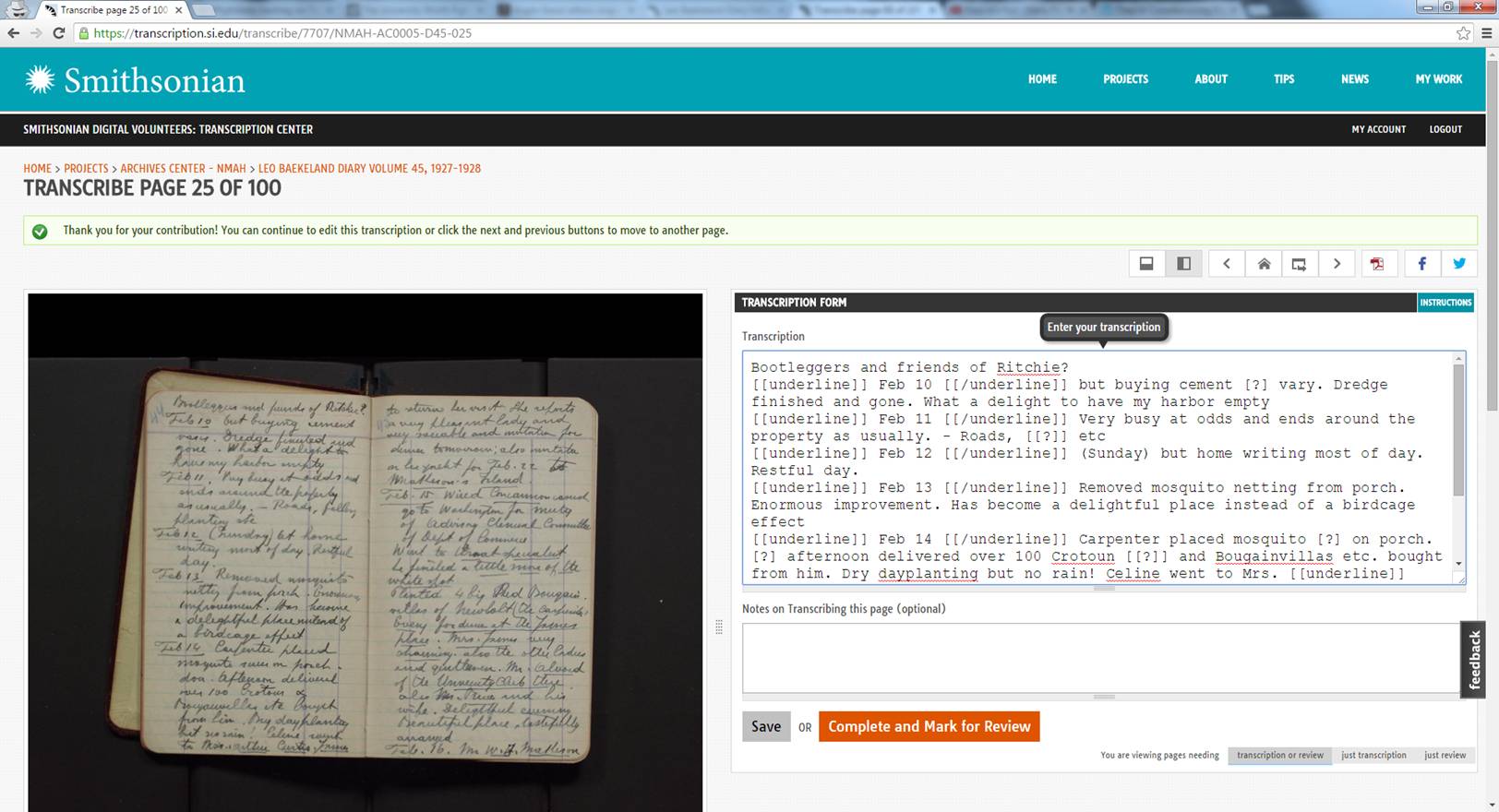
The Smithsonian (https://transcription.si.edu/) is currently crowdsourcing an impressive number of transcription projects, and I was curious to see how their transcription process works. I created an account and read the new users’ instructions, which were surprisingly simple. More advanced users have the option to add additional tags and notes to their transcription pages, but users don’t have to transcribe anything they can’t read—they don’t even have to indicate underlined or stricken text, as volunteer reviewers can add those notations during the text review process. I was surprised at how streamlined the whole process is.
The only difficult part of the transcription process is actually deciphering the text you’re trying to transcribe. I chose to transcribe a page from Leo Baekeland’s diaries, thinking it would be fascinating to help reveal the famous chemist’s personal life to the world. (If you don’t recognize his name, you probably recognize the name Bakelite, an early plastic he created.) However, the page I transcribed is a shining example of just how unsexy crowdsourced transcription work can be: the crabbed script on the page was sometimes illegible, and the text chronicles home improvement projects and dinner invitations—no astounding discoveries or profound thoughts. It is interesting to think, though, that Baekeland found it important to diary his daily activities, no matter how mundane. Did he find the process grounding, perhaps soothing, in the midst of an academic career that hurtled from one award to the next at breakneck speed?
Perhaps Baekeland’s thoughts on the value of mosquito netting—he hated having it on the porch, apparently—will be the breakthrough a future researcher needs to connect previously indecipherable data in one of Baekeland’s lab notebooks. Probably not, but the gusto with which other volunteer transcribers have taken up the Smithsonian’s many transcription projects implies that valuable hidden information has, in fact, been unearthed in these scans over time. There isn’t an official forum for Smithsonian transcribers, but one can get a sense of the exhaustive care taken by volunteers when scrolling through the scrivener notes typed underneath individual pages. This is the harvest that feeds academia, it seems—painstakingly curated, cultivated, and illustrated crop that only ripens when an entirely unpaid community tends it.

