Looking through the DH Resources for Project Building, I found a project through the Maker Lab at University of Victoria, where Jana Usiskin along with the Modernist Versions Project and the Maker Lab developed an interested research program for tracing themes in modernist literature. They describe the specific computing process (topic modeling) for generating their results here: “authors create documents using collocated clusters of words. By working “backward,” computer algorithms sort the words from a set of pre-processed documents and generate lists of words that comprise these clusters. In our work, we are using the LDA (Latent Dirichlet Allocation) probabilistic model. This rather popular model operates on the Bayesian method of inference, a mathematical concept that works backward from an observed set of data to calculate the probability of certain conditions being in place in order to produce that set of data. In other words, it depends on a notion of causality and asks what circumstances need to be in place in order for certain results to occur.” – See more at: http://maker.uvic.ca/mmm/#sthash.6LS1zN2w.dpuf
The graphs generated were interesting in terms of what themes they were able to quantify based on the word clusters. They describe the algorithm as “interested in finding the topics that can be used to correlate all the texts as well as the topics that can be used to distinguish between individual texts.” – See more at: http://maker.uvic.ca/mmm/#sthash.6LS1zN2w.dpuf.
So the project is searching for recurring themes throughout modernist literature in order to show the similar trends in subject material through clusters of words. The resulting charts focused on temporality displayed in three separate graphs: “temporality past,” “temporality embodied,” and “the temporality of place.”
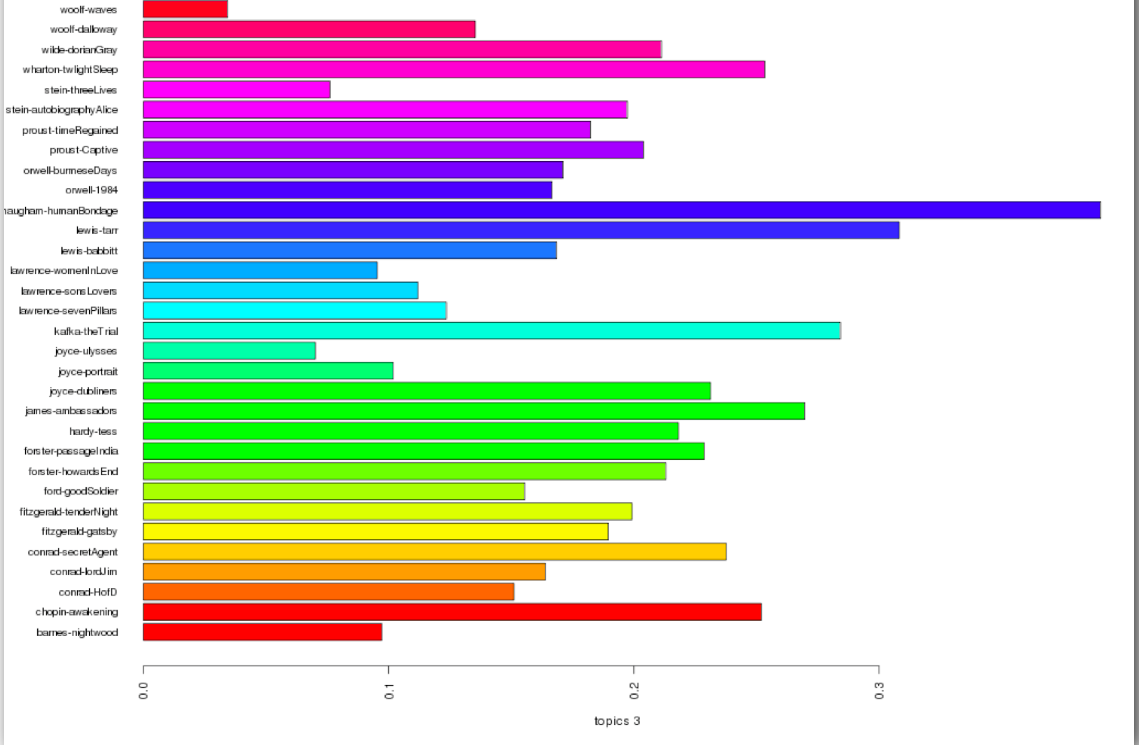
So after reading the basic overview of the project and somewhat understanding their methods, I was a curious about how and why they chose the texts that they did. They admitted to having a narrow selection of 32 modernist texts.
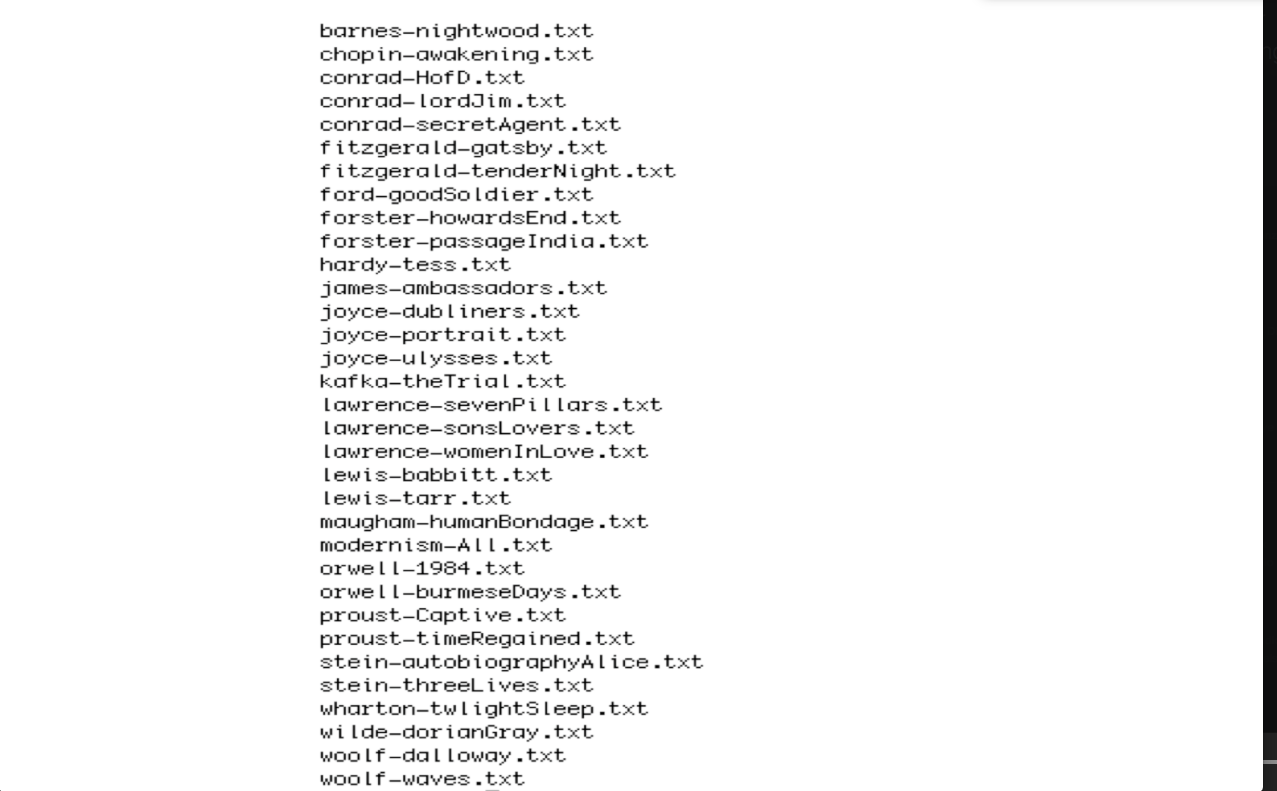
And this is project is a preliminary study using the methods described above. However, I was curious about why these authors. Mcpherson mentions the whiteness of digital humanities, and all of these authors are white and predominantly men. But the topics of temporality would also apply to writers in the Harlem Renaissance, particularly Nella Larson and Langston Hughes or Jose Garcia Villa. They did include quite a few queer authors (Virginia Woolf, Djuna Barnes, Oscar Wilde, and Gertrude Stein), but I was curious if this project were to begin to think about what McPherson outlines and argues in her essay on the whiteness of DH, then where could their research approach take critical race studies in modernism through a DH project? How might they outline racial politics evident in the modernist texts using a similar study?


For some reason my titles aren’t appearing? No idea why.