“Digital Skin” Database Shannon Kenny and Jeremy Cornelius

For our digital humanities project, we would like to make an open access database which centers around the body politic. Jan Radway discusses the body politic in her essay “The Body Project of Girl Zines,” stating, “When thought of as things material and substantive, human and animal bodies seem to begin and end at the surface of the skin. When used metaphorically to refer to the essential part of some thing — the body of a text or the body of the book — that thing itself is understood to be bounded in some identifiable way. Corporate and collective bodies, however, are harder to delineate. What is the body politic? How do we locate it? Where? Who is included and who is not? In this usage, defining the border may be elusive, but that doesn’t make it any less essential to the concept of the body” (224). Radway questions the boundaries and borders of bodies and physical text by thinking through zines fragmenting and restructuring the form of books in hands of riot grrrls. We will expand these ideas from material textuality to the digital realm, specifically the disruption of language and identity through poetry. Our title “Digital Skin” takes from Radway’s line of thinking to reassess the boundaries of identity as well as the boundless borders of digital databases.  


Poetry is a place where the fractured self can amalgamate into complicated bodies, creating intense juxtaposition and questioning the categories we implement upon the self. As co-presidents of the disability student organization, we want to have a forum in which people can learn and discuss about the ways people generate power around the body and how the body is normativized. Our project will work to collect various poetry projects, including online journals, relevant poetic articles and essays, and visual digital works, in order to generate a space for conversation around these forms. And so, our collection will feature poetry centered around body politics with a strong focus on disability, its intersection with race, gender, and sexuality, and a focus on the power dynamics inherent in these classifications.


There has recently been much discussion in academic circles about the silences present within the archive. For instance, the most recent issue of Social Text is devoted to thinking about the silences of the archive and recovery. In “Post-Archive: The Humanities, the Archive, and the Database,” Tara McPherson states “From Michel Foucault’s framing of the archive as a space of enunciation, as the site for what can be said and known, to Jacques Derrida’s fragmentary and feverish archive, scholars have delineated the archive as a complex and contradictory site of power, ideology, and control. The scholarship of the archive is rich and far-reaching if also multi-vocal and sometimes abstract. We have learned of the archive’s deep complicity with empire and the colonial (Stoler 2010; Richards 1993), of its many erasures (Steedman 2002; Hastie 2007)” (McPherson 485). Through the Digital Skin database, we hope to engage in an ongoing conversation around body politics in poetry, particularly focused on disability, race, gender, and sexuality. We hope to approach this collection with a countercultural approach to notions of power, identity, and ideology presented in multi-vocal poetry and ultimately work through the complications of representation and visibility.


We want to both represent and trouble taxonomized identity categories, which

becomes increasingly complicated as databases require metadata in order to make the items searchable as we saw with the exercise for class on Omeka.com. However, as queer theory rightfully critiques taxonomies of identity based on its often violent and pathologizing histories, how do we both inhabit these categories as a means of political and social activism, while simultaneously critiquing the power and potential reductiveness of these identity categories? Poetry is a vehicle for reassembling identity and working within these structural restraints. Collecting poetry that focuses on the body in an online database will hopefully enable and enliven discussions around identity politics and the categories that we are bound to inhabit in the world.  


In furthering our aims to broaden the conversation around taxonomized identity, we want to have a way for users to contribute to our site and its workings, in order to approach poetry as an ongoing dialogue. In essence, we will create an online poetry community which can also be accessed and influenced by a multidisciplinary perspective, as well as those outside academic spaces. We hope to learn, as we discuss the ways people are using DH outside of academia in the weeks to come, how others are creating online poetry projects/works, especially unique representations of radical politics. In disability, the digital spaces are important in forming communities for those with restrictions (both physical and mental) that prohibit “showing up” in the physical world. And, when it comes to race and sexuality, and creating these countercultural spheres of influence, physical safety becomes a concern for participation in movements around these politics. So, online spaces are important in the expansion of and participation in identity-forming, generating important resources for those working in these multi-dimensional frames. We want to include these voices in our initial product, while also granting them (and others like them) ways to add to our vision.


Some questions we have:


  1. We would like to have images included on the site, and not just hyperlinks. How can we structure this so that we can have more of an interactive digital landscape as part of our database?
  2. We want to think about how this fits in, how it doesn’t fit in, and in what ways it subverts/challenges/etc. literary canonicity. For example, Virginia Woolf’s work can be viewed through the lens of disability, even though it wasn’t necessarily contextualized as that at the time. We are working with very contemporary models, but we wanted ideas on how to pull from these past spaces, and potentially investigate the laid-out frameworks of these works.
  3. What website should we use to create our project? We’re thinking WordPress so we can use images, but does anyone have any alternate suggestions? Because we also want others to be able to contribute, and just be able to approve their additions on our end.
 

Discourse and Digital Dialogues

Lit Review

Discourse is the overarching, dominant, cultural or institutional “narrative,” and it circulates hegemonically or hierarchically (“vertically”) more or less independent of context (Nafría and María). Dialogue is the process of exchanging “messages” (I assume for any purpose) and it occurs collaboratively (“horizontally”) and is shaped by context (Nafría and María). But I think the relationship between the two is still reciprocal. If I think about my analysis of the poems and literacy circles using these concepts, I might look at how the poems and the dialogue among people “merely” reflect the overarching discourse, but also how those dialogues might disrupt or resist that discourse. This also helps me think of Freire’s work as using dialogue to critique and resist the discourse (“By stimulating ‘perception of the previous perception’ and ‘knowledge of the previous knowledge,’ decoding stimulates the appearance of a new perception and the development of new knowledge. During the decoding process, the participants…externalize a series of sentiments and opinions about themselves, the world, and others…)

Research Questions & Methodology

For my final project I want to analyze digital dialogues (written) about colorism to understand how they reflect and/or resist the dominant discourse on colorism. 

In order to accomplish this I will analyze the following sets of texts:

  • blog posts
  • comments on blog posts
  • tweets
  • Digital/digitized journal articles, theses, books, dissertations, etc.

using some or all of the following (and possibly other) tools:

to perform the following (and possibly other) tasks:

  • Word frequencies
  • topic modeling
  • Named Entity Recognition
  • Sentiment Analysis

In the scope of this semester, my goal for this project is simply to mine the data and see what happens. Therefore, my final product will be an analytical report (generously illustrated with various visualizations, of course).

Rationale

The rationale for such a report is that it will be useful in ‘perceiving perceptions’ and ‘knowing the common knowledge’. It can be a tool for “conscientização” (Freire) or “consciousness raising” in the context of critical dialogue.

Additionally, a clear understanding of the broad, dominant discourse on this topic facilitates the identification and understanding of contraflow when, where, and how it occurs.

This might possibly be the largest “lit review” on colorism ever attempted.

Limitations

One significant piece of the discourse that I’m not sure how best to track (and so probably will not track for this final project) is all of the non-written dialogue. YouTube videos, podcasts, Vimeo videos, songs, speeches, memes, photos, illustrations, etc.

Atlas of Astounding Stories

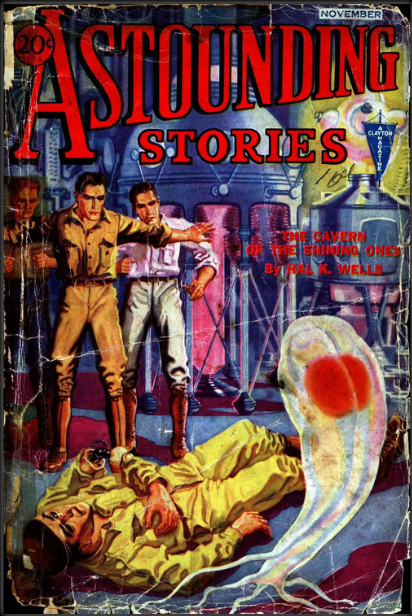
For my seminar project, I will continue the work I started last week for topic modeling. I took as my subject the twelve monthly issues of Astounding Stories of Super Science, a science fiction pulp magazine founded in 1930. Astounding Stories eventually became Analog Science Fiction and Fact, which still publishes science fiction. My project will continue the work I have already done in several stages.

Screenshot 2016-03-16 16.34.48

First, I will continue building my corpus. For each story or portion of a serial work in the first year of publication, I removed artifacts introduced by the transcribers, such as illustration descriptions, as well as elements added to the manuscript by the magazine staff, such as advertisements, recaps of previous installments, and sidenotes. This left me with text files that included only the text of each story. I will continue this work with the remaining issues of the first iteration of Astounding Stories, which was discontinued after the March 1933 issue due to financial problems stemming in part from the Great Depression (it was then sold to a new publisher). This initial 34-issue run represents a manageable corpus of about 200 stories with a variety of authors, many of whom contributed several times, under the supervision of a single editor, Harry Bates. While I cleaned these text files manually for the existing corpus, I will attempt to use TextWrangler to automate this process in the future. I will also collect basic metadata for these text files (date, volume, issue, author, length) and associate it with the text files in Zotero.

Next, I will mine this corpus using Voyant, Mallet, Stanford NER, and the Paper Machines plugin for Zotero. While performing topic modeling on my existing corpus, I ran into issues with fanciful names of characters, planets, and alien races clogging up my topics, which led me to create a provisional name stoplist that included not just “William” but “Jetta” and “Sarka.” As I move forward, I will use the Stanford NER to extract these named entities not just for potential use in a stoplist but as a valuable corpus and reference list (not to mention a test of the NER software’s ability to return valid results on wholly original named entities).

Hopefully, this text mining process will yield productive directions of inquiry. To that end, following Moretti’s example, I intend to produce an “atlas” of maps and graphs that might reveal patterns within both the imaginative and real contexts of these stories. For instance, I might use ArcGIS along with Stanford NER to map the settings of these stories. I could also use the lists produced using NER to investigate naming conventions among the magazine’s cadre of authors. Ultimately, I want to investigate how these adventure stories in science-fiction trappings represented particular visions of the exotic Other (such as aliens, subhumans, and monstrous creatures), as well as a geographic analog to otherness that might be called Elsewhere (such as alien planets, deep caverns, and the bottom of the ocean).

Although I consider this project to be primarily an investigation of a particular corner of the American popular imagination, I may also investigate the real-world contexts of these stories’ publication. For instance, I could use social network mapping to visualize the creative and professional relationships between the magazine’s authors, or turn my attention to the many advertisements and reader letters published in each issue.

I envision that this project could continue after this semester. After all, the magazine has continued to publish science fiction under several names for more than 80 years. However, most of the issues produced after the magazine was first sold in 1933 are still protected by copyright, which is a possible barrier to expanding the corpus of Astounding Stories. That said, many contemporary issues of magazines such as Amazing Stories are no longer under copyright and might provide valuable context for the stories from Astounding Stories.

Evangeline Images Archive

For our project, Caroline and I would like to expand our mini digital archive project, Faces of Evangeline, by archiving various illustrations of Henry Wadsworth Longfellow’s epic poem, Evangeline.  We think this project is worth revisiting and expanding because Evangeline is an iconic representation not only of American literature during the 19th century but also of Cajun culture in Louisiana, depicting the mass movement of people from Canada to Louisiana. So the character Evangeline is literally the face of a culture and a people. That’s why we want to archive all of the images of her we can get our hands on.

Within the many editions and publications of the poem there are various illustrators who represent Evangeline in a wide array of styles. While there are online databases that have archived Evangeline and Henry Wadsworth Longfellow’s works in general, these resources are not geared toward the illustrations that supplement the text. This is where we come in! Since the poem’s publication in 1850, many different illustrators have contributed to a collective representation of Evangeline. Just as we’ve discussed in class how the organization of databases can influence researchers, adding unique visual interpretations to the text can enhance and broaden the ways in which readers perceive the text.

With this project, we hope to contribute to the DH initiative to “reshape the representation, sharing, and discussion of knowledge… no longer bound by print” (Sampler).    In this collection, we want to create a way to archive the illustrations in the context of the poem so that users will not only be able to compare various interpretations of Evangeline over time, but also compare how the same passage of the poem is visually interpreted by different illustrators. We would also like a portal where users can upload their own illustrations of Evangeline to continue to add to this visual discourse.

We want to create a platform to compare illustrators’ variations of the story. We are excited about the crowdsourcing potential of our archive, which will allow users (with both academics and normal people in mind) to contribute their own illustrations or findings to the archive.   In terms of our platform, we are thinking about returning to Omeka because it offers visualization and viewer input plugins that are virtually tailored to our project. We are also considering similar content management software, such as Drupal. We are still poking around with specific tools we want to use for the archive’s aesthetic and organization. Right now, we are most excited about the crowdsourcing potential mentioned above, and about the prospect of creating a Timeline visualization that users can navigate with dual chronologies in mind: the timeline of the text itself, and the timeline of the illustrations’ publication dates. We were also toying with the idea of creating a mobile app, but we are at a loss for where to start with that (guidance welcomed if anybody knows anything at all about it!).

In creating this project, we hope to spark discussions about “Evangeline” and Louisiana culture but also other people who have been displaced, culture, and women. Although we are archiving interpretations of Longfellow’s work, like the digital humanities project “Expanding the Republic of Letters,” we are hoping to expand Evangeline. As McPherson in her article “Why Are the Digital Humanities So White?” and Wernimont’s “Whence Feminism?”, we are incorporating perspectives that, when combined and viewed as a whole, fall outside of canonical categorization. We are looking at this poem from a visual angle, providing context to the illustrations and  representing a displaced female character (sometimes by a female illustrator). As a side note, later on, we would also like to include the French version of this tale.

Snails in the 21st Century: Grass Digital Archive Proposal

Günter Grass, in one of his final interviews, revealed a deep-seated antipathy towards the digital sphere. He says, “I still write my manuscripts by hand. Afterwards, I type them onto my old Olivetti, my travel typewriter. I don’t have a computer in my studio. I don’t have a mobile phone. The mere thought of having a mobile phone on me all the time – so being reachable all the time and, as I now know, – being monitored all the time, is a horrific thought.” In keeping with Grass’ own penchant for irony, I propose my intention to create a grant that would hopefully create a centralized hub for Grass scholars worldwide.
“Here Come the Snails: The Günter Grass digital archive,” would include writings, drawings, interviews, and other artifacts related to the Kashubian Gdansk-born German novelist, essayist, and political activist. Additionally, I would hope to include annotated bibliographies, critical essays, transcriptions, and other secondary information related to Grass. The idea would be to create a digital space that would represent in form, presentation, and content, the personage and work of Grass.

In going about this, the importance of language would need to be stressed in all the presentation of materials featured on this proposed archive. Grass often wrote about the power of language as a tool of reform and resistance to authoritarian regimes. Specifically, Grass saw his artistic and literary mission as one that sought to “take the goose-step” out of German. In keeping with this tradition, the materials featured should be presented in many different languages so that a cross-national audience of scholars and non-scholars may engage with Grass’ work.

Additionally, Grass was a scholar who attracted much controversy throughout his career due to his involvement with the Waffen-SS early in his life. Further, his novel, The Flounder, was criticized for promoting sexism. He unpopularly opposed German Reuinification and defending his opposition in his works Too Far Afield and Two Nations, One State? And, at the end of his life, he published a poem entitled “What Must be Said,” harshly criticizing Israel foreign policy towards the Palestinians. Because Grass was so rarely neutral on issues of great importance, neither should an archive bearing his name. Essays critical of both Grass himself and current events Grass would likely have something to remark on should be included in this project. The goal is to simultaneously preserve Grass’ artistic legacy while refusing to perform hagiography on him.
Given the ambition of this project, a grant proposal would be more apropos since anything I could do on my lonesome would invariably not live up to the legacy of Günter Grass. Further, as a white male, I possess biases that limit my ability to be critical of Grass from all necessary angles. Therefore, a multi-ethnic, preferably, multi-lingual group of scholars would be necessary not only in the production of critical material in the Grassian vein, but in the maintenance of the website.

The legality and availability of Grass’ writings presents another set of challenges as well – Grass died in 2015 and many of his writings are not yet in the public domain, making tools such as Hathitrust a non-starter. As such, a truly good digital archive would need to reach out to Grass’ publishers in order to gain data for text-mining and topic modeling if such methods are eventually needed.

Further, Grass Studies are connected to Holocaust studies and Diaspora studies – making the necessity of reaching out to these groups far more necessary. As such, the ability to make a satisfactory website requires funds, creativity, perspective, and labor beyond what I can muster at the moment. However, these institutional hurdles can be cleared with the right creative vision and intellectual gumption. As a result, creating a grant proposal of this type represents a great opportunity to “go beyond the page” as it were in exploring the vast literary scope and breadth a writer like Grass offers to a world he admired so dearly.

Sources:

http://herecomethesnails.tumblr.com/post/138647481897/transcription-of-grass-interview-with-louisiana

http://www.theparisreview.org/interviews/2191/the-art-of-fiction-no-124-gunter-grass

From “Cornfield Journalist” to Political Commentator

Joel Chandler Harris lived with debilitating shyness, repeatedly expressed regret at having his name in print, and insisted that he was a mere “cornfield journalist,” not a literary leader. However, in 1881, New York Times called Uncle Remus: His Songs and Sayings “the first real book of American folklore,” and by 1900, Harris was publishing his opinions on the principles of capitalism in the Saturday Evening Post.[1] In my final project, I intend to explore the connection between Harris’s early regional writing, and his later political commentary. What publication processes and professional connections led the shy regionalist to a position from which he could provide political analysis to a national audience?

Digitally visualizing Harris’s publications and correspondence will, I predict, reveal connections between the growth of a national audiences for his regional tales, his social and literary networks, and his eventual position as a political commentator. These patterns have the potential to help us more deeply understand how regional writers were endowed with a sense of authorial authenticity that contributed a sense of credibility to their nonfiction essays. As Richard Brodhead writes in Cultures of Letters, “regionalism made the experience of the socially marginalized into a literary asset.”[2] Harris, like all regional writers, performs marginality in his texts, and this performance of marginality could be used as cultural currency in nonfiction publication—a genre that did not typically value marginality.

I will explore Harris’s cultural transition by mapping his letters and publications using Neatline, a digital exhibit-builder that provides a way for scholars to connect maps with timelines and narratives. With this tool I will not simply create a static map, but I will also sync the map with a timeline of Harris’s biography and publication history, thereby visualizing the large-scale geographic and social networks that shaped Harris’s career. I hope to color code his publications by genre, so that the map will provide a clear visual of Harris’s shift from fiction to nonfiction writing. In order to use Neatline, I will need space on a server. Fortunately, I have been given access to the Digital Scholarship Lab’s server, and a programmer in the library is assisting me with the initial technical set up.

To return to the analog world, I will use information about Harris’s publication history, correspondence, and biography provided by books such as: The Life and Letters of Joel Chandler Harris by Julia Collier Harris; The Life and Letters of Joel Chandler Harris by Robert Lemuel Wiggins; Joel Chandler Harris: A Biography by Paul Cousins; Joel Chandler Harris by R. Bruce Bickley; and, perhaps most importantly, A Checklist of the Periodical Contributions of Joel Chandler Harris by William Bradley Strickland.

When I’m finished with my final project, I hope to have a digital map that will reveal connections between regional fiction, literary and social networks, and political influence; an understanding of these connections will allow me to propose written arguments about the development of Harris’s career and its place within the national literary and political landscape.

[1] Robert Hemenway, introduction to Uncle Remus: His Songs and Sayings, (New York: Penguin, 1986), 9-14.

[2] Richard H. Brodhead, Culture of Letters: Scenes of Reading and Writing in Nineteenth-Century America (Chicago: U of Chicago P, 1993), 117.

ARGs and Library Research


In addition to teaching writing mechanics, analytical writing, and argumentative writing, English GTAs and faculty are tasked with instructing students at LSU basic skills for effective research. Our students, especially freshmen 1001 students, often find research intimidating, as they are tasked with evaluating resources on their own for the first time. Some students do not see value in investigating sources beyond their database abstracts, and/or view their inclusion in the LSU library database as self-evident proof of source relevance.

In her presentation, Leah discussed some valuable methods of incorporating DH tools into our undergraduate classrooms; along similar lines, I am proposing the development of an Alternative Reality Game (ARG) to aid first year composition students at LSU with developing the skills required for effective library research in a fun (and productive) avenue.

An ARG is a video game, often mobile platform based, which intertwines the real world and game space to create a networked narrative gameplay. Most ARGs use either posted QR codes and/or GPS coordinates to stimulate events within the game space, often leading players to their next area of discovery or investigation. ARGs have often been likened to digital scavenger hunts, but unlike typical scavenger hunts, the transmedia nature of ARGs allow for real-time manipulation of the game by either the creator(s) or, in some cases, the player.

ARGs offer several educational advantages related to both tech literacy and critical investigative skills; most importantly for library research, ARGs encourage a strong skepticism of digital information based on their gameplay mechanics and reliance on detail interpretation. Most importantly, ARGs encourage the same set of DH principals discussed by Lisa Spiro in “This is Why We Fight”: openness, collaboration, collegiality, diversity, and experimentation. Thus, the creation and implementation of my proposed ARG into lower level English courses may serve the dual purpose of engaging students in library research while also exposing them to core DH values.

I understand that this is a very basic definition of ARGs; however, I plan on expanding my explanation of ARGs and their potential use for humanities educators during my in-class presentation on April 14th.

For the final project, I will use ARIS, an open-source ARG creation tool, which you can learn more about (and play around with) here: http://arisgames.org/

Of Grass and Grammar

This week’s excercise and readings regarding data collection and topic setting is illuminating insofar as it demonstrates the similarities between the Social Sciences and the Humanities. The notion that the humanities is somehow less technical or evidence-based than the social sciences is a tenuous notion, especially in light of Jockers’ writings regarding scale and theme. Indeed, Jockers’ creation of stop words and his appraisal of certain tools for use in the DH, isn’t explicitly DH, it’s statistical as well.

In the statistical fields, what Jockers is doing would be called “coding” and his attempt to illuminate certain patterns already existing in texts is extremely valuable in uniting the digital and the humane – the humane and social scientific.

In terms of my own research, topic modeling the interviews of Günter Grass, as opposed to his novels, seems like it would be extremely fruitful. Grass speaks of his novels consisting of German “tapeworm-length sentences.” Indeed, many readers of Grass are either amused or frustrated (or both) by these long sentences. Yet, in his interviews, Grass is much more reserved, speaking in very short, even fragmented, sentences. By running a topic model on Grass’ sentence structure, a comparative study could perhaps quantitatively indicate this distance. And through interpreting the topics of these sentences, perhaps show why.

Canary in a Text Mine Cont’d

Underwood says topic modeling is a way of inferring what discourses could have contributed to the creation of a set of texts. This idea relates to the notion of literacy (and literature) as a social practice (which is the perspective I’m using in my own research) and perhaps allows us to shift focus from the interpretation of individual standalone texts to the interpretation of various contexts, texts in context.

Underwood also mentions that the focus here is on probability (not “fact”) and that we should “reflect carefully about which assumptions we actually want to make.” Of course I’m all about examining assumptions, particularly the latent cultural and racial assumptions that we’re often oblivious too.

There was a moment, though, when I wished we’d (humanities, esp. Literature, folks) stop mythologizing the hard sciences. In my notes I quote Underwood: “This sort of thing is very much a critical judgement call; it’s not a science.” I then add the following commentary: [but science is also quite often a critical judgement call!!!].

After reading Underwood, I think Jockers offers a clear, interesting, and useful explanation and illustration of topic modeling, texts in context, and probability. Jockers actually highlights the probabilistic nature of topic modeling by giving us percentages of accuracy. I found this act of transparency important in a field with so much “hyperbolic rhetoric” about the saving powers vs. evils of DH. Having read multiple pieces from his book, I’m actually intrigued and want to follow his entire thread by reading the whole book.

A most interesting read, given my present projects, is Rhody’s piece about topic modeling with poetry. I think a crucial difference in how Rhody approached her poetic corpus with the way I approached mine is that I already knew “the topic.” I’m not really mining for topics, per se, but essentially looking at how poets choose to write about one particular topic (colorism). My question when using these various tools is How do poets represent X topic? What images are they using? What metaphors etc. do poets turn to when writing poetry on this predefined topic. So, I’m curious to see how the topic modeling will work given that I already know the topic I’m interested in and the topic that each of these poems is (supposedly) about, and that I’ll be reading the results with the question, What’s the relationship between these word clusters and the central theme that’s at the heart of the project? What do these “subtopics?” reveal about the overarching theme and how poets are pulling from various discourses (Underwood) to portray that theme?

Finally, to explain why I use the canary in a coal mine metaphor, this all resonates with the intersection of labor, value, risk, experimentation, and uncertainty involved in DH projects. Of course the stakes are exponentially lower when mining texts, but we have seen that text mining requires labor, that we hope for some value, and that the text mining process requires risk, experimentation, and uncertainty.

Poetry

I mined my own collections of poetry using Voyant. I uploaded five collections (2 chapbooks that have been accepted for publication and are in production, and 3 manuscripts that have not and are works-in-progress). Perhaps something resembling a research question would be along the lines of comparing the differences between those accepted for publication and those not yet.

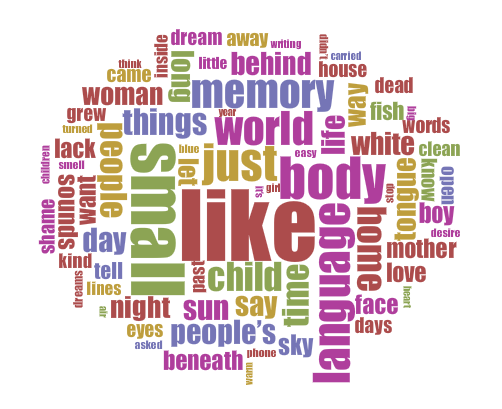
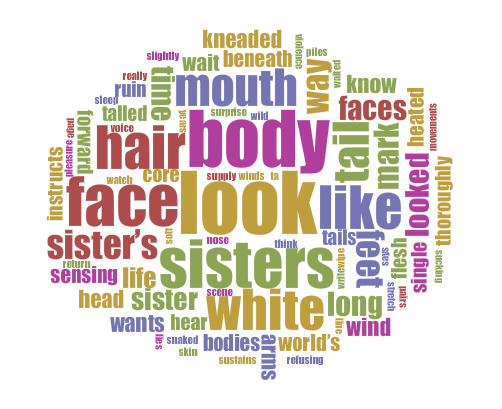
The following word clouds is from a collection that is in production and forthcoming later this Spring. I did find it interesting that this one features more words that are related to the body– words that correspond to specific concrete object–such as ‘body,’ ‘hair,’ ‘mouth,’ ‘tail,’ ‘sisters,’ ‘face,’ and so on. Perhaps in terms of what publishers find ‘fashionable’ to publish, there is still attention toward representations of bodies on the page? Acknowledging that this is a small sample size, however, doesn’t quite confirm anything more than posing a hypothesis.

propwordcloud


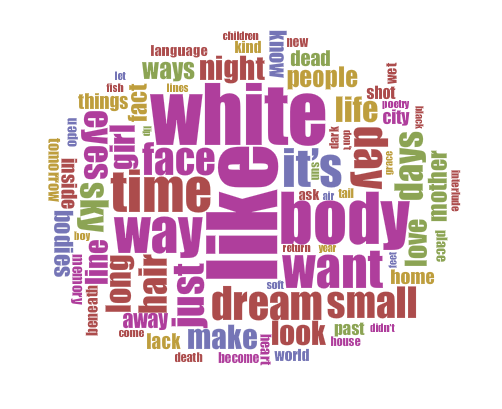
My current manuscript-in-progress (word cloud below), on the other hand, seems to have shifted slightly to include more abstract, idea-based terms, in addition to physical/concrete language. Some words pertaining to corporeality remains (“body,” “eyes,”), but other abstract words like “memory,” “world,” “child,” “time,” “language,” also became more prominent.

Notably “like” is prominent in both texts, suggesting a reliance on similes.

modulation


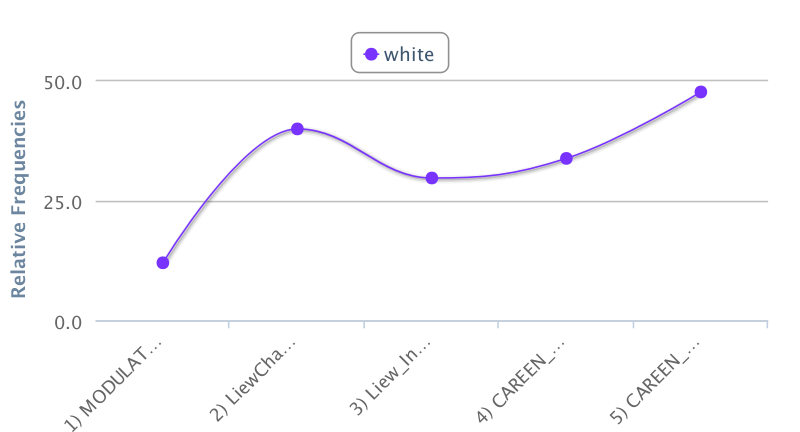
One of the most prominent words for all five collections is the word ‘white,’ which reflects my particular poetics and method of writing about race by its inverse ie, flipping back the gaze from hypervisible racialized bodies onto whiteness, and have that presented on the page instead.

all5

chart


I haven’t yet really mined my own writing this way to find patterns and frequencies, and I think what has been helpful was that it allows me to identify and bring to the surface (rather than residing in the subconscious) some of the ways I write about recurring themes, as well as explore new ways to diverge from and experiment with representation within creative writing. The frequency of the word ‘like’ actually surprised me because I recall trying very hard to move away from similes (for whatever reasons I have harbored against similes), and yet, there it is, showing up very prominently.


Hathitrust

I too have been running into some problems with pulling up enough data sources on HathiTrust that matches my research interests (contemporary poetry, Asian American poets, and cultural theories that are largely circa 20-21st century). The search process was actually really frustrating, since at the very least I wanted to find something pre-1923 with a lineage toward my current research interests, rather than randomly mine say Shakespeare for the sake of it (not to mention I wouldn’t be able to pose relevant questions regarding a field so far out of my current scope). I will try to return to this later today.

UPDATE:

My initial attempts to focus on Asian American poetry led me to realize the dearth of resources in that area (pre-1920s), and led me too to finding a lot more surrounding information on the field of Asian American poetry as well as underresearched areas. I found out, too, that Asian American poetry is inextricably tied to USA’s immigration policy. Another underexplored link I found is the link between AA poetry and modernist poetry, with some commentary making the point that scholarship in those two areas have always been discrete and separate, rather than studying closer the cross-pollination and relationship between the two.

As I was only able to find a handful of names for pre-1920 AA poetry (Yone Noguchi, Sadakichi Hartmann, and Bulosan), I crowdsourced on facebook for help to no avail (which confirmed the lack of sources). I decided to open up the field of inquiry to include translated poetry from Asian languages. I was reluctant to do so because translations in the early 20th century were almost 100% the territory of white male writers, many (if not all, in my worksheet at least) of which either never set foot in the country whose language they translated, or didn’t even speak the original language themselves (most famous being Ezra Pound). I felt that this changed the composition of the collected texts, since the two (to me, anyway) operate from very different positions and hold very different assumptions. For example, some early 20th century AA poetry came about as critiques of the racism faced by the AA community (and the prominent yellow peril scare), whereas American translations of Asian poetry often was done through the very orientalist/fashionable lens that resided in an imperialist context. I am still not sure how to reconcile the two. I did some topic modeling and wordcloud (for words that most frequently occur among the texts) and posted the results to Moodle.

I think what I gained from this exercise was a thorough introduction to modernist-era AA poetry (and its lack). Moving forward I would be interested to examine the links between AA poetry and the advent of modernism and modernist techniques in poetry, as well as some of the restrictive immigration policy and anti-Asian climate around the turn of the century that contributed to the lack of AA poetry. (Maybe this is slightly off-topic since it exceeds the level of text-mining? But to me I feel it’s still..process related.)


css.php