Disability, Pedagogy, and Reassessing Familiar Technology

In thinking more about accessibility, pedagogy, and technology, I’ve been thinking explicitly about dis/ability and privilege and their relation to different technologies. While reading “Utopian Pedagogies” by Elizabeth Losh, I couldn’t help but feel that some of the points she was addressing were very engaging, but also possibly not fully embracing the many differences that accessibility can take.  I also wondered about how she is considering teaching from the margins specifically, given the title. However, Losh definitely addresses some interesting points around subversion and utilizing digital technologies as enabling creative and alternative forms of learning. I like her approach of subversion through digital technologies: “These are also pedagogies that draw attention to the procedural character of learning in ways that are potentially deeply subversive” (431). Although, my first question here is subversive for who? But I do agree that utilizing digital technologies has subversive potential. She continues saying, “Rather than present such procedurality as a set of predictable linear and hierarchical processes in which learning outcomes and assessment methodologies emphasize prescribed prerequisites and goals that are hard-wired into paths of sequential steps to success of failure, such pedagogies invite questions about rule-making and rule-breaking by facilitating activities that bring operational logics to the forefront.” Losh here is thinking about how technology can reorient pedagogical strategies in different directions by having students critique the very technology around them and begin to see the underlying logics functioning in these devices. And I’m particularly seeing this subversive pedagogy in connection to how access happens with these technologies. I would also definitely take her class on digital poetry.

Disability has a particularly interesting relationship to accessibility. As humans interact with the structures of materialized technology, dis/ability has a way of complicating and reassessing this relationship to it. How does the physicality of a body interact with technology? So for instance, how might someone who is blind or has low vision be able to use digital resources? What becomes of the usefulness of a screen when someone’s vision is impaired? Everyone has different ways of engaging and accessing technology, which largely goes overlooked when thinking about the physical design or structure of a website or platform. This recognition between user and platform becomes a way of also addressing and highlighting ability to then begin to possibly subvert ableist approaches to understanding digital technology.

Hastac.org has a list of different class activities, which I looked through and found one on disability (https://www.hastac.org/blogs/merylalper/2014/02/07/03-disability-and-defamiliarizing-smartphone-class-activity). The exercise is a very clever and simple way to have a class reassess their relationship to technology that they are familiar with. Meryl Alper, who designed the exercise, explains it as “Disability and Defamiliarizing the Smartphone,” where they break into small groups and explore the accessibility options on their phones. She explains that some students cut on the voiceover feature, where other students can hear their text messages, which causes them to feel very vulnerable and exposed. This exercise struck me also because the students aren’t necessarily put in a position of problematically imagining themselves with a disability, but instead are thinking about the how accessibility is structured on a device that they think they are feel familiar with, which makes them reassess their own relationship to not only technology, but their own abilities.


Teaching to Fail

The “Failure” keyword of the Digital Pedagogy in the Humanities collection includes the “Teaching to Fail” artifact, which is derived from an essay by Edward Burger. His pedagogy is based on acknowledging, rewarding, building on, and celebrating failure in a variety of ways. In order to destigmatize–even encourage–failure in the classroom, Burger bases 5% of his students’ final grades on their “quality of failure.”  Grading students on failing throughout the semester encourages them to share their mistakes rather than hiding them–and encourages them feel free to make more mistakes in the first place.

For certain essay assignments, he instructs students to “intentionally fail–in the spirit of an industrial stress test” by first having write a first draft of an essay “very quickly and poorly” long before it’s due and also submitting their marked-up second-to-last draft with the final one.

That 5% “quality of failure” grade is based on several factors:

In the case of assessing “quality of failure,” at the end of the semester I ask my students to write a one-page reflective essay describing their productive failure in the course and how they have grown from those episodes (which might have occurred outside of class — including false starts and fruitful iterations). They conclude their essay by providing their own grade on how they have evolved through failure and mistakes (from 0 – meaning “I never failed” or “I learned nothing from failing” to 10 – meaning “I created and understood in profound, new ways from my failed attempts”). I read their narratives, reflect on their class participation and willingness to take risks, and then usually award them the surprisingly honest and restrained grades they gave themselves. To date, I’ve never had a student complain about their “quality of failure” grade.

Burger’s approach of teaching failure isn’t specifically related to dh. However, it is often impossible to learn how to use digital tools effectively without reaching failure or limit states. Rewarding failure through grading practices makes the value of failure tangible to students who might otherwise fear reaching the limits of digital tools and processes.

I don’t necessarily intend to bake failure into my syllabus. However, crafting assignments so that students are not just set up to fail but intend to fail seems very productive to me. I don’t want to toy with my students. Kobayashi Maru style tricks are against my teaching philosophy, but desmystifying writing and critical practices is very much part of it. Making “failure” –something that students are conditioned to avoid more than anything else — a part of the classroom conversation in a positive way seems deeply productive.

Close Reading and Networking

The article “Description” sets out some interesting keywords when thinking about digital humanities pedagogical strategies including “remix,” “play,” “collaboration,” “race,” and “failure.” And, as I was thinking about what kinds of things I would want to encourage in my classroom (when I teach one day), I was drawn to the words “play,” “collaboration,” and “failure” in part because I think that these words are not normally associated with learning and coursework. So, I wanted to incorporate these ideas in my post while I was thinking about digital pedagogy in the humanities.

I am particularly excited about collaboration in digital humanities, not just between local colleagues or networks of scholars working on a project but in participatory culture, fandoms, and collective intelligence more broadly on a wide variety topics. I think, as Henry Jenkin’s argues in Convergence Culture, that participatory culture is vital for understanding communication today as well as helpful when working through the rhetorical triangle (speaker, audience, and message) as well as rhetorical appeals and close reading. Additionally, participatory culture also deals with the same issues that digital humanities struggles with, particularly authorship and open access.

Because of the passionate and voluntary nature of the participatory culture, many of these fandoms and groups perform close readings of the texts and shows that they love, which also makes close reading fun and exciting. For example, the Harry Potter fandom has countless re-readings and re-interpretations of the movies and the books surrounding the series. And, they create these re-readings together and in a way that challenges traditional academia:

Harry Potter Interpretation

So, when I was looking at digital tools or assignments in the classroom, I wanted something that reflected at least some of these thoughts about participatory culture, close reading, and visual analysis. I really liked Cordell’s example of his student using a Tumblr to work through fandom communities and practices since his student could interact in a network space. I was also intrigued by Netprov that is mentioned in “Interface” since students made their own images to tell a story or make an argument that can be analyzed. Likewise I was intrigued by Gayle’s post about analyzing images in ThingLink.

So, to incorporate all of these assignments into one, I made my own assignment. To start small and get students into new media, as Cordell claims in his piece, I thought it would be cool to have a few weeks set aside so that students could interact in a participatory group online and not only close read the rhetoric surrounding their groups but also create something to add to the discourse.

Part 1: Join a group. Students join a social network group on Tumblr or another social networking site that encouraged creation and collaboration on something that interests them and involves close reading, and this could be anything from Harry Potter and Doctor Who to Game of Thrones, football, wrestling, or fashion.

Part 2: Examine the participatory practices. Check posts often, examine the practices and how people post.

Part 3: Take part in the discourse. Comment on a post, add to a post, and create a meme. http://www.digitaltrends.com/social-media/how-to-make-your-own-meme/ (I think the meme would be extremely fun but also helpful to get students to think about how to use an image and few words to make an argument or a post that adds to a discourse).

Part 4: Analysis. How did other people create their posts? How did you create yours? (Get students to fill out the rhetorical triangle and rhetorical appeals)

This is just the skeleton for the assignment. But, this assignment would allow students to play around with technology and media they may be more familiar with (and if not then experiment), to collaborate with peers in other discourses online, and the opportunity to fail at maybe making a meme or communicating online.

Honestly, I’m not sure if this assignment would necessarily qualify as a digital humanities assignment, but I think this would be an interesting way to get students not only comfortable with technology and ideas surrounding new media, like participatory culture and collective intelligence, but also to become comfortable with close reading. I think this assignment could also be a spring board into other projects that students could experiment with such as creating visualizations of social networks with a tool like Netlytic to examine how the participants in these networks affect the discourse realistically. And, perhaps students could also use this tool to analyze who is actually participating in these online social networks. This could also be an interesting first assignment or an introduction to thinking about social networks before digital media like the course from the Mapping the Republic of Letters (Networks: Ecological, Revolutionary, Digital) that examines how other networks operate and compare these networks to social networks now.

Outlining with Prezi

Since I am steadily making progress on my ARG with 1001 students in mind, I wanted to find other ways to incorporate digital interactive experiences into the composition classroom, especially those which would help students to visualize the writing process and feel more engaged with their work. For the assessed assignment in 1001, students are asked to analyze an issue and its various subtopics and stakeholders. We do our best to prepare students for such a large undertaking, but many of my students at the end of the semester still struggle with organization and determining how much summary and/or background information is relevant to their argument. For this reason, the Issue Analysis first drafts often read more like a history report on an issue than a mature analysis. Last semester, my technique for solving these issues included having my class create a reverse outline of their drafts (a technique I’m sure many of you are familiar with). This strategy was successful enough, but I wondered if there was a way to engage the students with the creation of an outline through digital tools, perhaps creating a visual map of their essay so that they could see their own writing through new eyes.

After conducting Google searches on “digital humanities and composition outlines”, I found this lesson plan from the University of Texas at Austin’s Digital Writing & Research Lab called “Using Prezi for Outlining Papers”: http://lessonplans.dwrl.utexas.edu/content/using-prezi-outlining-papers

In this lesson, students break down their writing notes into categories and sub-categories, and then create a visual map/draft of their essay through the presentation website Prezi. (If you aren’t familiar with Prezi, here is an example presentation.)

When students finish, they end up with wide mind-map. Ask them to spend some time resizing. Which categories are most important? Which seem to be floating out there with only one note or so? This is a way for them to visualize the strongest points of their argument, to cut pieces that might seem interesting but aren’t pulling their weight, or to recognize where further research could be done at home.

The lesson is, at its roots, a digitized version of a bubble/thinking map, a technique that many of our students will have experienced in grade school. Thus, the task runs the risk of inciting resentment in students, who might feel these techniques are below them. However, because this lesson includes a digital interface (and an extremely elegant one, at that) I believe students will be more likely to positively respond to and appreciate mapping their ideas, perhaps without realizing that they are employing familiar techniques.

This example lesson plan is based on an assignment in which students construct a rhetorical analysis of a controversial topic, making it very easily adaptable to any of the UWP’s recommended assignments in 1001. In my own adaptation of this activity, I would prefer to have the student’s create a mind-map of an early draft, ideally before their first peer-review session.

I highly recommend checking out the DWRL’s other shared lesson plans. The DWRL Lesson Plan website and Blogging Pedagogy site is now retired. However, the department has started publishing lesson plans and other content on their current website, which can be accessed here.

Racist by Design

I’ve found a few candid readings on race and technology that I would include on my syllabus for different types of courses. They could obviously be used in explicitly DH courses. They would also work well in any course with a tech and/or race or social justice focus. Here’s a brief annotated bibliography to give you a sense of them.

#transformDH. (2011).

This is a hashtag and a movement which has a life on various social media platforms, primarily a tumbler blog and twitter. #transformDH is self described as:

an academic guerrilla movement seeking to (re)define capital-letter Digital Humanities as a force for transformative scholarship by collecting, sharing, and highlighting projects that push at its boundaries and work for social justice, accessibility, and inclusion.

For this course I would have students read the Tumbler and Twitter feeds for #transformDH, participate in conversations as they choose by commenting on the Tumbler or tweeting with the hashtag, responding to others’ tweets, etc. This interaction with the #tranformDH community would inform in-class discussions and reflections, perhaps inspire projects, etc.

Bailey, M. Z. (2011). All the Digital Humanists are White, All the Nerds are Men, But Some of Us are Brave. Journal of Digital Humanities 1.1. Web.

The title of this article is an allusion to one of the most important books in black women’s studies–All the Women are White, All the Blacks are Men, But some of us are Brave. In this piece, Bailey writes:

The ways in which identities inform both theory and practice in digital humanities have been largely overlooked. Those already marginalized in society and the academy can also find themselves in the liminal spaces of this field. By centering the lives of women, people of color, and disabled folks, the types of possible conversations in digital humanities shift. The move “from margin to center” offers the opportunity to engage new sets of theoretical questions that expose implicit assumptions about what and who counts in digital humanities as well as exposes structural limitations that are the inevitable result of an unexamined identity politics of whiteness, masculinity, and ablebodiness.

This specific piece might be more useful in a course that’s more explicitly or self-consciously a DH course. As Cordell argues in this week’s readings, students might not care about DH as a field, and this article is one of those DH-as-a-field pieces. However, I think it poses questions that I’d want my students thinking about (regardless of whether or not they want to think about them, and that’s another discussion entirely).

Eveleth, R. (2016). The Inherent Bias of Facial Recognition. Motherboard. Web.

This post explains how algorithms are biased because they reflect the assumptions and biases of their designers. Eveleth also addresses the lived reality of these biases by connecting the failure of algorithms for facial recognition to demoralizing experiences and even human rights violations involving actual people in real-world situations. Importantly, Eveleth also suggests solutions, which seem simple enough, but which of course are ignored because the designers and companies fail to acknowledge that there’s even a problem that needs solutions.

This article is important for thinking about systemic bias and systemic inequality in society more broadly and for technology more specifically.

Jeong, S. (2016). How to Make a Bot that isn’t Racist. Motherboard. Web.

This article (and the next) are in response to the recent Microsoft Twitter Bot scandal. Jeong focuses the piece on the fact that Microsoft failed to do even the most basic things to keep their bot from tweeting racist, nationalist, etc. things. Incorporating commentary from other well-known Twitter bot makers, Jeong essentially highlights that anti-racism requires intentionality. What all of these pieces speak to, I believe, is that not thinking about race is more likely to result in racist outcomes than proactively thinking about race and ways to be anti-racist. The absence of mal-intent (“But I’m not a racist!”) is simply not sufficient. To avoid perpetuating and being complicit in systemic and institutionalized racism, one has to be actively anti-racist. As the Twitter bot designers highlighted in Jeong’s post suggest, this requires making conscious, anticipatory design choices, even sometimes “sacrifices.” This perspective is basically the impetus for why I titled this post “Racist by Design.” Because in our society, which defaults to racism, failing to design anti-racist technology is essentially the same as designing racist technology, except that you get to hide behind the excuse of intentionality.

I like the fact that this is a post about recent and popular news. For students it takes the discussion and course work out of the theoretical realm and helps them see actual real-world results. This post would be extremely relevant in a design class to help demonstrate the level of consciousness and intentionality required for ethical design. And again, it’s a great piece to show how systemic bias often goes unchecked and the fact that counteracting systemic racism takes a lot more than just warm and fuzzy notions about ourselves as “colorblind.” It’s a practical look at Critical Race Theory.

Mead, D. (2016). Microsoft’s Tay Experiment was a Total Success. Motherboard. Web.

This is an obvious complement to the previous reading. Mead says early in the post:

These types of biases are not necessarily made with malice, but it’s no more excusable for tech to end up being exclusionary simply because its developers weren’t aware that they might have blind spots in the first place.

Mead goes on to ask:

What happens when, instead of tech being designed in the image of its designers, it ends up being reflective of each individual user? A truly distributed technology would learn its mores from all of us. Will we like what we see?

Mead’s questions ask us to do away with the utopian ideals we have about the internet being a space free of all the social ills of the material world. Mead’s post reminds us that the internet is populated by the same people who created the social ills in the material world. And we miss this fact at our own peril.

History Pin as a Pedagogical Tool

In incorporating DH into the classroom, the DH community offers a plethora of options. The tool that I found most interesting as a pedagogical too was History Pin, a space-modeling tool that allows users to attach historical events to locations on a map. Further, the website allows users to curate their own collection of locations that others may peruse and explore using the map. I find this tool valuable for the classroom, in part, because its content and purpose involves physical space that goes beyond the classroom. The idea is that students may be able to associate seemingly mundane locations they are familiar with historical importance. This can hopefully encourage students to see their own communities and dwellings in a different, historical light that they may personally engage in. Further, the ability to curate allows the instructor to create assignments whereby students may collect certain locations and present them in a way that spins a narrative or brings new information to light about their community. Perhaps students can be encouraged to physically visit these places and speak to those in the community about them. As a result, this tool, in theory can engage students in physical and digital spaces and encourage them to mentally link them in order to see their communities in new ways.

DH as a Creative Tool: Edgar Berdahl’s Digital Instruments

In thinking of DH projects as “instruments,” it was a pleasant surprise to see a presentation that envisioned DH tools as literal digital musical instruments that can be manually created through Dr. Berdahl’s “Synth-a-modeler” tool. Unlike existing synthesizer software, Edgar Berdahl’s toolset is more focused on the creation of musical instruments and the physical quality of their sounds.

The idea is that through a digital interface, one can create musical instruments through manipulating a simulacra of their physical components and recreate these sounds physically through 3D printing. Dr. Berdahl argues this process boasts interdisciplinary uses, mentioning specifically its uses in archaeology and physics. He also reiterated this project’s open-ended design philosophy, capable of being used to create experimental music or usable as a pedagogical device in the classroom.

There are a few issues with Dr. Berdahl’s project that deserve to be raised. 1.) The project seems to lack an apparently consistent language of databasing tools created in this software. While the tuning capabilities of the interface is very-well arranged by physical properties, the metadata does not seem to be a visible factor this early in the project’s development. This is a setback, but could become problematic in the future.

2.) The physical nature of the project’s interface is not fully “worked out.” Dr. Berdhal showed a few examples of physical peripherals that would work with the program, but did not discuss in detail alternatives to the “sliding device” he had on him. Further, it was unclear beyond the possibility of 3D printing peripherals could become available in the future.

These issues aside, Dr. Berdahl ended his lecture with a very important question, that I feel encapsulates a vital issue in Digital Humanities projects: “How do you create interdisciplinary knowledge that is interesting for all fields involved?” Such a question’s answer, I feel, depends on the question being asked and how pertinent it can be made to each fields through the communication of all fields involved with one another. However, this can only dent the surface of such an important question.

Using ThingLink as a Tool for Visual Media Analysis

The first assignment my ENGL 1001 students will complete next semester is a visual analysis assignment, in which students must identify a pattern within an example of visual media and use that pattern to explain how the image effectively (or, in some cases, ineffectively) persuades viewers to, say, support a certain political candidate or purchase a particular item. Students are required to lean heavily on their understanding of rhetorical appeals (pathos, ethos, logos) in order to formulate theses for the written portion of the assignment.

This is my favorite Comp. I assignment for many reasons: students find visual media accessible and readily contribute to classroom discussions; many students were asked to deconstruct images in high school and thus feel more comfortable asking questions about the task; and students often begin to grasp textual metaphor in new ways after our discussions about visual metaphor. During introductory exercises, I like to push students to evaluate not just popular media but famous paintings, as well. The resulting conversations prove that the visual analysis required to complete this paper helps some students understand that “high” art (and, later in the semester, poetry) is not something to be appreciated by humanities majors alone—we repeatedly discover that everything, from a gum wrapper to The Birth of Venus, is a text open to interpretation.

I’ve been thinking about new ways to approach this assignment, and the ThingLink Education Blog has given me a few ideas. ThingLink is an incredibly simple dh tool that allows users to annotate images. In the past, I’ve asked my students to post the images they would like to use for their papers to the class Moodle page, and then I’ve had students break into small groups and discuss their preliminary thoughts about each image. This works fairly well, but using ThingLink to annotate these images might be more beneficial. The simple act of dropping a pin on an image and writing a comment about it forces students to interact with the image by disrupting it, and clusters and patterns of pins could help them (literally) see these disruptions as tensions worthy of further examination. For example, here’s an image that I use to discuss the racial controversies surrounding Tommy Hilfiger advertising campaigns (please click):

I added some thoughts to the image based on previous students’ notes. Conversations about this image tend to focus on the model on the far left, whose posture and clothing students find troubling after a few moments of reflection. ThingLink could visualize their discomfort—that model would quickly be covered in pins if I were to type student comments in ThingLink during class. Because this tool permits groups to work with multiple images, small groups of students could work together to identify specific areas of tension in visual media, and then use the patterns created to formulate working theses for their papers.

As a side note, sharing annotated ThingLink images works similarly to sharing memes on social media, and I doubt any undergraduate would be intimidated by a request to upload a ThingLink image to a class blog or website. I’m also hoping that this tool will make it easier for students to examine each other’s comments; a stream of these images embedded into a blogpost seems more accessible and attractive than a list of JPEG file links on Moodle.

Theorizing the Computer—Digital Architecture through the Capitalist-Materialist Lens

Tara McPherson’s argument in “Why Are the Digital Humanities So White?” is that the 1960’s moments in racial politics and computer software development “coconstitute one another, comprising not independent slices of history but instead related and useful lenses into the shifting epistemological registers driving U.S. and global culture in the 1960s and after.”


In another part of her essay, she puts it like this:


“I will argue that the difficulties we encounter in knitting together our discussions of race (or other modes of difference) with our technological productions within the digital humanities (or in our studies of code) are actually an effect of the very designs of our technological systems, designs that emerged in post-World War II computational culture. These origins of the digital continue to haunt our scholarly engagements with computers, underwriting the ease with which we partition off considerations of race in our work in the digital humanities and digital media studies.”


A bit later, in moving from a discussion of the UNIX operating system to “modularity in the social field,” she reframes the argument like this:


“The push toward modularity and the covert in digital computation also reflects other changes in the organization of social life in the United States by the 1960s. For instance, if the first half of the twentieth century laid bare its racial logics, from ‘Whites Only’ signage to the brutalities of lynching, the second half increasingly hides its racial ‘kernel,’ burying it below a shell of neoliberal pluralism.”


I want to start with a summary of McPherson because her argument illustrates an interesting problem in theorizing computation—in effect, theorizing a machine. Her argument relies on a very complicated set of analogies and metaphors situated somewhere between the notions of causality and correlation. She goes to lengths to head off objections that she’s offering a causal argument. At one point she claims merely to be “highlighting the ways in which organization of information and capital in the 1960s powerfully responds—across many registers—to the struggles for racial justice and democracy,” saying “it seems at best naïve to imagine that cultural and computational operating systems don’t mutually infect one another.”


But at other times McPherson seems to tip her hand with a kind of metaphorical/symbolical equation between a computer’s operating system, humanist critical philosophies, and socioracial zeitgeist, muddying her disavowals of causal argument. Here are a couple examples:


“UNIX is widely understood to embody particular philosophies and cultures of computation, ‘operating systems’ of a larger order that we will return to.” [Referring to the “philosophies and cultures of computation” embodied in UNIX as “operating systems.”]


“Critical theory and postructuralism have been powerful operating systems that have served us well…They are also software systems in desperate need of updating and patching. They are lovely, and they are not enough. They cannot be all we do, but that is not to say that they are not of any value.”


[And, from the earlier example, implicitly equating digital computing’s basis of discrete mathematical logic to the 20th century “logics” of “‘Whites Only’ signage and the brutalities of lynching,” referring to racist policy/violence as a “racial ‘kernel’”—the most basic component of an operating system.]


Okay, my goal is not to hate on McPherson—trying to pin down what I found confusing about her article has opened up the area I want to explore in my paper. My goal will be to explore exactly what can be meaningfully said or discovered by examining computers—as both engineered objects and social tools—in light of a particular idea, theory, etc.


The problem, at one level, has to do with the validity of metaphor. It’s sort of metaphysical. Bridging the gap from apparent similarities in complexity and hierarchy (such as those between an operating system and a society) to concrete realities/outcomes requires a lot of heavy lifting. In a 2003 essay, Nick Bostrom made the argument that, most likely, humans are living in a computer simulation; part of his argument relied on the concept of “substrate independence.” He states:


“Provided a system implements the right sort of computational structures and processes, it can be associated with conscious experiences. It is not an essential property of consciousness that it is implemented on carbon-based biological neural networks inside a cranium: silicon-based processors inside a computer could in principle do the trick as well.”


In other words, the concept of “thought” is not a priori fused to the concept of “carbon.” We might justifiably call the electrical transactions of a silicon processor—one sufficiently similar to a brain—“thought.” The substrate—the material conducting the electric impulses—is, maybe, not the point.


McPherson seems to subscribe to a similar idea. She implies that the different substrates—whatever you call them—of the abstractions “operating system” and “theory” and “society” are immaterial, and that by observing trends, functions, operations, etc., of these structurally similar systems, we can draw useful observations—and that, moreover, the systems themselves do share a kind of substrate, not a physical one, but a more abstract, ideological one. In short, McPherson seems to say, these systems occupy one substrate—you could call it human conception, or a socially constructed worldview—and that changes in these structures/substrates “mutually infect on another.”


Okay. Whether you believe this is valid or not, it would seem that really connecting these substrates would require a whole bunch of finely-tuned, dense arguing. You would have to be clear about what aspect of what structure is doing what to which other aspect, and so on. Part of what I found frustrating about McPherson’s article was the implication of causation without anything beside, what seemed to me, vague gestures toward specificity. She gave isolated examples of computing software and what certain people wrote at certain points and by innuendo linked them to very broad trends in 1960’s culture and called it a day. Which brings me, finally, to the subject of my paper. Proposal: I want to find a concrete way of linking the structures and uses of computing to a theory about how and why they work in the world.


One possible way I’ve found of making this jump is in Gerd Gigerenzer’s (great name) concept of tools-to-heuristics. Gigerenzer talks about theories of discovery in cognitive psychology. He argues that accounts of discovery as probabilistic induction (from data), lucky guesses, and eureka! moments do not suffice in explaining where discovery comes from. He proposes a model where scientist’s tools “shape theories of mind”—how “analytical and physical tools” turn into “metaphors of mind.” Gigrenzer states it outright:


  1. New scientific tools, once entrenched in a scientist’s daily practice, suggest new theoretical metaphors and concepts.
  2. Once proposed by an individual scientist (or a group), the new theoretical metaphors and concepts are more likely to be accepted by the scientific community if the members of the community are also users of the new tools.


I see this as both (a) fairly reasonable on its surface and (b) a crucial theoretical link that can help organize thinking about the concrete aspects of computing and their theoretical implications. I think McPherson was really using this kind of logic, but didn’t do it in a very clear way. Further, I think she was guilty of at least a little reverse engineering—taking her theoretical prejudices and trying to cram notions of computational development into a shape that would support her views. (Not to say that her observations, hunches, and insights weren’t necessarily valid.) My goal in my paper will be to try a little more of a materialist (in the Marxist sense) progression from the physical realities of computer architecture to a theory of what they are and what they do. Since this is such an admittedly large and complex vista, I’ll proceed in the form of a few isolated case studies of particular digital structures and concepts to see what they imply and how they affect what the engineer, programmer, and end-user think/feel/do.


I, of course, have my own prejudices and areas of interest, and I won’t try to hide what my ideological goals are. I believe computers are an extremely complex manifestation of underlying capitalist logic. And while I will try to be more forthright and clear than McPherson (at least as I understood her), I do nonetheless have an axe to grind.


All that being said, the most clear and concise summary of what I hope to be up to is:


I want to perform a few theoretical case studies of digital-computational concepts—possibly including the structure of digital memory, the “slave/master” nomenclature of computer peripherals, the functions of registers and caches, and the reality of vertical software abstraction—in the context of Marx’s critique of capital. The goal will be seeing to what extent, and in what ways, computers represent, reflect, and enforce capitalist logic.


If you have read this far, I bow respectfully.

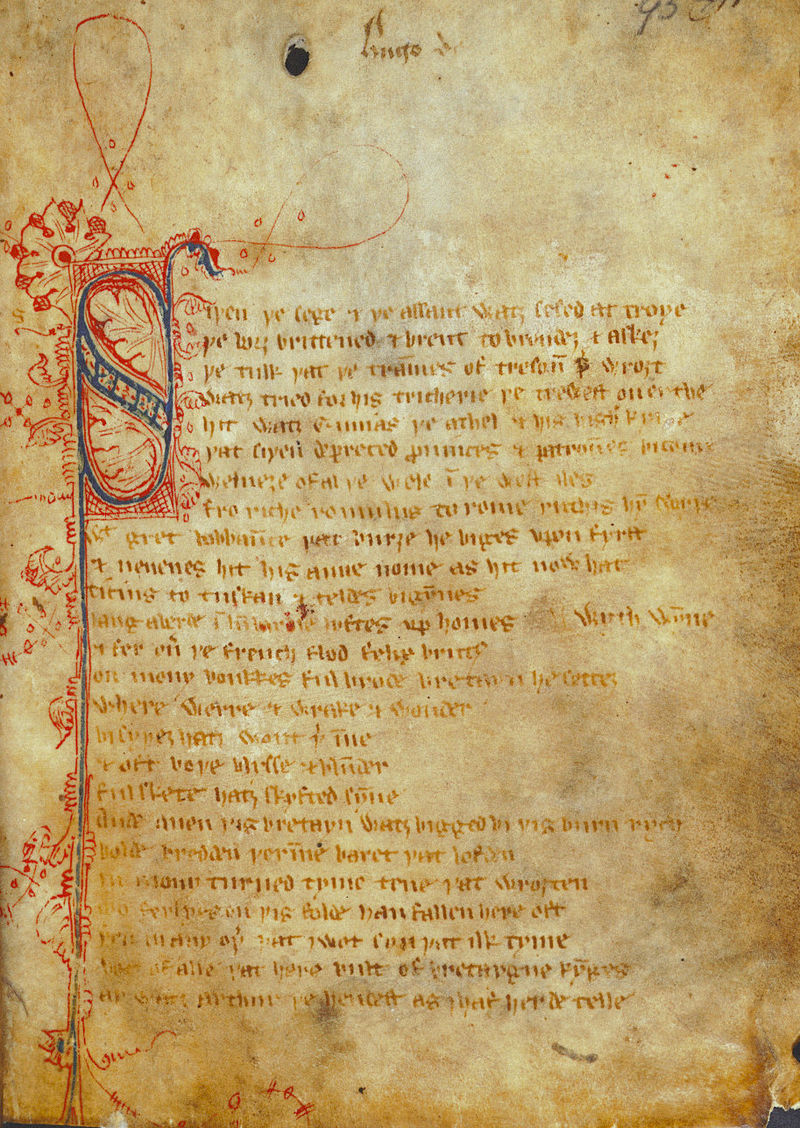
A “Sense of Authorial Presence”: Stylometrics and the Gawain-poet

Sir_Gawain_first_page_670x990

In 1988, medieval literature scholars R. A. Cooper and D. A. Pearsall published “The Gawain Poems: A Statistical Approach to the Question of Common Authorship,” in which they recount both the history of the authorship debates that began shortly after the fourteenth-century MS Cotton Nero A.x. was discovered in 1839 and their own attempt to determine whether or not the same poet composed three of the poems in the manuscript. Cooper and Pearsall use their own stylometric computer programs to quantitatively measure the alliteration, syntax, and word frequency of Gawain, Patience, and Cleanness while employing similar analysis of three other fourteenth-century poems of known authorship as controls. (They omit the poem Pearl because of “its different metrical structure” (Cooper and Pearsall 373).) Though the scholars conclude that “the evidence [they] have presented offers the strongest support to the hypothesis that [the poems] are by the same author,” not all critics—including Cooper and Pearsall—see their results as irrefutable fact (Cooper and Pearsall 385). Nevertheless, it is difficult for modern critics to speak of the Gawain-poet as a poetic collective, since the subject matter and themes present throughout MS Cotton Nero A.x. share the same resonance, such as repeated motifs and what Sarah Stanbury calls “a sense of authorial presence, a sense of a writer confronting and working through difficult issues” (Stanbury 1). Despite this resonance, however, Stanbury acknowledges that “[i]n yoking these narratives to a single author and then in searching for—and hearing—that poet’s voice, we are creating a fiction out of the fabric of fiction,” even though that fiction is most certainly woven from more substantial thread than the intuition of literary researchers (Stanbury 1).

Recent advances in stylometric tools have made it possible to do the work Cooper and Pearsall did in a fraction of the time. On the other hand, one may argue, Cooper and Pearsall worked with the advantage of knowing their text in an intimate way—they could not afford to not do close readings of the poems at certain junctures, and before they could even begin to mine data from the poems, they first had to painstakingly create digital text files by typing each word into the computer. It is surprising to me that, with the advent of stylometric freeware, no one has published another methods paper concerning the common authorship of the Gawain codex. The debate is by no means settled.

I would like to use Cooper and Pearsall’s stylometric analysis as the inspiration for further stylometric experimentation with MS Cotton Nero A.x. The programs Signature and JGAAP are the freeware tools most suited for this project. Though I do not expect to make any startling discoveries about the identity of the Gawain-poet, I do expect to uncover statistical evidence that will either support or contribute to Cooper and Pearsall’s results, especially since I will have freedoms they did not: I am easily able to use works from a larger collection of positively identified authors as controls (and to include the poem Pearl in my analysis), check the text for multiple types of features simultaneously, and support my results with other tools, such as MALLET, that may help explain why it is so difficult to positively articulate the “sense of authorial presence” that Stanbury mentions.

The challenging part of this project will be learning exactly what the algorithms of Signature and JGAAP actually do to text. (For example, there are nearly 40 different event drivers in JGAAP. If I can’t explain what each of those does, I can’t account for most discrepancies that might occur between my data and Cooper and Pearsall’s.) The end result of this project would be a simple methods paper that can (hopefully) serve as an updated amendment or appendix for Cooper and Pearsall’s original experiment; this paper would include more recent commentary regarding the authorship of the codex in question. If time permits, I would like to publish this paper on a website built for the purpose of showcasing the results of my project.


A sample bibliography:

Anderson, J.J. Language and Imagination in the Gawain Poems. New York: Manchester UP, 2005. Print.

Cooper, R.A., and Pearsall, D.A. “The Gawain Poem: A Statistical Approach to the Question of

Common Authorship.” The Review of English Studies 39.155 (1988): 365-385. Print.

Craig, Hugh, and Alexis Antonia. “Six Authors and the Saturday Review: A Quantitative Approach to Style.” Victorian Periodicals Review 48.1 (2015): 67-86. Print.

Gillespie, et al. The Cotton Nero A.x. Project. British Library, 2010. Web. 16 May 2016.

Hauptman, Robert. Documentation: A History and Critique of Attribution, Commentary, Glosses, Marginalia, Notes, Bibliographies, Works-Cited Lists, and Citation Indexing and Analysis. Jefferson, NC: McFarland and Co., 2008. Print.

Kahan, Jeffrey. “‘I Tell You What Mine Author Says’: A Brief History of Stylometrics.” ELH 82.3 (2015): 815-844. Print.

Love, Harold. Attributing Authorship: An Introduction. New York: Cambridge UP, 2002. Print.

Stanbury, Sarah. Seeing the Gawain-poet. Philadelphia: University of Pennsylvania Press, 1991. Print.


css.php