DH, Identity, and Intersectional Theory and Praxis

I’ve been thinking a lot about how theory and DH speak to each other, particularly as this course is the theory seminar this semester. We’ve read a range of different kinds of theories in Digital Humanities, but I keep coming back to questions about identity, praxis, and DH.

I came across  “Beyond the Margins: Intersectionality and the Digital Humanities” by Roopika Risam in Digital Humanities Quarterly, which I think outlines a lot of the different debates and critiques going on in DH. We’ve read a lot of the different theorists/critics, discussions, and specific articles she mentions throughout her piece. I like her article in particular because of how she’s outlining these debates as well as situating her own critique of DH through intersectionality by drawing heavily from critical race studies and feminist theory. Risam is also thinking here about how theory and praxis work together, which is something that DH is (or at least should be) thinking about consistently.

Risam’s article focuses strongly on theory and debates within DH, but then I also wanted to find an article that puts some of these theories into practice through a specific DH project, so I found “Speculative Praxis Toward a Queer Feminist Digital Archive: A Collaborative Research-Creation Project” by Dayna McLeod, Jasmine Rault, and T.L. Cowen in A Journal of Gender, New Media, and Technology.  The three authors discuss their theoretical and political investments in DH and queer cultures, as well as their experiences of creating a collaborative DH project called “The Cabaret Commons.” They used the Scalar platform to archive queer and feminist performances from a cabaret in Montreal. I love how they are approaching the project with a queer feminist theoretical underpinning and putting it into practice through DH. I also really appreciate all of the questions they are asking about the process of creating the project itself.
Practical Advice and Popular Perception

Last week, I stumbled upon “Here and There: Creating DH Community,” an informal talk by Miriam Posner (UCLA). The purpose of the talk is to give concrete advice to those scholars–usually young, fresh graduates–who have been tasked with initiating a space for local digital humanities labs and projects. The piece is brief, witty, and conversational, but it delivers some heavy food for thought. (This statement, especially, hits home: “When people anticipate challenges to getting DH activity off the ground, they often anticipate technophobia (which, as I’ll explain, I think is a fairly misguided fear) or a dearth of technical expertise. But let’s be real. If anyone sees you as a threat, it’s because you represent a shift in the institution’s power balance.”)

I’ve also found Matthew Gold’s blog, The Lapland Chronicles, to be a useful resource when pondering ways to foster global dh solidarity. Facts, Patterns, Methods, Meaning: Public Knowledge Building in the Digital Humanities provides discussion about how the dh community is perceived in popular discourse. He points out the recent shift from exploratory, wonder-filled dh experimentation ( à la Moretti) to the “scientifically oriented” work that has more recently gained the spotlight (à la Jockers) and encourages us to pursue a philosophy of dh studies that will also allow projects which fall in between those extremes. I think this piece is especially helpful when deciding how the dh community should present itself and its goals to those outside of the digital humanities–we want people in all fields to participate in our discourse, not just those who use dh tools for particular ends. (As a side note, Gold’s prose is gorgeous. He’s a joy to read.)

And here’s a bonus article that has little to do with this week’s topic, but everything to do with expressing the profundity of interpersonal relationships. This is Cathy Davidson’s touching, informal homage to Eve Kosofsky Sedgwick, and I can’t stop thinking about it: Handicapped by Being Underimpaired: Teaching with Equality at the Core.

Participation in DH Communities and Digital Spaces

When I think about community, after addressing what a community is about, I always wonder about two things: 1) Who is participating? and 2) Where? In what spaces?

Who participates?

Moya Z. Bailey “All the Digital Humanists Are White, All the Nerds are Men, but Some of Us Are Brave”

In this article, Bailey talks about identity of digital humanists within this field of study and how they can enter into the community. Additionally, she talks about digital humanities projects in other spaces like other digital platforms. I thought this would be interesting when we think about who is realistically participating in this community and how to make this accessible! (like we talked about on Thursday) to whoever wants to be a part of the community.

Where do they participate?

Since many DH communities also exist in digital spaces, I think Exploring and Designing Virtual Worlds seems like a cool starting off point when examining more specific digital humanities communities or projects. I think it is helpful to think about the spaces that these communities inhabit, be it the physical or digital world, and how this affects the community.

Lisa Spiro’s Digital Scholarship in the Humanities: Exploring the digital humanities is a neat article just to glance through (especially after reading Exploring and Designing Virtual Worlds) because it helped me at least see the different Digital Humanities Communities that pop up either around conference and THAT Camps or projects or disciplines.

Participatory Culture! Henry Jenkins!

Like Dr. Coats said in class, I love Henry Jenkins and his exploration of participatory culture!

I found this book he wrote with other scholars called Confronting the Challenges of Participatory Culture: Media Education for the 21st Century. I think the two chapters on “Enabling Participation” on page 7 and “Why Should We Teach Media Literacy: Three Core Problems” on page 12 would provide nice transitions from pedagogy to community as we think about what is means to be a part of a participatory community and what spaces participatory culture takes place in as well as how we can enable these practices in the classroom and what challenges we face when doing so.

Collaboration, Convergence Culture…

Thanks, Taylor & Sarah, for your suggestions.  A few I had:

Collaboration
The following readings take up the concept and practices of “collaboration,” which — as Taylor notes below — is one of the principles that, according to Spiro and others, defines  dh.

Participatory Culture & The Social Life of Information
These two readings are not about digital humanities as such.  But they both help map the critical landscape that surrounds our term, “digital humanities community.”   Jenkins — an incredibly influential and well-known scholar — can help us think about the ways in which digital humanities projects engage such participatory experiences (e.g., the crowdsourcing projects we have discussed).  Brown & Duguid write about the social contexts that shape “information.”  Although they focus mainly on corporate culture, their insights about the structures of/for information would help us map similarities and differences in the academic context.

  • Henry Jenkins, “Democratizing Television? The Politics of Participation” from Convergence Culture
  • John Seely Brown and Paul Duguid, from The Social Life of Information (“Introduction, “Limits to Information,” and “Learning — in Theory and in Practice”).  I’ll post the pdfs on Monday [update: the pdf is now linked]. In the meantime, you can review the work overall here: https://en.wikipedia.org/wiki/The_Social_Life_of_Information

Along these lines, it could be interesting to experiment with Scripto or From the Page, CommentPress, Commons in a Box, or other tools.

JDH & Open Knowledge

I’d be interested in delving into the following two items:

Journal of Digital Humanities Vol. 2, No. 2 Spring 2013

I would suggest we read the introduction, “Expanding Communities of Practice,” and 1 of the 4 articles published under the “Explorations” tab. This issue of the journal looks at ways that DH can be used to cultivate community/collaboration in the classroom as well as in sites outside of and independent of the classroom.

Open Knowledge

Open Knowledge is self defined as: “Open Knowledge is a worldwide non-profit network of people passionate about openness, using advocacy, technology and training to unlock information and enable people to work with it to create and share knowledge.” I recommend we read OK’s “Mission,” their “Vision and Values,” and their “Open Definition 2.1.”

The Community and Culture of THATcamps

With THATcamp Louisiana two weeks away, I thought it might be valuable to explore the community, culture, and debates surrounding the unconference.

We’ve previousy discussed THATcamp and its principles through Lisa Spiro’s “’This Is Why We Fight’: Defining the Values of the Digital Humanities”, but I thought it might be useful to explore the proceedings of past (and future?) THATcamps posted on the website, and consider how this strategy of communal planning both works and doesn’t work. You can find the proceedings tagged by topic here: http://proceedings.thatcamp.org/topics/
Another idea to consider: How are these proposals similar/dissimilar to conference panels you’ve attended in the past?

Second, this article by Bethany Nowviskie, “On the Origin of ‘Hack’ and ‘Yack’”, discusses the origin point (THATcamps) and troubles the popular DH slogan “more hack; less yak”. http://journalofdigitalhumanities.org/3-2/on-the-origin-of-hack-and-yack-by-bethany-nowviskie/

Finally, Natalia Ceceire’s critique of the focus on the digital, rather than the humanities, at THATcamps, titled “When DH Was in Vogue; or, THATCamp Theory” found here: http://nataliacecire.blogspot.com/2011/10/when-dh-was-in-vogue-or-thatcamp-theory.html

Twine—a Hypertext Story Builder

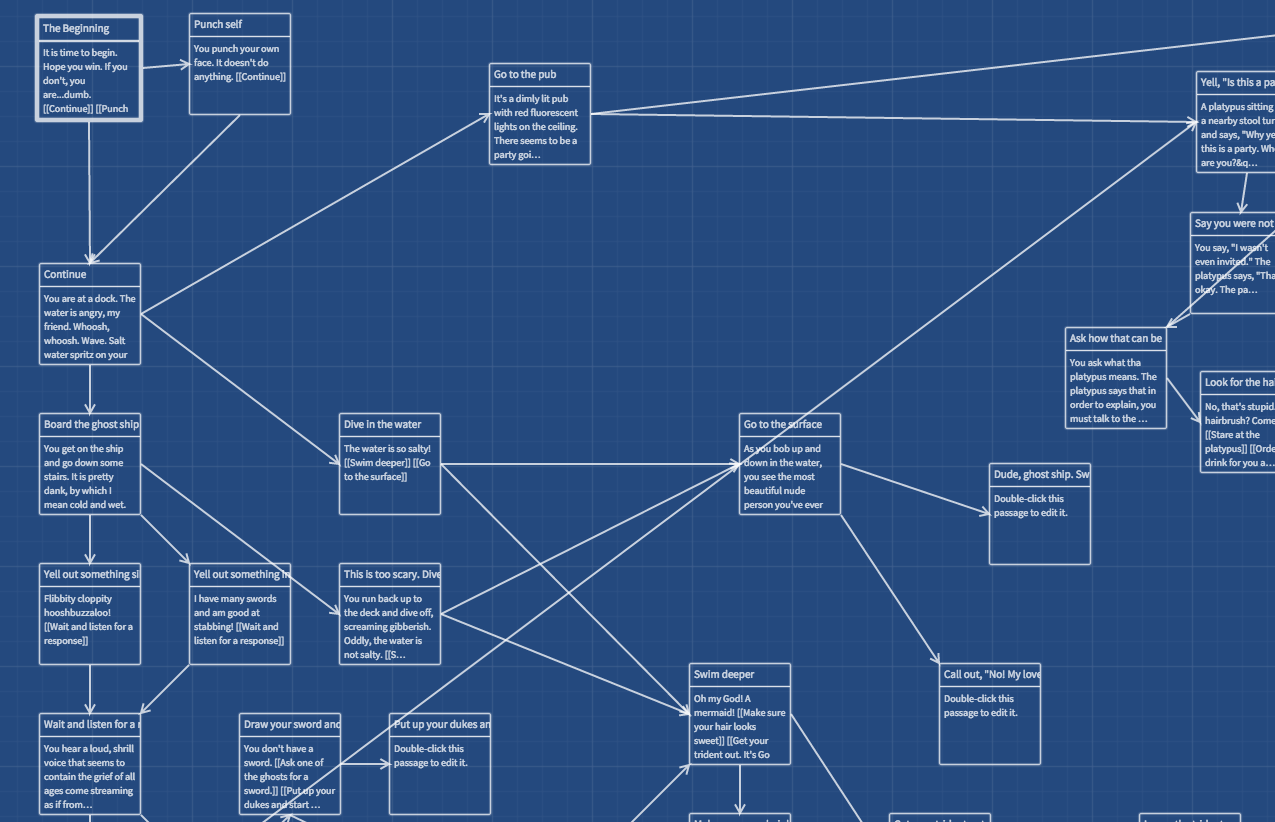
I found a program called Twine (http://twinery.org/)—it’s a hypertext story creator that lets you create a basic furcating story structure quickly and easily. You just start a new project, start typing a situation, then by adding double-bracketed options ([[ ]]) it creates new user options for progressing the narrative. Here’s a picture to show you kind of what I mean:


Screen Shot 2016-03-31 at 11.32.49 AM


Each of those boxes is created just by putting the [[ ]] around a new option. So it’s super easy. And you can test your story at any point and ultimately export it as an .html file.


I’m teaching a fiction workshop next semester focusing on developing a writing process and learning the basics of technique, craft, whatever you want to call it. One of my class texts will be John Gardner’s The Art of Fiction, which, aside from being a great overview of what fiction is and how it works, provides a lot of exercises for developing writing skills. One area I’m going to focus on early in the semester is plotting. I’m strongly considering using this tool as an easy way to learn the possible intricacies of plotting. It’s also designed to force you to think about what comes next. Instead of getting caught up in sensual details, every text box sort of demands brevity and progress to the next step. I think it would be an excellent way to focus students on thinking about the possibility of plot as opposed to getting bogged down too early in matters of style.


Below is a link to download the test story I was working on. There are a lot of dead ends—it turns out it takes a lot of time to account for a geometrically increasing # of plot options—but it gives a good idea of how the thing works. (The pub story line is the least fleshed out, but as you progress you can always use the convenient back option to go choose the other options.)


http://www.filedropper.com/twinetest2


digital ethnography

This week’s readings got me thinking about the way that undergrad students might perceive the value of Digital Humanities, and how that is bound to effect the progress of DH in the future. I think that, given Cordell’s claim that “their disinterest is right and even salutary”, the most important underlying issue of pedagogical strategy for DH instructors would be to lessen the obfuscation about what DH is, or about who does it. Cordell goes on to delineate a few helpful criteria for how to communicate the essence of it, including the cloudiness of even the name “digital humanities” (in favor of a more focalized course title like “Texts, Maps, and Networks”). I am especially drawn to Cordell’s insistence that “Humanities” can mean a lot of things, and it shouldn’t be limited to just texts or just social science, etc. when teaching a prospective batch of future DHers about the tools and methods involved.

This idea that getting students acquainted with the accessibility, and the universality, of DH lead me to the Zotero group “DH Education” in search of syllabi geared more towards other disciplines in the Humanities, like history and anthropology. I found one interesting exercise called digital ethnography, which is basically a digitally immersive style of relaying the events in a culture, via the individual (yeah… digital ethnography). I found one syllabus assignment: (http://blogs.uoregon.edu/digitalethnography/2014/05/12/concept-paper-guidelines-2/) of a course devoted entirely to digital ethnography. I think that nominal specification, though it seems a little petty, is a simple way to enhance or specify student interest/enrollment in DH courses. While this digital ethnography assignment was still flexible (both in terms of subject and  digital tools used), the category of “Humanities” being replaced by “Ethnography” allows for a more guided focus, as opposed to what some undergraduate students int he humanities might consider a daunting amount of possibilities.

Here’s a salient portion of the ethnography assignment: “Recall from class discussion so far that there is much flexibility in this assignment, in that it should fit within a larger research context for each of you. As such, the above guidelines can (and should) mold to what you are actually working on; please do consult with me in order to tailor the assignment to your specific situations.”- still an overarching degree of flexibility, in the legacy of creativity provided by DH, but here with a guiding content, ethnography.  I think that narrowing what certain courses mean by “Humanities” might actually broaden student interest and pedagogical possibilities.

Digital Poetics


As I looked through the different DH assignments, I was searching for something that might be applicable in my pedagogical conversations about poetry. And, I found an interesting list, related to our article on Interface, which I could see having potential relevance in my classroom:

https://github.com/curateteaching/digitalpedagogy/blob/master/keywords/poetry.md

One resource which struck my eye was the “for better or for verse” tool:

http://prosody.lib.virginia.edu/instructions/

I taught a Shakespeare class last semester, and I know right now, other TAs are working with Chris Barrett in her class Top 40 Shakespeare, which explicitly focuses on the sonic, metrical qualities of the Shakespearean text. And, since I work in different sonic poetics, to me, the rhythm and movement of a poem is incredibly important to its overall composition. But, it’s hard to spend an entire lesson focusing on meter, or rhythm, in a focused manner, or in a way which engages students while still focusing on the text at hand. I know Chris Barrett deals with this by using pop songs to analyze their different metrical qualities. “For Better or For Verse”, I perceive, could be another helpful tool, to get students thinking about meter outside the classroom and make them feel like they are engaged with the material.

In terms of our reading, I appreciated the specificity of this resource, and how I could see myself implementing it in a succinct, straightforward manner. This tool hinges on the practicality of these ideas, instead of broader concepts that might be unapproachable, especially in the undergraduate classroom. For example, I could see myself giving a homework assignment somewhere on the lines: “For tonight, pick such and such poem, listen to the recording and go through to implement your suspected meter. Check your work, and be prepared to be write out the meter for such and such text for a quiz in class tomorrow.” And then, to get them to think critically about these ideas, a potential in class writing assignment: “Write about your experience using the tool, and how you see the different ways we use sound, or speak a poem, as important to its overall workings. Why is the sound important? Why does it matter, and how do you see the meter as a part of that?” To me, “For Better or For Verse” is a potential study tool, giving students skills to replicate as well as better understand these formal poetic elements.
There are also many other resources linked through this article that could be potentially useful, such as the e-poetry site, and “Prism”, the image tracker. I look forward to exploring more in my future pedagogical practice.

Student Research as a Visible Narrative

I have been hoping to find a way to make the research process more meaningful and engaging for my 1001 and 2000 students without straying far from the traditional research methods that many of us use and students need to practice. Students often become frustrated with research when they “can’t find anything” on their topics, and teaching students how to research a topic creatively–to explore multiple platforms and approach a topic from multiple angles–is difficult, especially when I can’t see how they’re approaching research on their own. Leah Schafer and Lisa Patti created this assignment sequence, which they title “Extreme Searching,” in an attempt to lead their students to participate in collaborative and reflective research.

The assignment sequence would fit easily into the standard expectations for 1001 and 2000 classes at LSU. It includes 4 parts: a research question, an annotated bibliography, a video reflection, and a research screencast.

I already require my students to write a research question, but it often seems that they, or I, forget to return to their specific and interesting questions once the class is deeper in the paper-writing process, probably because the research question was only one sentence of a much longer annotated bib. Schafer and Patti ask students to provide their original research question, as well as their revised question and possible questions they decided not to pursue. Students also write a short paragraph explaining why they chose their question. I like that this part of the  assignment requires students to consider and discriminate between multiple paths. Furthermore, students would be working in groups, so they would have to collaborative discuss, combine, revise, and reject ideas while forming one complex but cohesive question.

The last two parts of the assignment are the more digital aspects–a video reflection and a screencast. I am particularly intrigued by the research screencast assignment, which asks students to provide a narrated re-enactment of their research process, allowing the viewer to see their process by literally following the path of their online search. If you, like me, aren’t sure this means, here’s an example from one of their students. In order to complete this part of the assignment students would have to keep track of and reflect on their research methods. I am excited by the idea of leading students to think about their own search habits, not as random or based on chance, but as research methods–habits that can be thorough or cursory, thoughtful or careless.

In my class, research can become a very isolated experience for students. I show them how to use databases and how to discriminate between sources, but they do most of their research outside of class where they encounter inevitable frustrations. Consequently, students often become more focused on finishing the final project than on going through the process of reassessment and problem-solving. I predict that using technology such as screencasting to turn research into a more visible narrative will lead to more engaged and thoughtful methods. Of course students will still encounter frustrations, but perhaps these frustrations will become fruitful points to work through in a research narrative, rather than roadblocks to ignore.


css.php