Redshift & Portalmetal by Dr. micha cárdenas

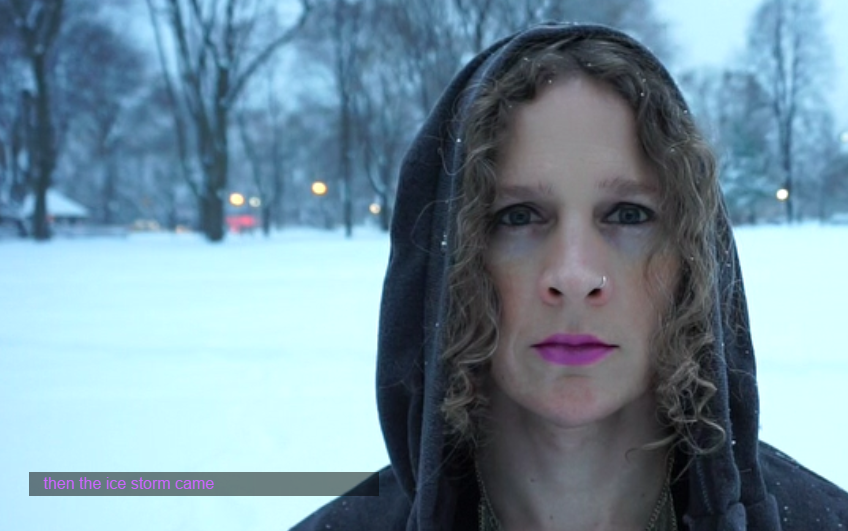
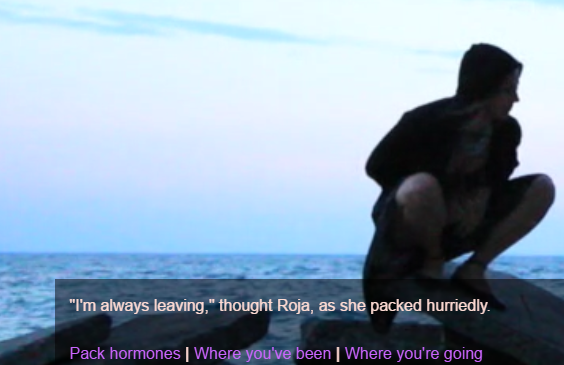
Redshift and Portalmetal is a story/game with an intentionally interactive, futuristic, environmentalist, queer, and raced digital interface. The creator of the project, Dr. micha cárdenas, seems pretty awesome! Here’s how she describes the project on the home page:

“The story uses space travel as a lens through which to understand the experience of migration and settlement for a trans woman of color.… The project takes the form of an online, interactive game, including film, performance and poetry. I designed the interaction, wrote the text, performed the movement, and coordinated the filming in Los Angeles and Toronto. The project is built with HTML5 video, CSS and Javascript, using the Scalar e-publishing platform.”

redshift + portalmetal mica cardens screenshot 3

This interface is not complicated in terms of how it functions for the general user, but I chose it because of how it illustrates the reciprocal nature of form, function, and content, in this case social and political content. I wonder how and why cárdenas chose to layer the static text and hyperlinks over the moving images, especially those of her own moving body, and to add an extra layer of sound. How does this “skin” or design contribute to a new or enhanced visual [and sonic] episteme” about the movement and migration of a trans woman of color in various environments? It definitely collapses “the bias against visual forms of knowledge production” that many have had in favor of “logocentric and numero-centric” ways of knowing (Drucker 16).

It’s also a powerful project to me simply because it calls to mind the idea of inter-faces.

redshift + portalmetal mica cardens screenshot 4

Poem Viewer: Participation Required

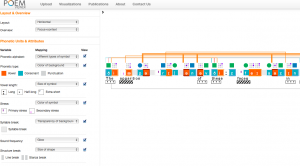
As more of a tool than a content-filled site, Poem viewer is perhaps an odd choice for thinking about interface. However, the tool raises interesting questions about the “duality between the web as an information space and as a task-supporting environment” (143). Poem Viewer does provide a certain type of information—visualizations of poems that reveals attributes such as sonic relations, word frequencies, and sentiment—but the site is structured to encourage user manipulation. In fact, the provided visualizations of poems are, at least at first, down right bewildering, especially for someone who is not versed in phonetics. It is only through playing with the poem (completing tasks suggested by the interface) that users can really gain information about the text.Screen Shot 2016-04-10 at 6.13.59 PM

Most of the page consists of the visualization, but a side bar on the left features 28 customizable features and attributes. By hiding, viewing, or changing the color/symbol/pattern for each attribute, the user can alter the visualization. The user approaches a better understanding of the image, and the poem it represents, as she manipulates each feature. For example, by hiding and viewing the “sound frequency” attribute, I realized that the brightness of the outline around each syllable indicated the frequency in the poem of that particular sound. It become clear that the short e sound is by far the most frequent sound in “In a Station of the Metro,” a frequency that ultimately contributes to the overall mood of the poem. Poem Viewer’s poems are not supposed to be, as Drucker would say, consumed (I’m not sure how a user would passively consume these mystifying constructions), but interpreted, examined, and used. The site certainly forms “an event-space of interpretative activity” (178). Without participating in the event proposed by the site, the user is left in the dark.


What Jane Saw: Regency Art Exhibits in a Ghost Building

What Jane Saw

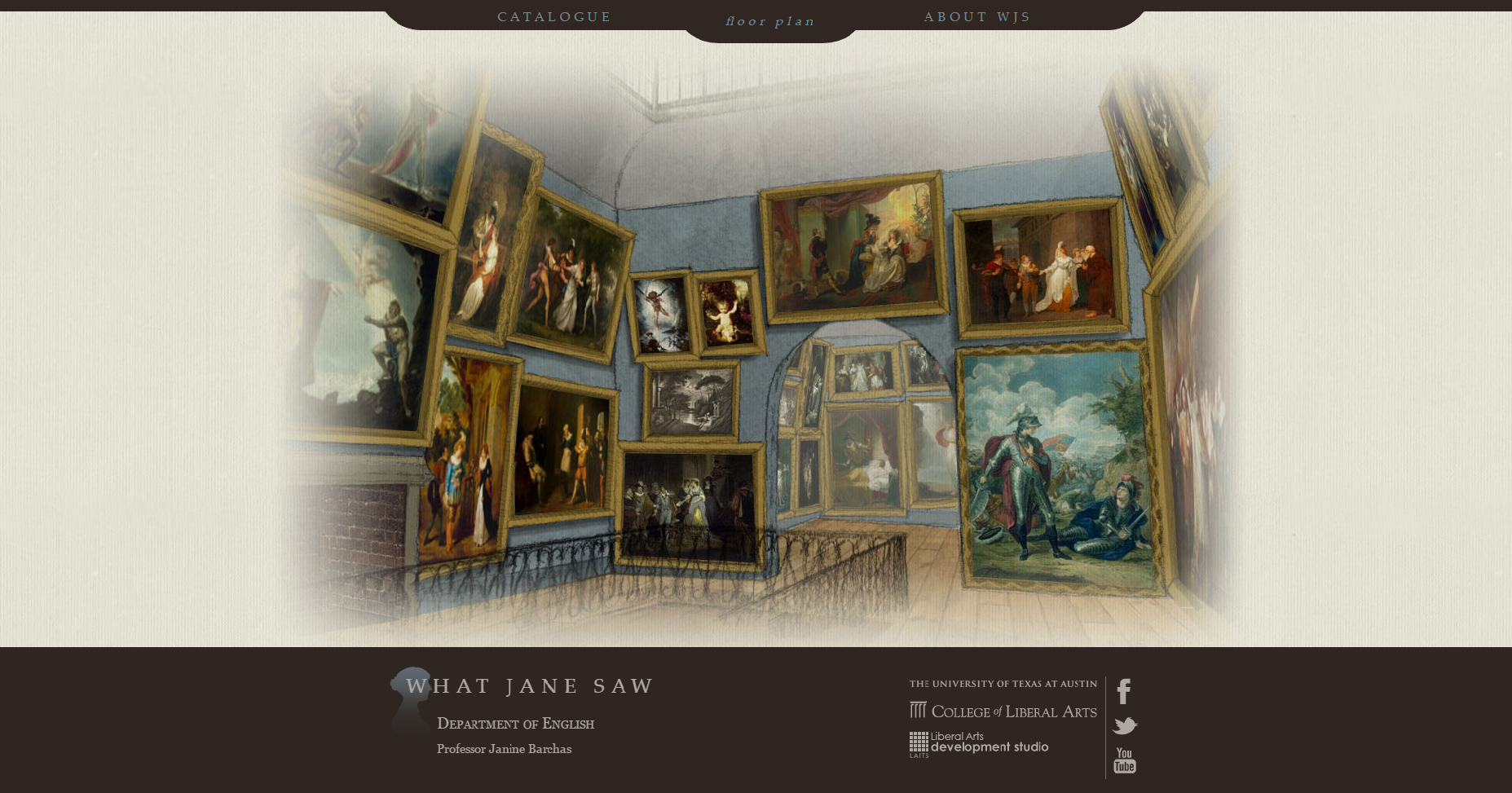
The digital humanities project What Jane Saw reconstructs two Regency-era London Pall Mall exhibitions: the Shakespeare Gallery of 1796 and the Sir Joshua Reynolds exhibit of 1813. (The building that hosted the exhibitions no longer stands.) In order to create a virtual walk-through space that emulates as closely as possible the historical exhibit space, the web designers tracked down sizing information for each painting believed to be present at the time and pieced together the most likely wall arrangements in every room. In some cases, the designers had to rely upon surviving scraps or prints of paintings that can no longer be located in order to estimate original canvas size. Impressive metadata was added to paintings, including–in the Shakespeare Gallery, at least–reproductions of text that inspired ekphrasis.

The interface* of the site is intuitive enough to be nearly invisible to the viewer; viewers easily navigate through rooms by following directional arrows and examine paintings by clicking on them. The non-invasive imagery associated with the interface complements the minimalist web design. The muted colors and calm architectural spaces created in Google’s SketchUp contrast nicely with the furious color schemes and hyperbolic gestures within the picture frames–a fussier presentation with, say, menus and metadata along the sides of the gallery visuals would be overwhelming. A hint of the large windows running along the gallery’s ceilings is included in every available view and the paintings closest to the ceilings are slightly tilted, as paintings are in real galleries; the combination of a natural, high light source and angled artwork works to both draw the eye upward and encourage the viewer to concentrate on one painting at a time. Wherever the viewer looks on the screen becomes a focal point for the whole room. (Similar use of light and angles is, I believe, used in cathedrals to draw the individual’s attention upward and away from oneself.) These collections could have been displayed online as a simple series of images, but virtually hanging the art in a gallery reconstruction drastically changes user experience by forming a context, allowing the viewer to consider the tangible dimensions of each canvas and its relationship to other famous pieces of the time.

*Is it a stretch to consider the type of user navigation required for WJS an interface?

CCCC Conference and Community

Thinking about DH community (and communities more broadly) as well as choosing readings about this for the course, and reading about different kinds of communities were in DH was sort of perfect while I was at the CCCC conference this week.

The 4 C’s is a huge community of its own that focuses on rhetoric and composition, especially writing pedagogy and how to teach composition better. But, within this community, I realized that 4 C’s members are similar to the communities from the readings this week. Like #transformDH, there is a #4c16. But, at the 4 C’s, there was a lot of talk about Digital Humanities and digital tools, like in the DH community! For example, Dr. Carter pointed out that there is even a map for the PhD in Rhetoric! (So, we have made a visualization of our community!)

During this year’s chair address, Dr. Joyce Locke Carter gave a talk on “Making, Disrupting, Innovating.” During the talk, she pointed out some of the same issues Bethany Nowviskie talks about and Natalia Ceceire about “more hack, less yack.” And, whereas, Dr. Carter did not use these terms per se, still one of her main points was yes, you should learn to code, if what you are trying to make involves code. Like we have talked about in class, while Dr. Carter heavily encouraged everyone to make things and disrupt the norm, still it was not a call for technology for the sake of technology, as Miriam Posner points out: “my job is about the students….In the end, my loyalty isn’t to the digital humanities – it’s to knowledge, and sharing knowledge.” Like Posner states, the talk and the conference has been more about the students.

Still, I was surprised that in this community, like DH, our community of writing and composition has to defend itself and explain why we teach writing (which is nothing new I guess). I was just surprised that our community is feeling threatened by things like dual enrollment and budget cuts, and our response to this is to make things. I’m not saying this is a bad thing, but it is interesting in light of the debates that go on in the community and when these authors are thinking about what makes a DH community. In Dr. Carter’s talk, she also encouraged people in composition to be disruptive just as Miriam Posner talks about in her article, “Here and There: Creating DH Community.”

In addition to the 4 C’s being a long standing community itself with similar issues in the DH community, I also went to a panel on Digital Identity and Community.

While the talk was different from our readings about DH community and Dr. Carter’s talk, still it was an interesting mix of this week’s and last week’s readings since it was really about how students and teachers create digital identities and communities! There was three different panelists. Cassandra Branham from the University of Central Florida talked about veteran students, how they create online identities and what digital communities they take part in. Carie S. Lambert from the University of Texas at Dallas talked about how students in an online class talk about themselves on a discussion board and how they form communities. And, the last speaker, Jeff Naftzinger, whom I thought had the most to do with our class, talked about the digital center at his university and how faculty use the center, have digital assignments, and really how or if the faculty have a digital community. Here is his talk if you are interested: http://cccc.jeffnaftzinger.com/.

Just to sum up, since I’ve rambled on about this conference, he basically talks about if faculty were integrating digital projects into their classrooms like we talked about last week, and he found that many of them were not even though they had a digital center because either A) they did not have experience being taught with digital tools themselves or B) didn’t think that the digital tools were applicable to their lesson plan. While Rhetoric and Composition professors used digital tools quite often, Literature and Creative Writing did not. So, if the teachers had a stronger inter-department community, I think this would have encouraged more use of digital tools. So, it was interesting because here, the lack of community at the university jeopardize the use of the digital in teaching and helping students. I thought this was a good combination of this week’s and last week’s readings, and a good panel to reflect on as we are reflecting on DH communities.

 

Reading Suggestions: Meta-Wikipedia and Academic Piracy

My first reading suggestion is simply the Wikipedia article on Wikipedia. As with most Wikipedia entries, it’s hard to read it without falling into a wormhole of linked entries. I think it’s interesting to read not just because of its content (how much do we really know about Wikipedia?) but also because it’s an example of a digital scholarly community narrating its own history and identity. I would also suggest taking a look at the article’s talk page to get a peek at the complexity of the Wikipedia community’s norms, practices, and rules. I also found many strange and interesting “information” pages–meta-pages that aren’t part of the official encyclopedia–related to the community, such at the “village pump” (where editors discuss big-picture ideas and problems) and “WikiFauna” (a humorous taxonomy of Wikipedia editors).

My second suggestion is this recent article about Sci-Hub, “the first pirate website in the world to provide mass and public access to tens of millions of research papers.” The article also covers Aaron Schwartz, the activist who committed suicide after being charged for attempting to “free” millions of articles from JSTOR. The creator of Sci-Hub, Alexandra Elbakyan, defends her efforts as contributing a “community” of researchers. I was struck by how similar a lot of Elbakyan and Schwartz’s rhetoric is to that of Jimmy Wales from Wikipedia.

Neither of these suggestions are specifically about digital humanities communities, but I think that they raise a lot of issues related to digital academic communities that have big implications for dh.

Lessons on the operation of digital communities from reddit, 4chan, and Wikipedia

Hello,

I decided to look for info on user-created online social communities. I got the idea from Davidson and Goldberg’s chapter on the future of learning. While I don’t feel the university system—which they refer to as “antiquated” multiple times—is desperately out of date, I do think we need to pay attention to how digital communities operate and how they facilitate learning and information diffusion. These digital communities represent a novel form of community, one unique to our era, and we can draw lessons about digital scholarship from the social uses of digital technology.

One article I found is “Interfaces as Rhetorical Constructions: reddit and 4chan During the Boston Marathon Bombings.” It’s a pretty fascinating look at the basic workings of reddit and 4chan and their interfaces, and then a case study in the two sites’ reactions to the Boston marathon bombings in 2013. The article tracks how the two communities reacted and what their self-generated goals quickly became, and how the websites took the tools at hand and pursued those goals. (The article is 8 pages.)

Another interesting article is “Socialization Tactics in Wikipedia and Their Effects” (10 pages). It’s a bit stats-heavy, but the overall gist is that researchers tracked socializing tactics in WikiProjects—sending greeting messages, offering assistance, etc.—and analyzed how this changed new users’ likelihood of remaining committed to the project. No surprise—the more socializing and welcoming, the longer the newcomers remained active. It’s a little more complicated than that, there are more categories, but overall it’s a good look at effective strategies for growing and maintaining socially networked projects from like an administrative or leadership perspective.

Andrew

DH and Community Building – Week of April 3

Dear Friends and Colleagues,

This week I’ve chosen three articles on the topic of DH Community.

Paul Crowther’s Ontology and Aesthetics in Digital Art is not about DH per se, yet I believe it touches on issues near and dear to the Digital Humanities as Crowther’s work typically deals with importance of canonicity in art criticism. Many of his arguments can slide right into discussions we’ve been maintaining regarding the status of criticism as a creative process and as a curative process. Crowther maintains that a canon is an open-ended feature of artistic criticism that seeks to maintain the context of work and evaluate them on the basis of ethical worth rather than form or reputation. As a result, the new focus on canonicity is one that is tightly interwoven with community.

Causer and Wallace’s piece in DHQ, Building A Volunteer Community: Results and Findings from Transcribe Bentham describes challenges with interactivity and crowdsourcing from the “Transcribe Bentham” project. Such an article is interesting because it is a more “subjective” account from two well-known Digital Humanists and their attempts to engage with their audience. It also deals with crowd-sourcing, a very contested concept in the 21st century and presumably deals with authorship as well as labor in community.

Finally, I’ve chosen to include a work from my field by Charles Taylor, simply titled Identity and Democracy. Taylor is a political theorist at McGill University who is classified as a “Communitarian.” His work argues that the modern identity is shaped by a variety of intellectual and creative sources that the modern mind must communicate with others. This short work deals with the importance of communicativity of identity in modern democracy. I feel this can be easily applied to the digital humanities as much of what we discuss as issues in DH are issues in democracies as a whole.

“Personal Theory” to Build Academic Community

Academic communities, whether comprised of DHers or not,  manifest themselves largely in writing. In her essay “Personal Theory: A Method for Humanities Scholarship in a New Media Moment,” Abigail De Kosnik argues that our scholarly writing style should embrace the personal inflection of digital genres (blogs, op-eds, etc.). De Kosnik advocates for what she terms “personal theory”–a style of criticism in which personal experience and situatedness is relevant–as a way for academic writers to reach a wider audience. This article is not so much about DH communities as about how scholarly communities should respond to the prevalence of digital media, but her argument about how our writing could work to change traditional academic structures is very relevant to discussions we’ve had about the DH community all semester. The article is chapter 6 of the book Digital Media: Technological and Social Challenges of the Interactive World, which you should be about to find here if you’re logged in to myLSU.

I also propose that we read Martin Weller’s “Interdisciplinarity and Permeable Boundaries,” which is a chapter in his book, The Digital Scholar: How Technology is Transforming Scholarly Practice. In this chapter, Weller takes a critical look at cultural and economic aspects of the academy that discourage interdisciplinary. He then examines the usefulness of technology in breeching divides between disciplines. He uses blogs and Twitter as examples of interdisciplinary technologies. He tries to describe Twitter to people who don’t use it, which comes off as a bit dopey, but the meat of his analysis could provoke an interesting discussion about collaborative community. I scanned this chapter out of a hardcopy, and I can’t figure out to post a pdf to this post (if anyone knows, let me know), but if we choose this reading I can email it out.

Formal Communal Structures

For this week, I was trying to look at spaces that formally reproduced the ideas they put forward about community. It’s one thing to talk about collaboration and accessibility. It’s another formally implant those ideals into the very structure of what you’re creating. I really liked the questions Heather asks in her post:  1) Who is participating? and 2) Where? In what spaces? And so, I found two resources which, I believe, are thinking critically about their inclusive frameworks, and the way we think about participation, hierarchies, and power dynamics, especially in the academy.

http://transformdh.org/

Transformative Digital Humanities: Doing Race, Ethnicity, Gender, Sexuality, Disability, and Class in DH

Sarah and I have posted about transformDH for our weekly blog post assignments, and I think it could be an important resource to explore for the entire class. Their about statement reads as follows: #transformDH is an academic guerrilla movement seeking to (re)define capital-letter Digital Humanities as a force for transformative scholarship by collecting, sharing, and highlighting projects that push at its boundaries and work for social justice, accessibility, and inclusion.” (#transformDH Tumblr)

This forum uses Tumblr, has a video showcase, and hosts a thatcamp. And so, it’s thinking about the different ways a space can be accessible, transformative, and multi-dimensional, which I think is important for us in generating final projects.

http://mediacommons.futureofthebook.org/question/what-relationship-does-digital-humanitiesacademy-have-social-media-activist-movements

What relationship does the digital humanities/academy have to social media activist movements?

We’ve had some brief discussions about how the digital humanities are being used in the academy, and how they are being used outside of that sphere. But, this piece looks at the parallels and connections between the two, and how we can form community around activism and digital platforms. And, it does so in a way which incorporates multiple voices, through its formal structure on “MediaCommons: A digital Scholarly Network”. This is the setup of the overall discussion, taken from their site:


  • What role does the academy play in determining whether it is our place to theorize social media activist movements? Is it even our place to theorize these movements?
  • How might digital humanities work with social justice movements such as #blacklivesmatter?
  • How could the digital humanities translate the rhetoric of such movements into our scholarly conversations while preserving their core ethos of activism and social justice?
  • What lessons about technology use can digital humanists learn from movements such as #blacklivesmatter?
  • How can scholars rethink their own roles as academics in digital spaces in order to become more involved with activist movements?

The project will run from approximately March 14th through March 25th. Responses are 400-600 words and typically focus on introducing concepts for larger discussion, with the idea that interested individuals will read and respond daily to engage authors in digital conversation. Proposals may be brief (a few sentences) and should state your topic and approach. You may submit as an individual or offer up a special cluster of responses with others.
And so, we have a multi-perspective, short commentary that opens itself up to these larger conversations. Those who contributed think about the ways the academy interacts with larger social issues, specifically in the ways digital humanities are functioning.

Collaboration and DH community

This linked article is from DHQ 9.2 (2015), and addresses what author Alix Keener dubs the “arrival fallacy”, providing via interviews an interesting perspective on the relationships between faculty and librarians, and how those dynamics should look to foster the most collaborative research relationship.  “The Arrival Fallacy: Collaborative Research Relationships in the Digital Humanities” by Alix Keener:

http://www.digitalhumanities.org/dhq/vol/9/2/000213/000213.html


This second article is also from DHQ, 9.3. (2015).  Author Isabel Galina Russell explores the limitations that the DH community faces outside of English speaking countries.  Through a case study of the organization “Red de Humanidades Digitales”, this essay offers a detailed discussion of establishing a Digital Humanities community in Mexico, and offers more general insight into the expansion of DH communities outside of English speaking countries. “Creating a Regional DH Community: A Case Study of the RedDH” by Isabel Galina Russell:

http://www.digitalhumanities.org/dhq/vol/9/3/000221/000221.html


css.php