This is a Bop It:

Remember Bop It?! Great game. It has a speaker and it would command you to either “bop it,” “twist it,” or “pull it.” The player’s responsibility was to bop the Bop It button, twist the twistable lever, or pull the pullable handle when commanded. Remember this.
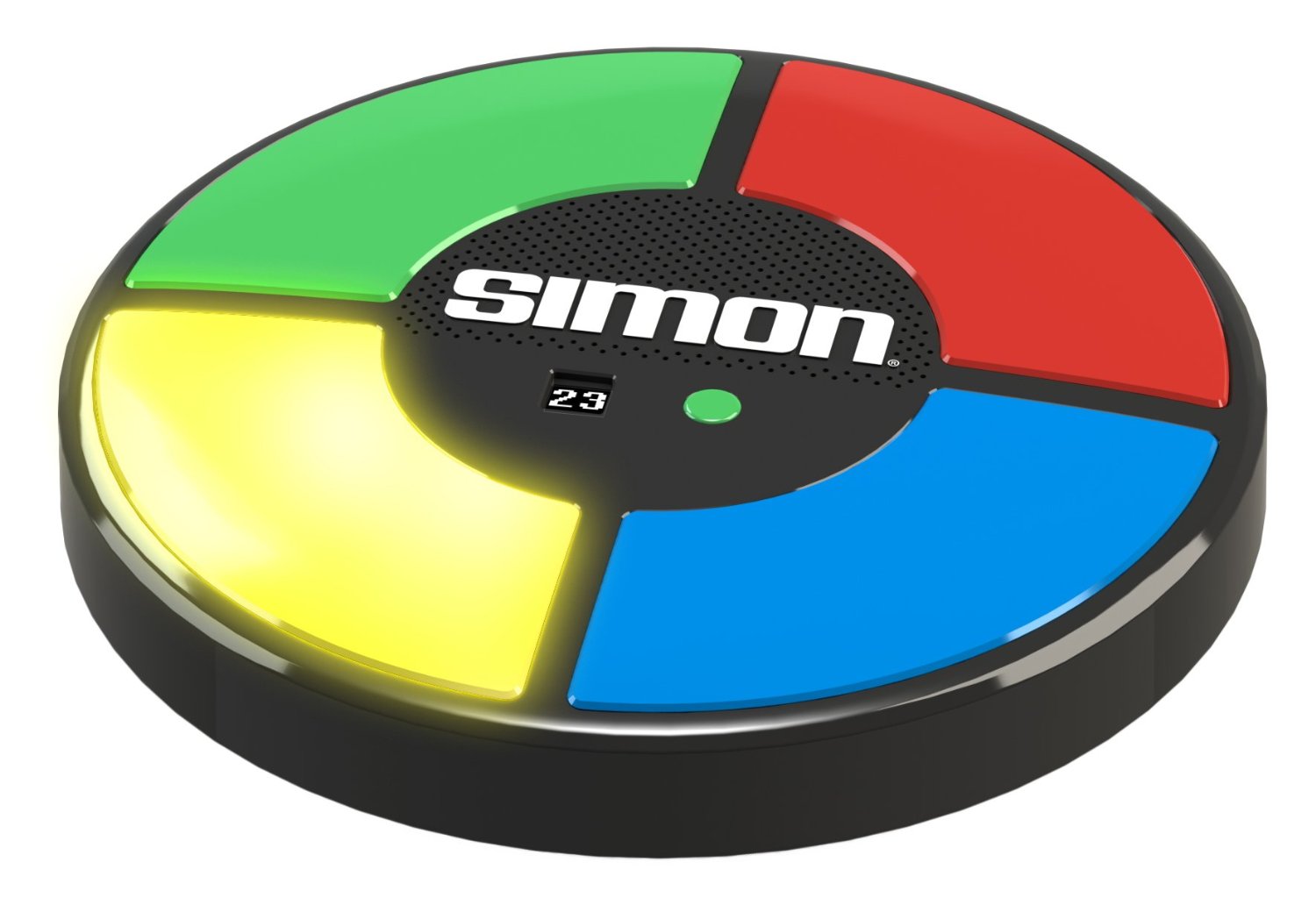
And look! A Simon! This game was far more cerebral than Bop It. When the game started, one of the colored quadrants would light up and play a specific tone. The player would press that quadrant. Each round, an additional quadrant would light up, and the player would have to repeat the whole order to advance. A kind of memory game.
The point is: interfaces negotiate physical action. Even the supposedly abstract interfaces of computer screens require physical engagement—seeing, reading, thinking. Despite these being largely sedentary, motionless tasks, they are physical.
An interface also refers back to the physical. Digital spatial arrangements can trace their roots to linear texts (books, encoded punchcards from early computers and their roots in handwritten logic and mathematical proofs); computer GUIs are drawn from a variety of influences including the filmic, library and scientific organizational/filing systems; with enhanced screen resolutions and processing speeds we even see visual arts and ideas of “realistic” spatial relations and physics intruding—think of modern video games, or the seemingly “real” way that icons on a computer screen slow down and stop when you drag them.
I think it’s easy to lose sight that the interface is not flat, shallow, or Other than the physical. And the more sophisticated technology becomes, the more we’re learning to meld the physical into the ephemeral-seeming digital interface. The Bop It and Simon did this through the concept of a game. The virtual commands required tactile responses. They were not very sophisticated—push this button, pull this lever—but they created the sense of spontaneous play in the absence of a physical person. Our devices are becoming tactile on a far more complicated level. Take the iPhone:
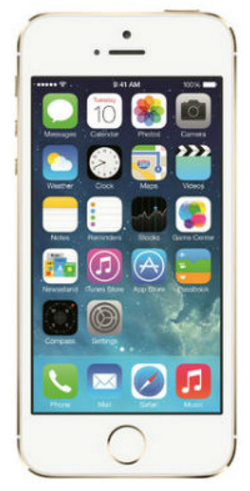 (In case you don’t know what one looks like)
A recent advent is the inclusion of fingerprint recognition on the home button. You can now unlock the phone without looking at it. This has created a new sense of a deeply, physically personal portal to our abstract world—clouds, networks, waves, signals.
I don’t have to tell you that the smartphone creates a novel physical experience. The vision of people walking around holding phones—whatever you think it says about people’s inner lives—is a new phenomenon, one derived from the appeal of the digital interface but enhanced (exacerbated?) and enabled by the way that interface melds into/corresponds with/comments on its physical interface (small, lightweight, portable, attractive, sleek, etc.).
Part of the genius of the smartphone is that, with sufficient computing power, it consolidates most of the visual/digital interfaces we’ve come up with to date (books, video games, web pages, calculators, cameras, televisions, maps, etc., etc., etc.,)—and does so in a physically convenient way. I feel I’ve rambled, but I just wanted to maybe suggest that there’s a lot more to the interface than graphic/spatial design; that interface accords in deep and powerful ways to our notions and preferences regarding the physical; that our collective imagination’s ideal for interface has always tended toward a sort of collapsing of digital and physical (The Matrix, Tron, Minority Report, The Purple Rose of Cairo); and that, in practice, the physical is invading the digital just as much as the other way around.


Oh and also: Google Glass.