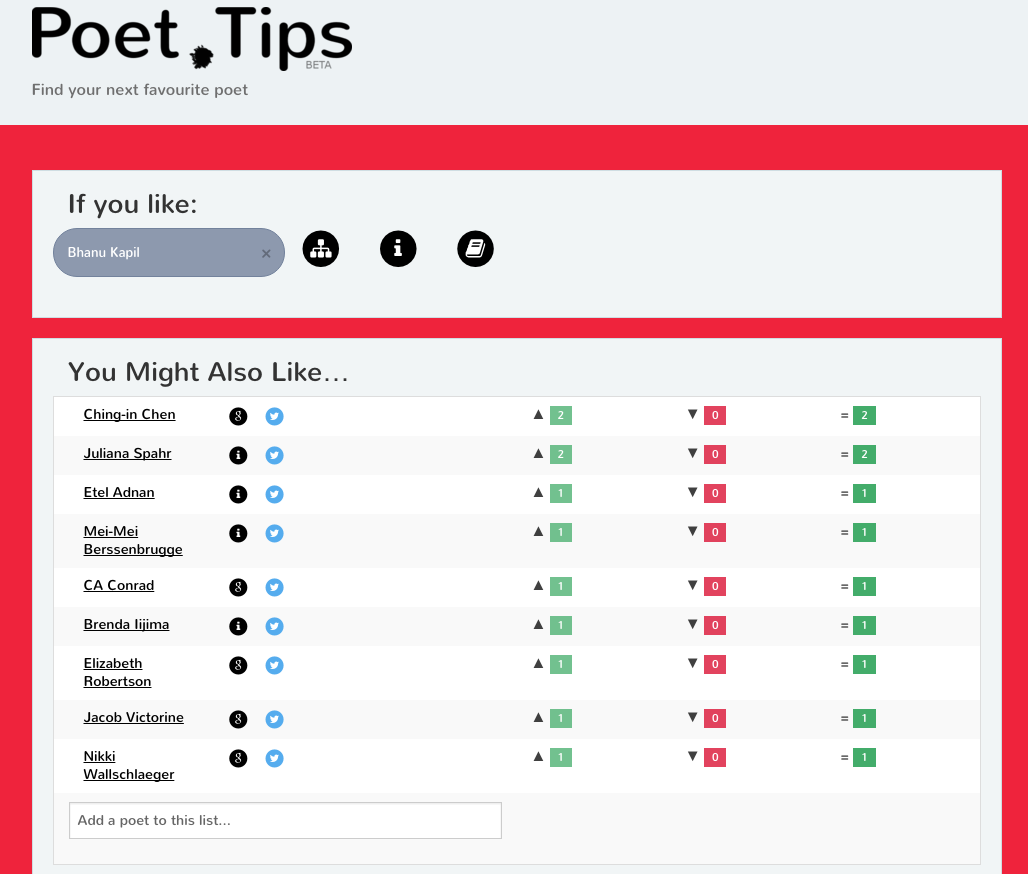
Poet Tips is a website for recommending poets. The interface is simple and straightforward–the front page loads into a blank box for users to enter the name of a poet. The site is easy to use and does not make false claims about its function. Kirschenbaum writes that: “The conventional wisdom, reinforced by commercial marketing campaigns like Microsoft’s “Where Do You Want to Go Today?” and AT&T’s “You Will”, is that computers can do just about anything we want them to do. As programmers and developers know, however, there are always limitations that come with particular hardware and software environments, and those limitations render the computer an eminently material medium…” The eminently material component of this site is that its info is user-generated, which leads users to question or wonder about the information presented, yet, at the same time, users are imbued with the power to diversify and change the site’s offerings. The process also may lead us to question how texts get canonized, to challenge the processes of literature-making, and to carry larger skepticism of the homogeneity in mainstream poetry circles.
Slightly unrelated — the article on cross-cultural considerations relies on some pretty serious cultural and gender essentialism, not to mention some pretty antiquated stereotypes surrounding culture, gender, and basic human psychology. The cartesian duality of emotion vs reason, of feminizing emotions and care, is the kind of dangerous biological determinism that really make little to no (good) impact in this sort of decision-making regarding user interface. This led me to wonder if better and more dynamic modes of discussing differences without essentializing has been/can be sought when it comes to making gross comparisons.


As I mentioned in class, I had the same reaction to the “cross-cultural considerations” guidelines. To recognize the prominence of this genre (the user manual form) does not obviate the instrumentalization of difference, difference too often defined in reductive and essentializing form. I, too, found them not conducive to what we might call critical interface design.
I’ve been playing with the Poet Tips site. Thanks for sharing it! The material components of the interface that shape how users can participate — not just that they can, but *how* they can (e.g., voting to agree or disagree, adding a poet in a simple text form) has been captivating. The simple interface invites participation, invites connection, by having a lower barrier to entry (to use a term that has come up in class). I find it fascinating how the simple list and process evokes–but does not document (perhaps evokes or authorizes by not documenting?)– the different ways and criteria by which users might suggest or vote against a poet tip. I’ll be interested to see how the textual networks that are emerging from the site develop over time.