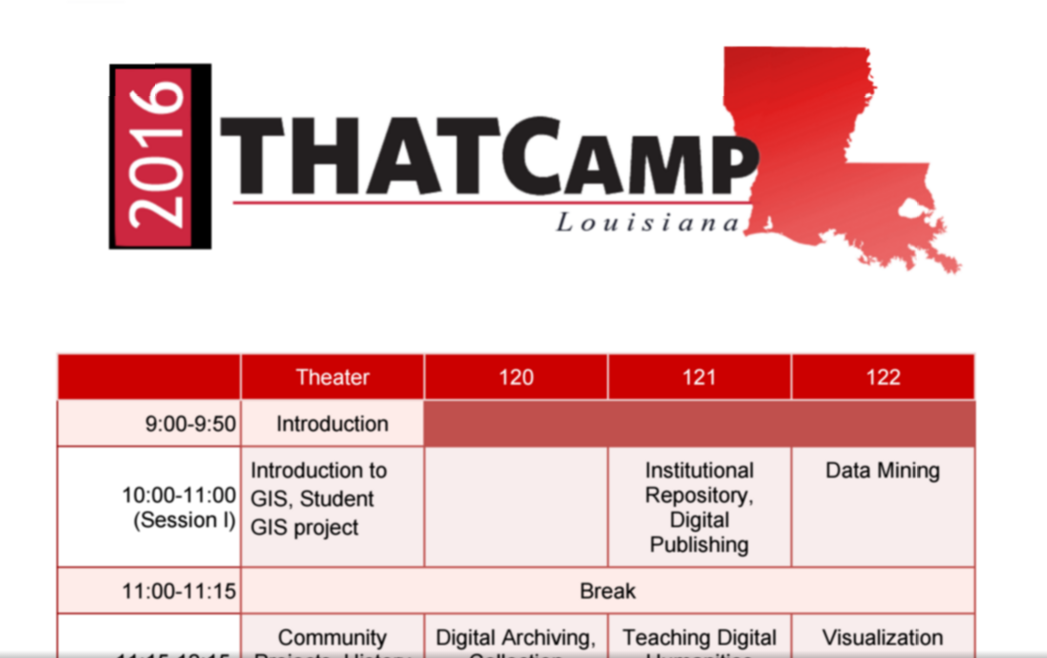
Today I attended the Louisiana THATcamp, and I wanted to write about that experience while the events were still fresh in my mind. Because of the informal structure of the unconference, this will be a less formal review. #blameTHATcamp
We’ve talked about the structure (or rather, non-structure?) of THATcamps in class before, but I was curious to see what an (un)conference planned the day of would look like. In the first (and only) pre-scheduled panel, the information session, we went around the room introducing ourselves and proposing topics for panels. The organizers of THATcamp added information and panel proposals to a GoogleDoc which all participants were invited to edit. (There was also a document in the GoogleDocs folder for noting whatever links, tools, and projects were brought up in the sessions.) After everyone was introduced, we openly discussed which sessions could be combined. I was impressed with how smoothly this process went. When I imagined how this kind of impromptu session planning would work, I pictured a much more chaotic and frustrating task. But as it turns out, a lot of participants were interested in similar topics, making the schedule creation an interesting, and even fun, experience.
I enjoyed the open discussion format of each session. There didn’t seem to be any “leaders” for these discussions; when it was time for each session to start, someone (literally anyone) could speak up and begin discussing that session’s topic. In the discussions themselves, each participant’s position/rank didn’t matter, insofar as who is allowed the right to speak within these spaces. Students, tenured professors, museum curators, and librarians each had an equal opportunity to speak, and each contributed to the discussion uniquely. This, I felt, was one of THATcamp’s greatest strengths, as it allowed for open dialogue from diverse sources, and created a more well-rounded discussion. Kieran and I originally (and jokingly) lamented our lack of nametags, but I think the fact that our institutional affiliation/rank (or lack thereof) was relatively unknown created more of an even playing field among participants.
One thing I’ve struggled with during conferences in the past is how to approach people whose presentations or work I find interesting without feeling like a weird stalker. At THATcamp, it felt much easier to engage in conversation with the other campers during breaks, because I had just spent an hour talking to them in our groups. Making connections felt a lot more organic. The fact that this was a regional event, I think, really helped too. Almost all of the participants are working in Louisiana institutions, and we are all experiencing the same anxiety about the state’s budget. There is something comforting about worrying together. It makes the whole experience feel less dismal, and certainly less isolating.
Another awesome thing about regional gatherings like THATcamp is that is gives you the opportunity to learn about all the interesting projects other people in the state are doing. Naturally, we discover a lot of cool projects that are going on from national news sites or academic blogs, but a lot of these projects are happening in institutions far from ours. At THATcamp, I got to learn about the amazing work being done right here in Louisiana, work that I can be a part of because of our proximity and shared goals.
Here are two cool projects I learned about this weekend that I wanted to share:

History Harvest – The Public History department at the University of Louisiana at Lafayette organized an event in which locals could bring documents and objects related to Cajun, Creole, or American Indian experiences to be scanned and archived to their website in order to share and preserve the French-speaking Louisiana heritage. Check out their website to see the cool stuff brought in!
Tripod New Orleans at 300 – A series of weekly micro-documentaries each devoted to a single story about New Orleans history, produced by The Historic New Orleans Collection and the Midlo Center for New Orleans Studies at the University of New Orleans. It’s a podcast, so you can subscribe to it on iTunes or listen on their website. Past broadcasts include the story of Eliza Jane Nicholson of the NOLA Picayune, the first female publisher of a daily metropolitan newspaper in the nation, and the story of the 1965 St. Aug and Jesuit High School basketball game, the first integrated high school sports contest in Louisiana.
http://wwno.org/programs/tripod-new-orleans-300
Overall, I thought THATcamp was an awesome experience, and I can’t wait to attend next year’s THATcamp. Hope to see you all there, too!
p.s. The provided lunch was so good.

