As more of a tool than a content-filled site, Poem viewer is perhaps an odd choice for thinking about interface. However, the tool raises interesting questions about the “duality between the web as an information space and as a task-supporting environment” (143). Poem Viewer does provide a certain type of information—visualizations of poems that reveals attributes such as sonic relations, word frequencies, and sentiment—but the site is structured to encourage user manipulation. In fact, the provided visualizations of poems are, at least at first, down right bewildering, especially for someone who is not versed in phonetics. It is only through playing with the poem (completing tasks suggested by the interface) that users can really gain information about the text.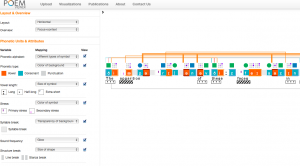
Most of the page consists of the visualization, but a side bar on the left features 28 customizable features and attributes. By hiding, viewing, or changing the color/symbol/pattern for each attribute, the user can alter the visualization. The user approaches a better understanding of the image, and the poem it represents, as she manipulates each feature. For example, by hiding and viewing the “sound frequency” attribute, I realized that the brightness of the outline around each syllable indicated the frequency in the poem of that particular sound. It become clear that the short e sound is by far the most frequent sound in “In a Station of the Metro,” a frequency that ultimately contributes to the overall mood of the poem. Poem Viewer’s poems are not supposed to be, as Drucker would say, consumed (I’m not sure how a user would passively consume these mystifying constructions), but interpreted, examined, and used. The site certainly forms “an event-space of interpretative activity” (178). Without participating in the event proposed by the site, the user is left in the dark.


Your post suggests that the “bewildering” is a productive, necessary step — a step that encourage manipulation, play, experimentation in order to try to find sense or meaning. It’s interesting to think about how the interface encourages a visual mode of the interpretive process — messy (at times, at least), sustained, enlightening, engaging.
This is fascinating. Thanks for posting this!
I thought you’d like it!