I mined my own collections of poetry using Voyant. I uploaded five collections (2 chapbooks that have been accepted for publication and are in production, and 3 manuscripts that have not and are works-in-progress). Perhaps something resembling a research question would be along the lines of comparing the differences between those accepted for publication and those not yet.
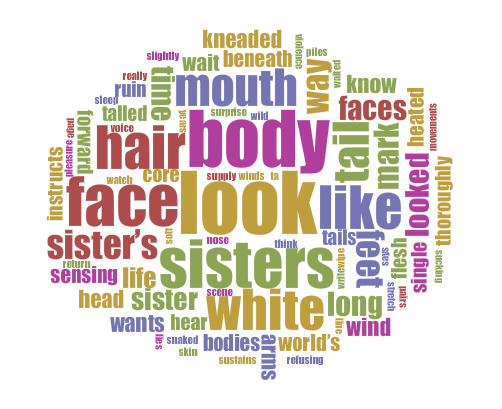
The following word clouds is from a collection that is in production and forthcoming later this Spring. I did find it interesting that this one features more words that are related to the body– words that correspond to specific concrete object–such as ‘body,’ ‘hair,’ ‘mouth,’ ‘tail,’ ‘sisters,’ ‘face,’ and so on. Perhaps in terms of what publishers find ‘fashionable’ to publish, there is still attention toward representations of bodies on the page? Acknowledging that this is a small sample size, however, doesn’t quite confirm anything more than posing a hypothesis.
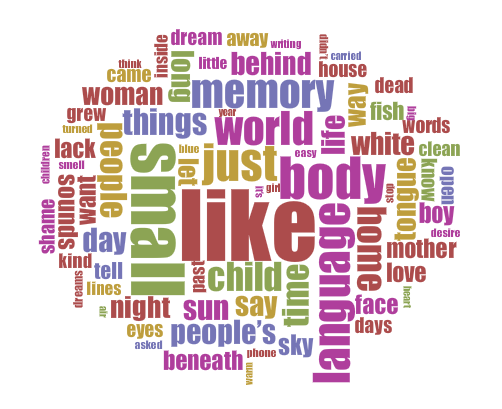
My current manuscript-in-progress (word cloud below), on the other hand, seems to have shifted slightly to include more abstract, idea-based terms, in addition to physical/concrete language. Some words pertaining to corporeality remains (“body,” “eyes,”), but other abstract words like “memory,” “world,” “child,” “time,” “language,” also became more prominent.
Notably “like” is prominent in both texts, suggesting a reliance on similes.
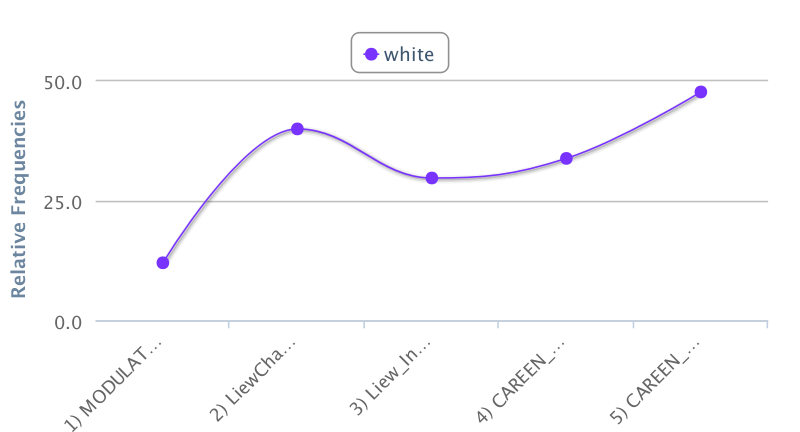
One of the most prominent words for all five collections is the word ‘white,’ which reflects my particular poetics and method of writing about race by its inverse ie, flipping back the gaze from hypervisible racialized bodies onto whiteness, and have that presented on the page instead.
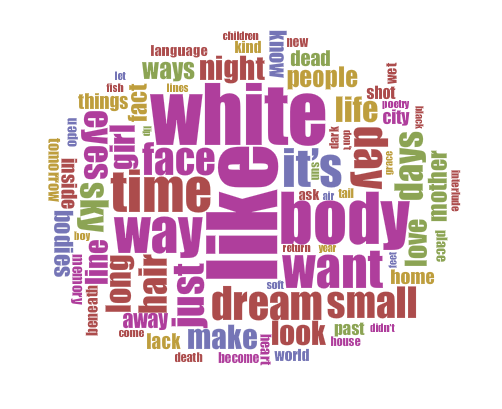
I haven’t yet really mined my own writing this way to find patterns and frequencies, and I think what has been helpful was that it allows me to identify and bring to the surface (rather than residing in the subconscious) some of the ways I write about recurring themes, as well as explore new ways to diverge from and experiment with representation within creative writing. The frequency of the word ‘like’ actually surprised me because I recall trying very hard to move away from similes (for whatever reasons I have harbored against similes), and yet, there it is, showing up very prominently.
Hathitrust
I too have been running into some problems with pulling up enough data sources on HathiTrust that matches my research interests (contemporary poetry, Asian American poets, and cultural theories that are largely circa 20-21st century). The search process was actually really frustrating, since at the very least I wanted to find something pre-1923 with a lineage toward my current research interests, rather than randomly mine say Shakespeare for the sake of it (not to mention I wouldn’t be able to pose relevant questions regarding a field so far out of my current scope). I will try to return to this later today.
UPDATE:
My initial attempts to focus on Asian American poetry led me to realize the dearth of resources in that area (pre-1920s), and led me too to finding a lot more surrounding information on the field of Asian American poetry as well as underresearched areas. I found out, too, that Asian American poetry is inextricably tied to USA’s immigration policy. Another underexplored link I found is the link between AA poetry and modernist poetry, with some commentary making the point that scholarship in those two areas have always been discrete and separate, rather than studying closer the cross-pollination and relationship between the two.
As I was only able to find a handful of names for pre-1920 AA poetry (Yone Noguchi, Sadakichi Hartmann, and Bulosan), I crowdsourced on facebook for help to no avail (which confirmed the lack of sources). I decided to open up the field of inquiry to include translated poetry from Asian languages. I was reluctant to do so because translations in the early 20th century were almost 100% the territory of white male writers, many (if not all, in my worksheet at least) of which either never set foot in the country whose language they translated, or didn’t even speak the original language themselves (most famous being Ezra Pound). I felt that this changed the composition of the collected texts, since the two (to me, anyway) operate from very different positions and hold very different assumptions. For example, some early 20th century AA poetry came about as critiques of the racism faced by the AA community (and the prominent yellow peril scare), whereas American translations of Asian poetry often was done through the very orientalist/fashionable lens that resided in an imperialist context. I am still not sure how to reconcile the two. I did some topic modeling and wordcloud (for words that most frequently occur among the texts) and posted the results to Moodle.
I think what I gained from this exercise was a thorough introduction to modernist-era AA poetry (and its lack). Moving forward I would be interested to examine the links between AA poetry and the advent of modernism and modernist techniques in poetry, as well as some of the restrictive immigration policy and anti-Asian climate around the turn of the century that contributed to the lack of AA poetry. (Maybe this is slightly off-topic since it exceeds the level of text-mining? But to me I feel it’s still..process related.)

