In Voyant, I looked at five horror novels/stories—Dracula, The Shunned House, volume I of Poe’s collected works, Kafka’s Metamorphosis, and The Damned (by someone named Blackwood). I got these out of the Gutenberg Project “horror fiction” wiki thing. I wanted to look for uses of words having to do with dark and light as they relate to…well, I’m not quite sure. I guess I’ve always assumed that a writer was sort of forced to use light and dark to indicate mood. That’s reductive, but it does seem like a writer is in a language bind when trying to describe the basic aspects of setting, because there are only so many ways to say “it was a bright day” or “the night was dark.” Anyway, I thought in horror novels there might be a high incidence of use of darkness, especially vs. light, and that you could tell something about the overall tone or “feel” of a work if you knew how often certain ones were referring to lightness or darkness. It turns out not to be true, at least in the case of these five works, that light+day or dark+night terms are used significantly more or less, and the more prevalent terms switch depending on which you’re looking at. As far as relative uses of words like dark/night/evil/black, Dracula was significantly darker/later/eviler/blacker than the other works, with volume I of Poe being a distant second. This is an interesting way to frame a work—I would now be extra sensitive to the light gradient in Dracula if I read it, which I haven’t, which points out probably what I see as most useful in these tools, at least at this cursory level: they are a good way to vet broad hypotheses or pet theories before diving in and possibly treading a few thousand pages before realizing you’ve wasted your time.
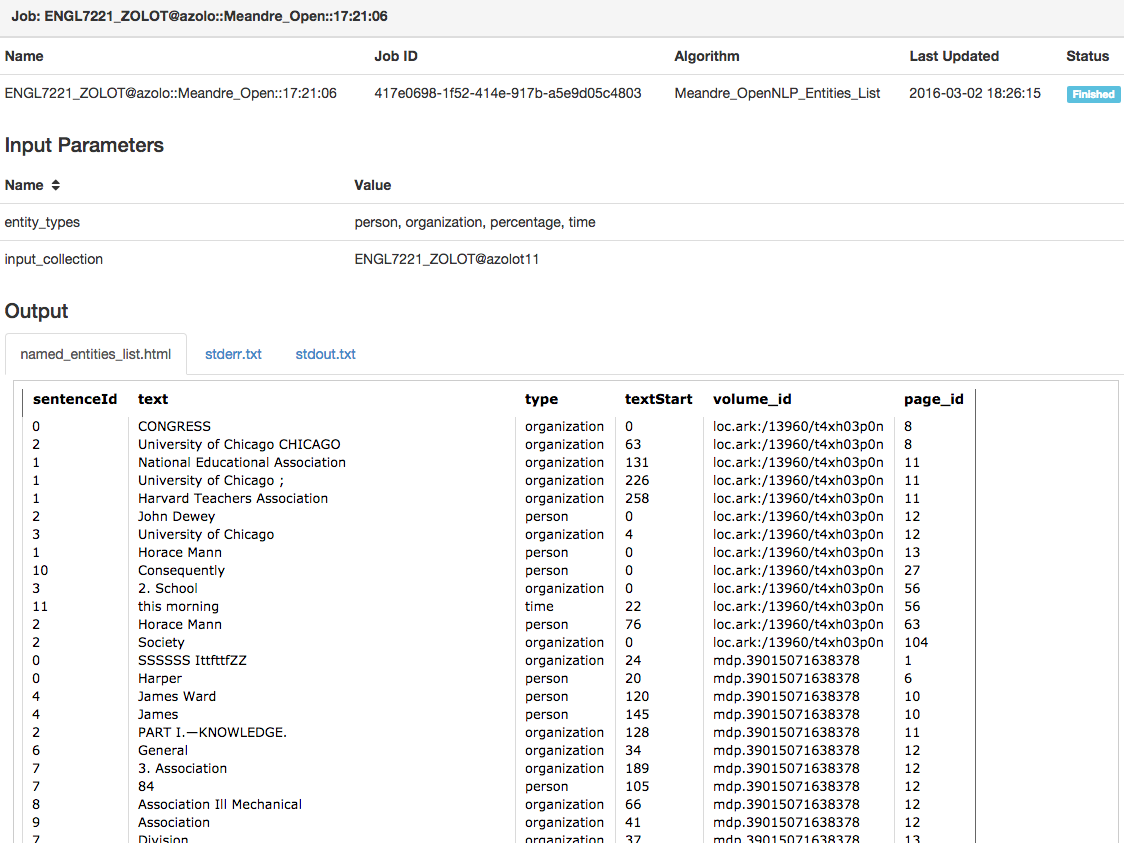
The same thing goes for the HTRC deal. I fed pretty much all of John Dewey’s works that they had in the database (w/o repeats) to extract a list of persons, organizations and (for kicks) time and percentages. It provides a pretty good road map, I think, for approaching Dewey’s work. This is coming from someone who’s read exactly 1.5 of Dewey’s books. The point is, he wrote a hell of a lot, and this would be a pretty solid way to focus reading around topics or people that I might want to see his reaction to. But it feels a little lacking…for one thing, it’s rife with errors. For another, this isn’t really anything I couldn’t do flipping through the book. Maybe I don’t have all the books on hand, but apparently I can get a lot (all?) of this freely since it’s public domain (not even to mention all the copyrighted stuff you can get online—and, perversely, with less hassle)—and what I’ve found is looking through one document with speedy deployment of CTRL+F is way better than trying to make heads/tails of this sort of list. So maybe I’m just not sold on list-based research. It seems like a lot of algorithm-application and intensive CPU time for little reward, especially as compared to: I did genuinely find the Voyant thing helpful, and am sure there would be even more benefit from diving into the various statistical measures, your Z-scores, your relative thises and logarithmic thats. Plus Voyant is 300 times faster.
And this all certainly opens up a whole vista of further research questions and possibilities. I’d be interested in a more complete/thorough analysis of light gradients in works of different types. But the technology involved would be more complex. I sure couldn’t create it, and I’ve yet to see something prepackaged that could handle questions like: How often are light gradients used to indicate mood vs. general setting? How is an author resisting using the same words to describe qualities of light (this is an extension of a general lexical richness thing)? Or is the author resisting at all? And couldn’t we measure all the synonyms/different expressions of light (or whatever) in a sort of ratio to see how much dictional acrobatics are going on? In other words, is the author even conscious of this kind of thing? Another question: how is the author using light/dark symbolically? In what way? Why? Where? In what situations? Etc.
Assuming you wanted to teach a computer to answer these kinds of non-quantifiable questions, the amount of effort and headache would seem greatly outweighed by the fact that a person can do this just fine—probably better, given the error rate on the list I pulled from Dewey’s work.
Maybe the issue I’m having is I’m more interested in individual aesthetic situations and choices and how the mesh of really great writing is woven, and this is particular, idiosyncratic, minute, resistant to macro analysis and aggregation. I maintain that counting words across books is to miss what literary criticism is about, at least for me. It might provide a top-down map for seeing areas I might want to go to, but there’s nothing a graph can tell me about why a sentence, paragraph, chapter, or book works well. Just can’t. And it seems there’s a sort of social/historical impulse in the mass distant reading that has to do with correcting past bias, which is good and fine and important. It’s important to know really how many books different demographics contributed, who bought them, how different markets grew and swelled and circulated and all that. But that doesn’t really touch the content of the books. And if you use that as a starting point for criticism, then what you’ll get is really good socially conscious criticism (or really crappy socially conscious criticism), but, essentially, social criticism shoved into a literary husk. The alternative would be to extract social (or whatever) meaning/redemption/instruction from the literary work itself, from the particulars of a given writer’s work, the way they use plot, language, convention, etc.—for which you often need only one book, one paragraph, one sentence. Not millions. The whole distant reading thing just seems all confused to me, somehow. I mean, it seems like a lot of people confusing what the point of literature is, the same way capitalism confuses what human relationships are for. I agree that there is great benefit to seeing big picture type stats and info on literature, movements, schools, demographics, so on and so on, but I guess I’m put off by people who suggest the old forms of humanist criticism could be replaced or superseded by some sort of techno-crit. It strikes me as being overly eager to embrace nifty new technologies, the kind of unearned faith in computers that drove a lot of that futurist writing from the 40s and 50s about how scholarship would be indistinguishable from panglobal mind melding once we could get these dang light projection index desks working right. What I mean is, I’m skeptical, and I find good criticism to be so powerful for so many reasons that are categorically other than macroanalytical, broad, etc. And I totally understand that the subjective approach to criticism is tied at the hip to all the anglocentric, colonial, empiric, hegemonic, misogynist, racist shenanigans of exclusionary literary canons from Aristotle to Updike, but I think we can perform strong subjective criticism in the light of this broad macro understanding without throwing out the method altogether, and we are also now better able to smell when the subjective is dangerously so (racist, sexist, classist, etc.), and if the contribution of these massive distant readings is to reveal just how wide and deep the contributions of different peoples have been, that’s a big win and I’m all for it. But contextualizing is not the same as scholarship—the first is part of the second, and can’t replace it. This is my opinion in more words than is necessary.
(And still) I just reject out of hand the idea that an impulse toward statistically significant trends—toward literary measurement that looks scientific—is a better—or even particularly good—spiritual seed for engaging literature.
(Not saying I couldn’t be convinced—but where’s the really sophisticated statistical/algorithmic literary analysis drenched in aesthetic principles and the humanist spirit to blow my hair back?)
UPDATE: So I took a nap and now I feel bad for being so grumpy about this. I amended part of this to try to make more sense about my resistance to corpus statistics as critical revolution.
Voyant stuff:
Screenshot from HRTC (I couldn’t find another way to drop an example in here?):