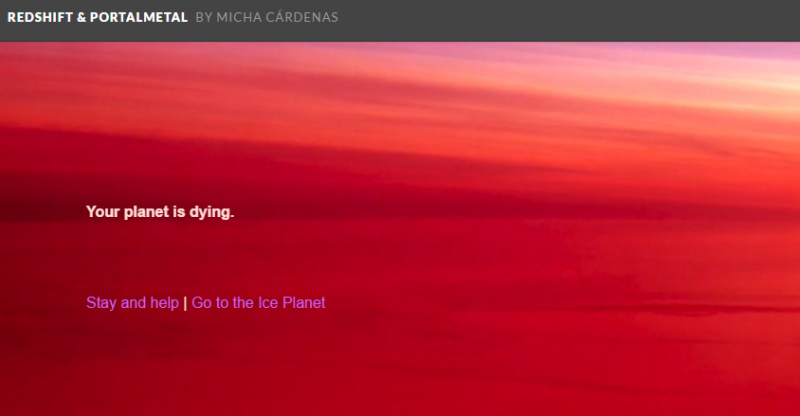
Redshift and Portalmetal is a story/game with an intentionally interactive, futuristic, environmentalist, queer, and raced digital interface. The creator of the project, Dr. micha cárdenas, seems pretty awesome! Here’s how she describes the project on the home page:
“The story uses space travel as a lens through which to understand the experience of migration and settlement for a trans woman of color.… The project takes the form of an online, interactive game, including film, performance and poetry. I designed the interaction, wrote the text, performed the movement, and coordinated the filming in Los Angeles and Toronto. The project is built with HTML5 video, CSS and Javascript, using the Scalar e-publishing platform.”

This interface is not complicated in terms of how it functions for the general user, but I chose it because of how it illustrates the reciprocal nature of form, function, and content, in this case social and political content. I wonder how and why cárdenas chose to layer the static text and hyperlinks over the moving images, especially those of her own moving body, and to add an extra layer of sound. How does this “skin” or design contribute to a new or enhanced visual [and sonic] episteme” about the movement and migration of a trans woman of color in various environments? It definitely collapses “the bias against visual forms of knowledge production” that many have had in favor of “logocentric and numero-centric” ways of knowing (Drucker 16).
It’s also a powerful project to me simply because it calls to mind the idea of inter-faces.
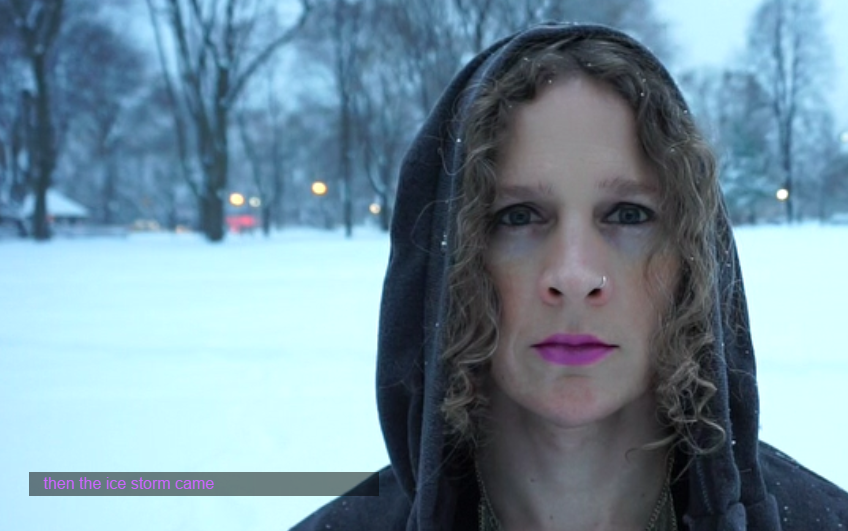


I love the complicated power dynamics of this project–it seems you’re being given a choice, like a Choose Your Own Adventure story, on the surface, but you realize quickly that your narrative choices are illusory. (At one point, I found myself in an endless loop of three or four screens and couldn’t advance unless I picked something else.)
Yeah, I think that correlates with a profound insight into the ways our movement through space, through the world is constrained by the design choices of others. It’s like an analogy for institutional or systemic social structures.
Very cool, Sarah! I especially love the incorporation of sound as well as text and video, as you point out. It made me think about how little sound is incorporated into digital projects, especially sound which autoplays. I wonder why this is the case? Is it because we think of sound as intrusive in ways that visuals aren’t? Or is it the stigma against autoplay in general (which again, might be related to sound as an intrusive sensation…)?
Yes, that’s definitely an interesting gap. I think projects like this one, though, might help make a case for why that “intrusiveness” of a design element like autoplay sound can really be productive and useful in creating precisely the effect you want. I might wonder how activist digital projects specifically might be able to utilize that feeling of intrusiveness of autoplay sound to help make their arguments and to make certain “disruptions.”