I found a program called Twine (http://twinery.org/)—it’s a hypertext story creator that lets you create a basic furcating story structure quickly and easily. You just start a new project, start typing a situation, then by adding double-bracketed options ([[ ]]) it creates new user options for progressing the narrative. Here’s a picture to show you kind of what I mean:
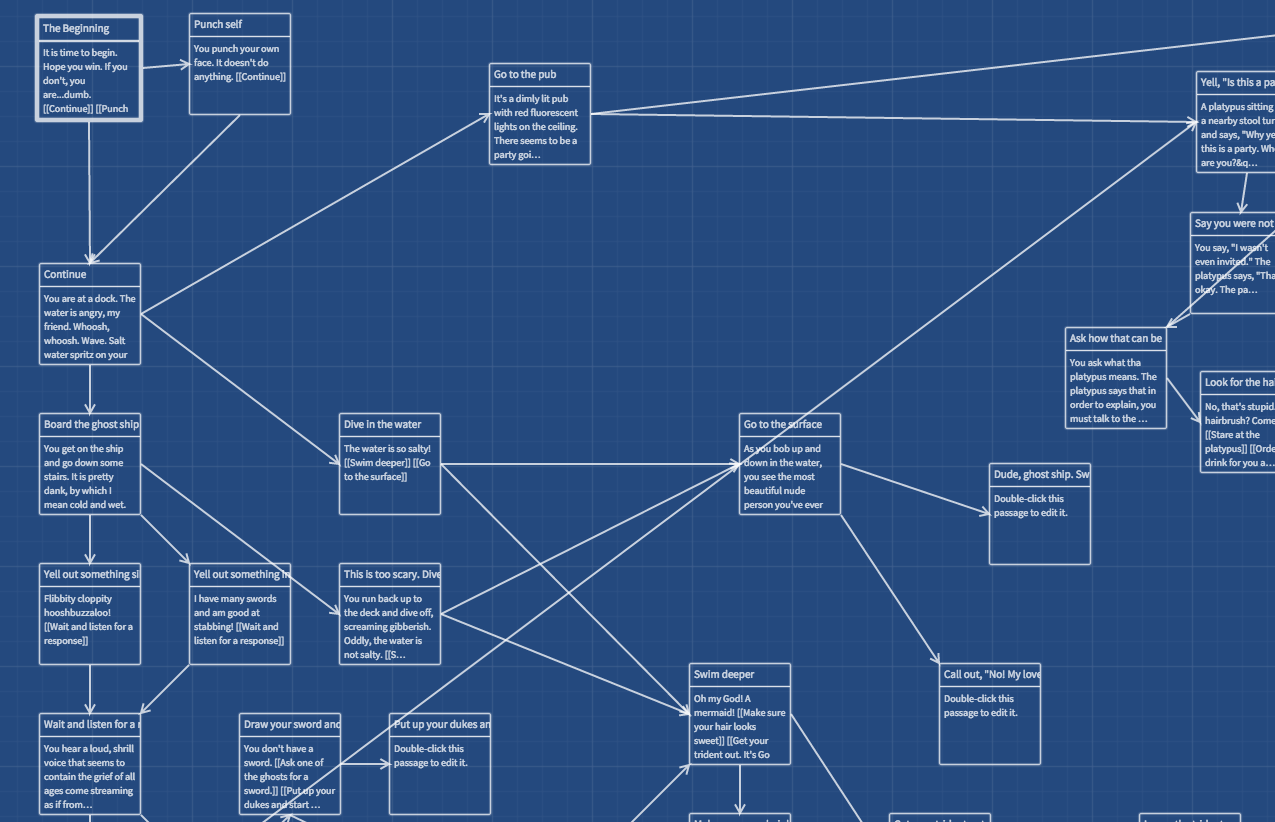
Each of those boxes is created just by putting the [[ ]] around a new option. So it’s super easy. And you can test your story at any point and ultimately export it as an .html file.
I’m teaching a fiction workshop next semester focusing on developing a writing process and learning the basics of technique, craft, whatever you want to call it. One of my class texts will be John Gardner’s The Art of Fiction, which, aside from being a great overview of what fiction is and how it works, provides a lot of exercises for developing writing skills. One area I’m going to focus on early in the semester is plotting. I’m strongly considering using this tool as an easy way to learn the possible intricacies of plotting. It’s also designed to force you to think about what comes next. Instead of getting caught up in sensual details, every text box sort of demands brevity and progress to the next step. I think it would be an excellent way to focus students on thinking about the possibility of plot as opposed to getting bogged down too early in matters of style.
Below is a link to download the test story I was working on. There are a lot of dead ends—it turns out it takes a lot of time to account for a geometrically increasing # of plot options—but it gives a good idea of how the thing works. (The pub story line is the least fleshed out, but as you progress you can always use the convenient back option to go choose the other options.)
http://www.filedropper.com/twinetest2


Those interested in Twine might want to check out Scalar — an authoring platform for “born-digital, open source, media-rich” scholarship. It has in common with Twine the ability to craft non-linear narratives. http://scalar.usc.edu/scalar/