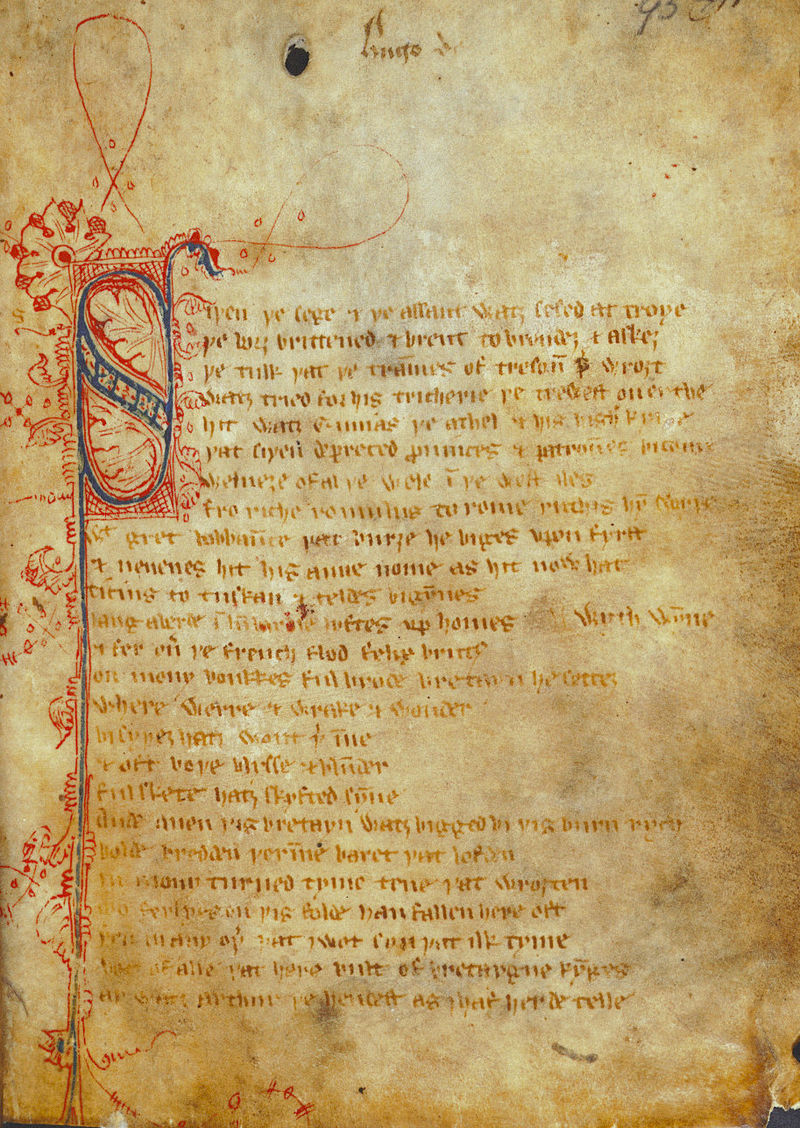
In 1988, medieval literature scholars R. A. Cooper and D. A. Pearsall published “The Gawain Poems: A Statistical Approach to the Question of Common Authorship,” in which they recount both the history of the authorship debates that began shortly after the fourteenth-century MS Cotton Nero A.x. was discovered in 1839 and their own attempt to determine whether or not the same poet composed three of the poems in the manuscript. Cooper and Pearsall use their own stylometric computer programs to quantitatively measure the alliteration, syntax, and word frequency of Gawain, Patience, and Cleanness while employing similar analysis of three other fourteenth-century poems of known authorship as controls. (They omit the poem Pearl because of “its different metrical structure” (Cooper and Pearsall 373).) Though the scholars conclude that “the evidence [they] have presented offers the strongest support to the hypothesis that [the poems] are by the same author,” not all critics—including Cooper and Pearsall—see their results as irrefutable fact (Cooper and Pearsall 385). Nevertheless, it is difficult for modern critics to speak of the Gawain-poet as a poetic collective, since the subject matter and themes present throughout MS Cotton Nero A.x. share the same resonance, such as repeated motifs and what Sarah Stanbury calls “a sense of authorial presence, a sense of a writer confronting and working through difficult issues” (Stanbury 1). Despite this resonance, however, Stanbury acknowledges that “[i]n yoking these narratives to a single author and then in searching for—and hearing—that poet’s voice, we are creating a fiction out of the fabric of fiction,” even though that fiction is most certainly woven from more substantial thread than the intuition of literary researchers (Stanbury 1).
Recent advances in stylometric tools have made it possible to do the work Cooper and Pearsall did in a fraction of the time. On the other hand, one may argue, Cooper and Pearsall worked with the advantage of knowing their text in an intimate way—they could not afford to not do close readings of the poems at certain junctures, and before they could even begin to mine data from the poems, they first had to painstakingly create digital text files by typing each word into the computer. It is surprising to me that, with the advent of stylometric freeware, no one has published another methods paper concerning the common authorship of the Gawain codex. The debate is by no means settled.
I would like to use Cooper and Pearsall’s stylometric analysis as the inspiration for further stylometric experimentation with MS Cotton Nero A.x. The programs Signature and JGAAP are the freeware tools most suited for this project. Though I do not expect to make any startling discoveries about the identity of the Gawain-poet, I do expect to uncover statistical evidence that will either support or contribute to Cooper and Pearsall’s results, especially since I will have freedoms they did not: I am easily able to use works from a larger collection of positively identified authors as controls (and to include the poem Pearl in my analysis), check the text for multiple types of features simultaneously, and support my results with other tools, such as MALLET, that may help explain why it is so difficult to positively articulate the “sense of authorial presence” that Stanbury mentions.
The challenging part of this project will be learning exactly what the algorithms of Signature and JGAAP actually do to text. (For example, there are nearly 40 different event drivers in JGAAP. If I can’t explain what each of those does, I can’t account for most discrepancies that might occur between my data and Cooper and Pearsall’s.) The end result of this project would be a simple methods paper that can (hopefully) serve as an updated amendment or appendix for Cooper and Pearsall’s original experiment; this paper would include more recent commentary regarding the authorship of the codex in question. If time permits, I would like to publish this paper on a website built for the purpose of showcasing the results of my project.
A sample bibliography:
Anderson, J.J. Language and Imagination in the Gawain Poems. New York: Manchester UP, 2005. Print.
Cooper, R.A., and Pearsall, D.A. “The Gawain Poem: A Statistical Approach to the Question of
Common Authorship.” The Review of English Studies 39.155 (1988): 365-385. Print.
Craig, Hugh, and Alexis Antonia. “Six Authors and the Saturday Review: A Quantitative Approach to Style.” Victorian Periodicals Review 48.1 (2015): 67-86. Print.
Gillespie, et al. The Cotton Nero A.x. Project. British Library, 2010. Web. 16 May 2016.
Hauptman, Robert. Documentation: A History and Critique of Attribution, Commentary, Glosses, Marginalia, Notes, Bibliographies, Works-Cited Lists, and Citation Indexing and Analysis. Jefferson, NC: McFarland and Co., 2008. Print.
Kahan, Jeffrey. “‘I Tell You What Mine Author Says’: A Brief History of Stylometrics.” ELH 82.3 (2015): 815-844. Print.
Love, Harold. Attributing Authorship: An Introduction. New York: Cambridge UP, 2002. Print.
Stanbury, Sarah. Seeing the Gawain-poet. Philadelphia: University of Pennsylvania Press, 1991. Print.


I’m wondering about your project’s relationship to close reading. As you mention, Cooper and Pearsall were forced to become intimately familiar with the text by manually creating their digital files. What role will close reading play in your analysis? I guess this depends on the kinds of evidence you think are necessary to support C+P’s results. There’s a theme in the stuff we’ve read for class that suggests an ideal integration of both traditional and digital methods as a way forward, and from your summary of the C+P’s work it sounds like they were forced into this kind of hybrid by circumstance. Do you plan on using any kind of close reading as a start- or endpoint? Do you have any hypotheses or hunches about the poems’ authorship that might lead to a different approach, one informed by previous stylometric approaches? It kind of seems to me that a methodological oscillation, from standard close reading to statistical approaches and back and forth is a good model for thinking about how technology can help us refine our scholarship, and I guess the broad question I have is where you see your project landing along this Digital-Humanist sine wave.
Hey Gayle! I’m most drawn to this particular sentence of your response: “Honestly, I might have to focus on different types of data interpretation instead of the raw data itself.”
This was *just* what I was thinking about: ways of interpreting the data and what are the underlying assumptions made/upheld about an author and their corpus (including disputed ones that get attributed to a certain author). It sounds like the factors that establish authorship (of multiple texts) are predicated upon a resonance in certain predetermined literary elements or topics. Definitely interesting too to hear Stanbury’s acknowledgment that yoking the works together and attributing them to a single author might be “creating fiction out of the fabric of fiction.” Will your project address a bit of the “why”–eg, why this is important to consider (“this” as in establishing “authorial presence” and attributing unidentified texts to certain, even prominent, authors?) in the context of medieval scholarship, or address/speak back to Stanbury’s admission?
Unrelatedly, I am reminded of Harper Lee’s Go Set A Watchman and the controversy around how the ms was “found” after being hidden away for decades.. 🙂
This project sounds so exciting! I do have a couple of questions though, and this may be partly because I’m still wrapping my mind around stylometrics.
For your project, you said you want to use Cooper and Pearsall’s stylometric analysis as an inspiration. So, will you be looking at the same patterns they looked for in the text, i.e. alliteration, syntax, and word frequency? Or will you be branching out and looking for/opening the door for other keys in the text, like consistent metaphors, symbolism, themes, or lack thereof, to prove or disprove that he is the author? Do you have any features that you want to look for in particular when trying to assess whether or not he is the author?
Good questions, Heather–ones I’m still wrestling with! I most certainly want to analyze the same patterns Cooper and Pearsall did. (They analyzed several things, actually, even though they classified their analyses as forms of alliteration, syntax, and word frequency.) With JGAAP, I can also easily scan for rare words, common sentence beginnings, ngram parallels, irregular word stems, etc. It even has a built-in SNER function like the one we used in class. However, I’m currently trying to figure out which of these things would add most to the conversation surrounding the authorship of the SGGK and the other poems in this codex. People have been using analog methods to evaluate all of these things since the discovery of this text, and I would like to use those most likely to shed new light on the poems’ structures. Honestly, I might have to focus on different types of data interpretation instead of the raw data itself. I need to learn more about the way(s) in which JGAAP’s and Signature’s mathematical analysis methods interpret all this stuff. For example, you can choose to apply different algorithms in JGAAP to the same text, and I’ll have to know why those algorithms seem to produce different results, even if I don’t fully understand the math behind it. This is daunting, but, I hope, possible! In short, to answer your questions, I’m not sure just yet, but if I can start to better understand the programs I’m working with, I might discover something someone has never thought to analyze, or, at least, to interpret data differently using the results from the programs as support.
N.B.: I should note that grad student Andrew Klein at Notre Dame is currently using stylometry to evaluate the Gawain-poet and several other authors; however, his work is still ongoing, and his results haven’t been published yet on his website (http://awklein.com/research/medieval-english-authorship-revisited/).