For my seminar project, I will continue the work I started last week for topic modeling. I took as my subject the twelve monthly issues of Astounding Stories of Super Science, a science fiction pulp magazine founded in 1930. Astounding Stories eventually became Analog Science Fiction and Fact, which still publishes science fiction. My project will continue the work I have already done in several stages.
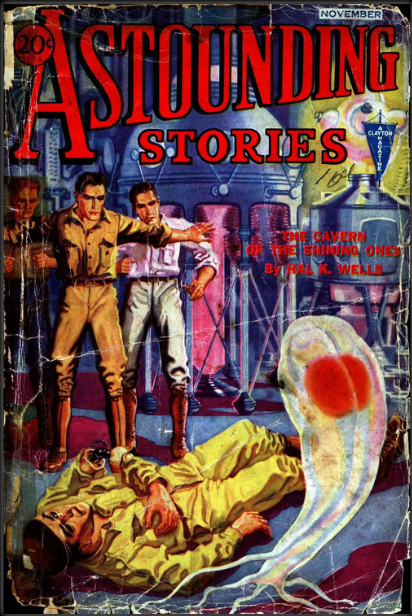
First, I will continue building my corpus. For each story or portion of a serial work in the first year of publication, I removed artifacts introduced by the transcribers, such as illustration descriptions, as well as elements added to the manuscript by the magazine staff, such as advertisements, recaps of previous installments, and sidenotes. This left me with text files that included only the text of each story. I will continue this work with the remaining issues of the first iteration of Astounding Stories, which was discontinued after the March 1933 issue due to financial problems stemming in part from the Great Depression (it was then sold to a new publisher). This initial 34-issue run represents a manageable corpus of about 200 stories with a variety of authors, many of whom contributed several times, under the supervision of a single editor, Harry Bates. While I cleaned these text files manually for the existing corpus, I will attempt to use TextWrangler to automate this process in the future. I will also collect basic metadata for these text files (date, volume, issue, author, length) and associate it with the text files in Zotero.
Next, I will mine this corpus using Voyant, Mallet, Stanford NER, and the Paper Machines plugin for Zotero. While performing topic modeling on my existing corpus, I ran into issues with fanciful names of characters, planets, and alien races clogging up my topics, which led me to create a provisional name stoplist that included not just “William” but “Jetta” and “Sarka.” As I move forward, I will use the Stanford NER to extract these named entities not just for potential use in a stoplist but as a valuable corpus and reference list (not to mention a test of the NER software’s ability to return valid results on wholly original named entities).
Hopefully, this text mining process will yield productive directions of inquiry. To that end, following Moretti’s example, I intend to produce an “atlas” of maps and graphs that might reveal patterns within both the imaginative and real contexts of these stories. For instance, I might use ArcGIS along with Stanford NER to map the settings of these stories. I could also use the lists produced using NER to investigate naming conventions among the magazine’s cadre of authors. Ultimately, I want to investigate how these adventure stories in science-fiction trappings represented particular visions of the exotic Other (such as aliens, subhumans, and monstrous creatures), as well as a geographic analog to otherness that might be called Elsewhere (such as alien planets, deep caverns, and the bottom of the ocean).
Although I consider this project to be primarily an investigation of a particular corner of the American popular imagination, I may also investigate the real-world contexts of these stories’ publication. For instance, I could use social network mapping to visualize the creative and professional relationships between the magazine’s authors, or turn my attention to the many advertisements and reader letters published in each issue.
I envision that this project could continue after this semester. After all, the magazine has continued to publish science fiction under several names for more than 80 years. However, most of the issues produced after the magazine was first sold in 1933 are still protected by copyright, which is a possible barrier to expanding the corpus of Astounding Stories. That said, many contemporary issues of magazines such as Amazing Stories are no longer under copyright and might provide valuable context for the stories from Astounding Stories.


Hi Kieran. An atlas of location mentioned in the stories sounds really interesting. Your mentioning of the limitations of the software recognizing non-“real” locations led me to wonder about the distinctions between sci-fi stories that are set in real locations and imagined locations. Could there be other differing elements that might distinguish stories into those two different categories? Or, even, can the categories be further delineated, ie, instead of “real” vs “imagined,” there might be a 3rd–a location such as Atlantis or Bermuda Triangle–not real in the sense of places on a real map, but they still reside in the popular imagination and carry preconceived connotations, as opposed to a fully made up location with a name that has never been evoked anywhere else, and therefore has a ‘clean slate’ and can be fully manipulated by the author.
Not really questions that require hard answers, just thoughts that came to mind as I was reading your proposal!
Kieran,
I love this idea as well as focusing on pulp science fiction! I have a few ideas, somewhat similar to what Leah mentions above, as well as thinking about the way worlds are created and how that interacts with social context and then what might be shown through topic modeling.
First, a small question: I was also curious about how you might be able to map circulation or publication movements of the texts and correspondence via the letters published in the issues. I wonder where theses letters are coming from might reveal about readership and circulation? Because this could potentially be a connection about the real world application that you mention — how do these crafted worlds interact with reality, I guess.
Second, I like this idea of looking to categorization because I feel like your searches might yield more productive results. I feel like in terms of your questions about othering/ otherness in the stories, the use of categorization might be helpful as you suggest. I guess I’m wondering here how they are related to one another or what these “other” characters and locations reveal about what you are asking in regards to social context? I wonder if there is a way to somehow see the frequency of “fanciful” names and characters in these stories in relation to one another? Reason being the results for Gayle and me during the topic modeling exercise in class bundled the dialect poetry words together, so I wonder if you might get similar results in this case? Possibly not since the names are probably a bit different, but I just wonder what threads you could trace about the othered characters and spaces/ locations in the stories? Because I feel like this is a very strong point of the proposal, particularly because as you point out, this pulp magazine only ran for a few years (although obviously the great depression probably had an impact on its financial situation) and since pulp occupies a very “low” art realm, with this, I’m curious if the more abject (I don’t know if this is the right word to use here) characters and locations could also have to do with that? Although, I do see the concern about these titles and names clogging the results.
However, I’m very curious what you find in your results! This is a great project idea.
I agree with Jeremy, that one of the strongest and most interesting aspects of your proposal is the proposal are the questions about otherness/othering. And, you might be able to connect this to circulation, and publication movements, by tracing the mentions in newspapers (like we did in one of the first classes) or some other similar system. The reason I’m mentioning is I think it could be an interesting facet of your project, to look where this magazine was most consumed, or most written on, and link that to cultural context. Which parts of the country were most invested in ideological pursuit of “othering”, and how does their cultural consumption reflect that leaning? That might be a lot to do in one semester, but since you’re thinking of expanding this project afterward, that might be a cool direction to move in.
I know you removed advertisements and such from your data pool, but I agree that it could be relevant to examine the reader letters, etc., and their connection to this larger conversation. Where were reader letters coming from in the US, what topics do they dwell upon, and do these topics connect to this othering schema? You could also look at the advertised products, analyze how they connect to a cultural exoticism, and trace their consumption regionally. And see if that advanced consumption links up to the places where the magazine was also largely written on. Anyway, just some ideas as you move this project forward!
This sounds really cool! A couple of questions: you say you are going to use ArcGIS to map settings. Do you know if there is a way to map your “elsewhere” settings (under the sea, alien planets, etc)? If now, how might you deal with that? Also, how will you figure out the social networks between authors? I ask because I’m interested in similar networks, but sometimes its hard to find those connections, especially if people are using pseudonyms or are infrequently published.
Thanks!
I’m not sure how the mapping is going to work out yet. For instance, some undersea stories might be set in Atlantis or the Marianas Trench, which would probably show up as named entities in Stanford NER. “Mapping” Atlantis (or Planet Archon or Xxxyxskzz) might be difficult but I could place it somewhere arbitrary since I’m more interested in visualization and categorization than, say, distance. However, places like “extradimensional space” or “the bottom of the sea” might not show up as named entities. I might have to intervene manually cases where the NER software doesn’t pick up any useful place names. This shouldn’t be too hard because the settings are very often mentioned in the titles. I could also focus on categorization more than mapping if that seems more viable–for instance, using overlapping categories such as “undersea,” “outer space,” “real locations,” “underground,” etc. I’d probably have to hunt for some new software to do so.
Since Astounding Stories paid very well compared to other pulps, it attracted many well-known writers. In addition, many of its early writers went on to become famous. This will hopefully make it easier to map their social networks (or at least their publication histories).