For my DH project this week, I explored a couple of contributing options that I found in DH Commons. First I looked at the Programming Historian site: http://programminghistorian.org/contribute. In this site, there are lessons and articles on digital research for history. There were lessons on programming, preserving data, and even a beginning lessons on network visualization like Mapping the Republic of Letters. There was also a strong contributing component and a couple of different ways to give feedback and contribute, whether you wanted to email or tweet, fix minor errors and make comments in GitHub, or submit your own lessons. I just wanted to fix a couple of minor errors and clarify a couple of sentences, and to do this, I had to make a GitHub account. While there were instructions on how to do this, the instructions weren’t extremely clear. I successfully made a GitHub account, but I fought with the site on how to actually post a comment or fix an error for a long time. Eventually, I gave up.
But, this experience was still beneficial for me when figuring out digital humanities and was interesting in terms of Martha Nell Smith’s “Democratizing Knowledge” and Peter Suber’s “Open Access.” Being able to just jump into a collaborative project that is completely open was both exciting and terrifying. In “Democratizing Knowledge,” Smith points out that in having research and archives that are open in this way, scholars can have multiple perspectives on their projects from a variety of perspectives, like students. She even says, “Believing that it is better to have more, rather than fewer, pairs of eyes looking at and evaluating primary materials (a writer’s manuscripts, for example), many scholars have argued for editorial practices that are more collaborative and transparent.” This was exciting because as someone who had no idea what this project really was or wasn’t deeply involved, I could still contribute in a meaningful way, even on something small like a typo or clarifying a sentence.
However, this experience was also terrifying because I was not deeply involved in this project nor, I felt like, qualified. I felt the discomfort of collaboration that Nowviskie talks about in her transcribed lecture, not in the sense of someone who created the project but as someone who is an outsider. I understand why giving credit can be difficult. Do I really deserve credit if I only made a simple edit one or two times? Where is the line? So, while various scholars are pushing for collaboration and transparency, in some way, I realized that even my fresh academic habits run deep: it was intimidating to just jump into a project, and I wondered too about the significance of my contribution.
And, contributing wasn’t extremely easy either. As the reader, I was exciting to interact directly with the writer, but in fact, just working on GitHub was somewhat intimidating, which made me think of Suber’s “Open Access.” Suber claims, “OA makes work more useful in both ways, by making it available to more people who can put it to use, and by freeing those people to use and reuse it” While the Programming Historian was open for anyone to contribute, there was a certain degree to the open access. How “open” is this project when the everyday person has to fight to actually access it? I understand that this site is gratis OA and libre OA, but I just wonder what degree of open access it really is?
After my hiccups in the Programming Historian, I decided to try out DIY History: https://diyhistory.lib.uiowa.edu/, in which users can just pop in and transcribe various historical letters. To me, this site was much friendlier and even the name was inviting and exciting. Do It Yourself History. This made me feel like I was taking a much more active role in the site, beyond just providing feedback, and that this history, this archive was created by the people, for the people.
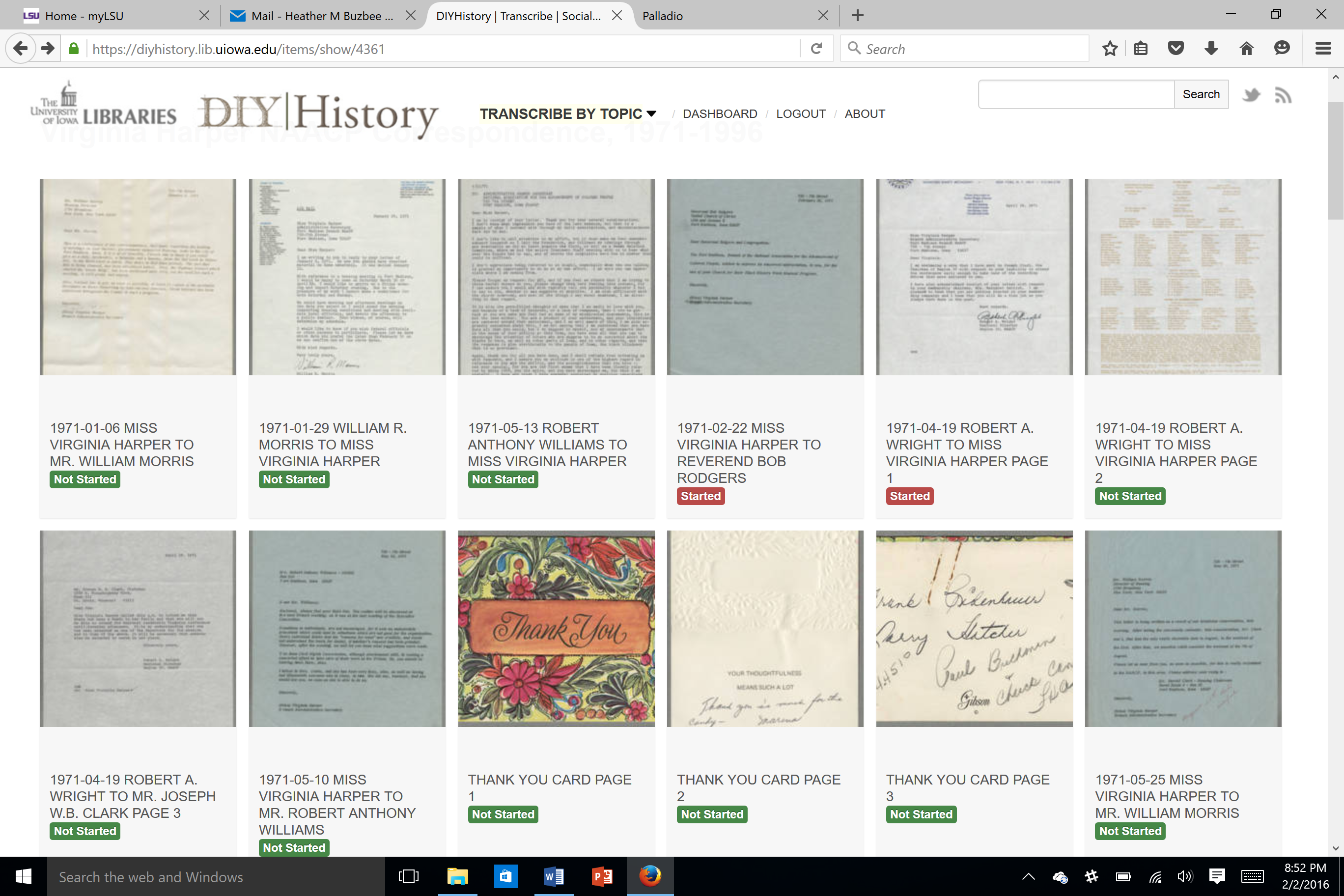
Although it took me a minute to figure out which letter to transcribe, especially because the first one I chose looked impossible:
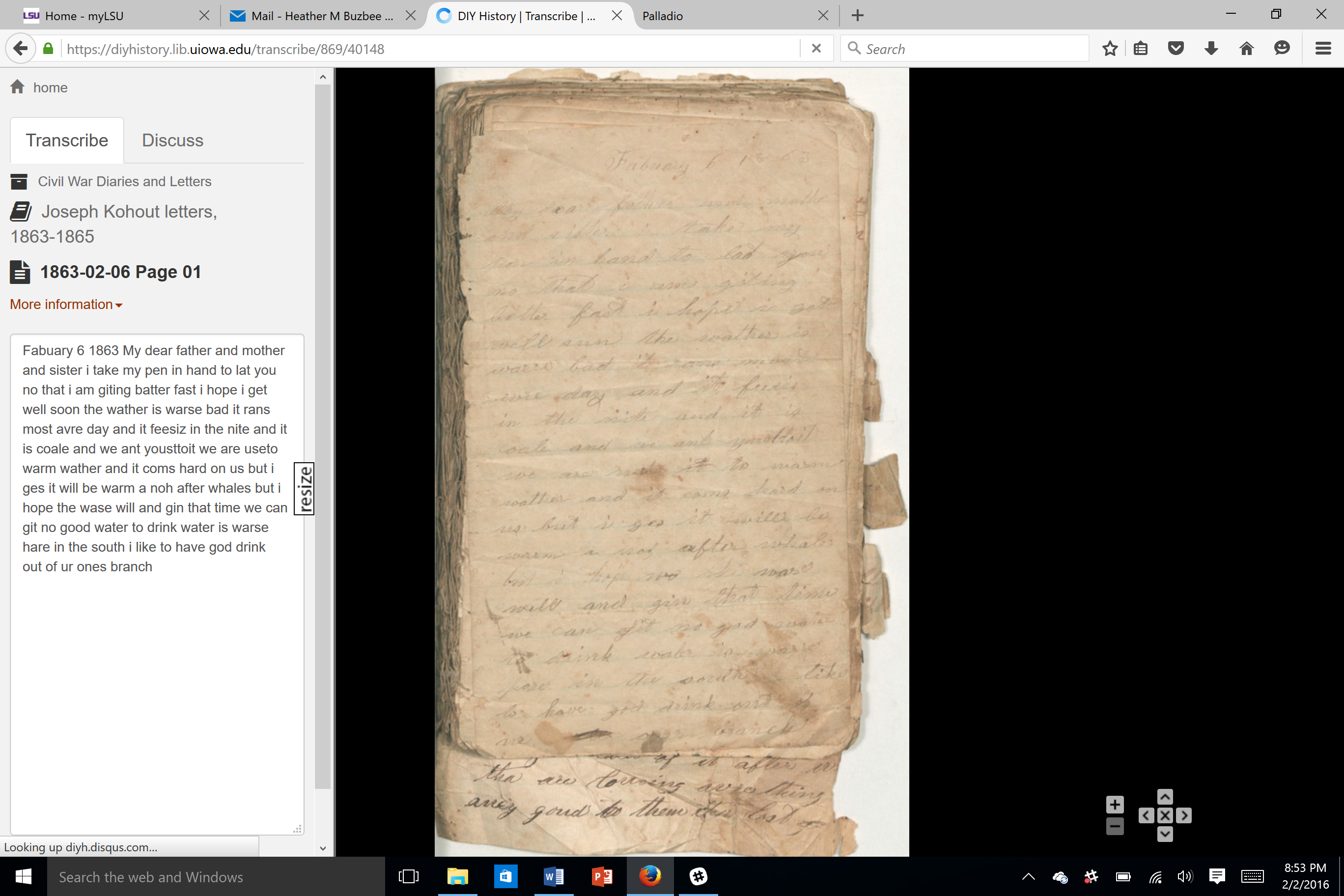
I picked one and set to work, fairly quick, painless, something to do if I was bored but also wanted to be productive.
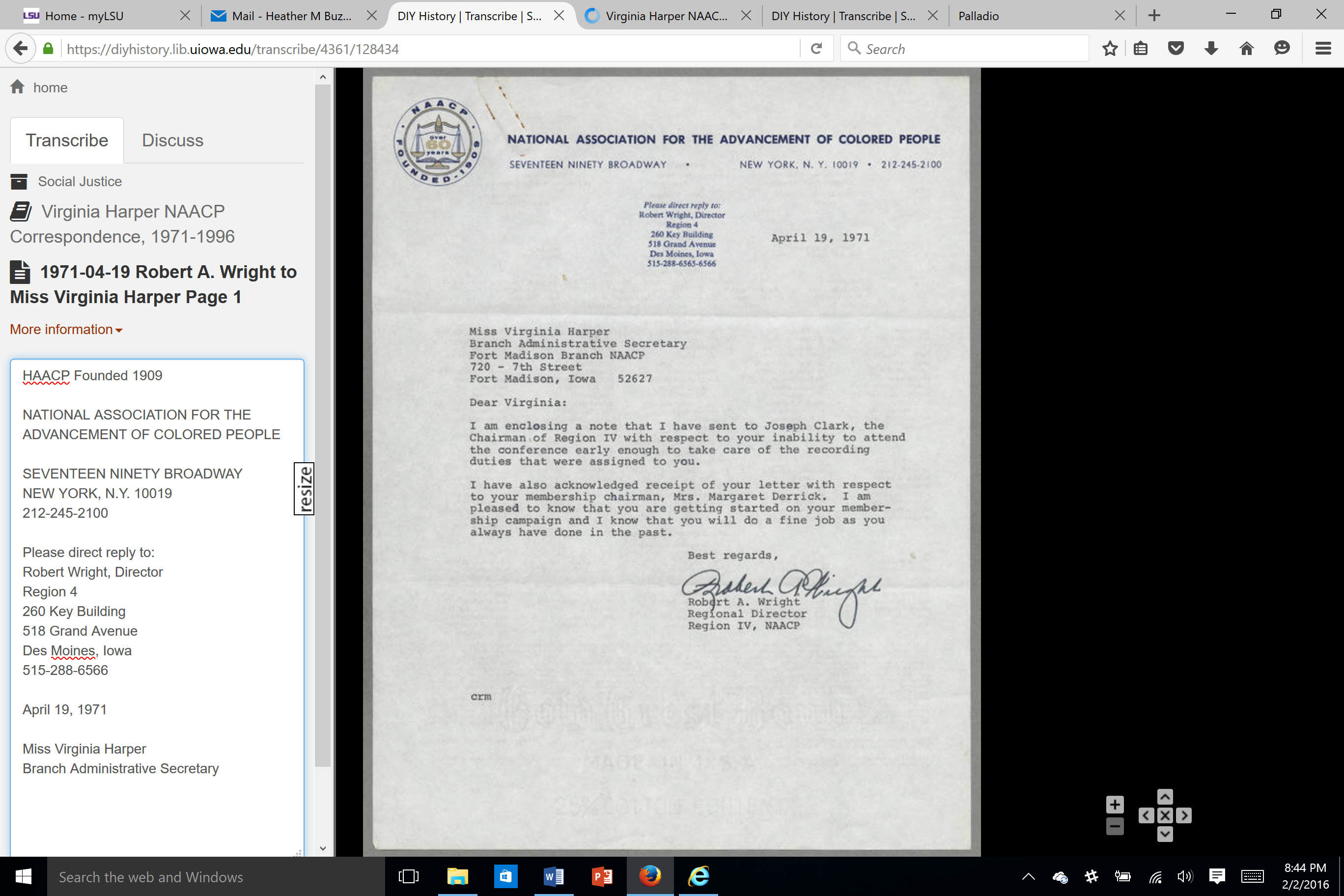
I thought this was really cool, and I felt I was contributing like Smith states “it turns students into researchers, and the teachers and primary researchers into students. A digital environment opens up research territories reserved for those most advanced to beginners and makes use of intellectual and social networks.”
In this site, you can also post comments and discuss the letters, which I thought was extremely exciting since it would really give the archive or database a critical edge, and we could see the thoughts of the people transcribing and archiving these works like the Google Fingers from last class. (This also made me think of Irish manuscripts, since some monks who copied the texts would write their own comments and poems in the margins.) And, while archiving the letters were important or beneficial, I thought the discussion component was critical to, as Mark Sample and other scholars have been writing about in our readings, build networks and analyzing what we are doing instead of blindly copying away. However, when I posted my comment, it did not pop up right away and had to be moderated. So, while I understand that not everyone can just say whatever they want, I was still disappointed that this was not completely open, that not anyone could just write anything, and that the golden vision of collaboration must still be moderated to some extent. So who gets to decide what comments are appropriate, which can be shown, and doesn’t this still change and modify even the discussions we have about these archives?
Still, in both trying to contribute and contributing to two different DH projects, I better understand the issues brought up by the readings we have done so far in the class, and these projects are addictive. I am excited to see what else I can find.
Also if anyone is interested in network visualization, I also found a free site for this too: http://palladio.designhumanities.org/#/

